Blogged elsewhere

Interoppo Research
(IT Standards & Interoperability)

Linking research & learning technologies through standards » Nick Nicholas

Ἡλληνιστεύκοντος
(Greek Linguistics)

2009-03-31

Late-Night Work Bender

The past few days at work, I've been doing one of my favourite work things (information modelling) under my least favourite work circumstances (four-day deadline for what was truly a four-month job)—with all the back history and negotiations and frustrations and blinding insights and occasional outbursts of singing that authoring by committee brings with it.

Today, I was on the phone at eight, off the phone at ten, in to work at twelve, getting somewhere by two. Alone in the office by six, with the occasional status update interstate. By nine, Interstate and I had declared what I like to call the Optimal Iraq Strategy: "Declare Whatever The Hell Happened A Victory, And Go Home." Maybe on a global scale the work wasn't done, but the door on this phase of work had creaked shut.

Save, Post, Done. I IM'd my goodbyes; I checked a couple of links for tomorrow's tasks. I turned off the harpsichord Goldberg Variations: too preoccupied to have been listening anyway, and interrupted too often for them to run their course. I unplugged the laptop, one peripheral at the time: Keyboard, Screen, Network, Power. I shrugged on my coat, I pocketed my mobile; I switched off the light. Door Release, Staircase, Passageway, Door Release. Night lights in Parkville.

As I paced into the street, and followed students onto the tram, I was hit by a wave that occasionally swells at the end of an occasional twelve-hour work day, or a nighttime lecture. Night and yellow street lights summon it, and bleary eyes host it. It's bleak and spent and slightly peeved; it's envious of those walking past, surely having more of a life than it does; it's subdued. It needs a coffee or a beer or a game of charades; more than that, it needs someone to share it with, and it's not going to get it. It's going home to crash; it's done. And yet, there's the corner of a smile about it. Not joyful, God no; not really even happy. Relieved, I guess. Relieved with a soupçon of potentiality. A memory of future expectation, a still awareness: "Now, now that's over. Now... now I can do something else."

Which is to go home to crash, yes; but still. Now I can do something else.

Twenty years ago, this would have been a poem, every bit as self-conscious as this post is. Ten years ago, this would have been a brewski, because I had a colleague who worked late too. Ten years hence... well, who knows where any of us will be, ten years hence. Right now, this post, too, is over. Now I can write something else.

2009-03-30

I'm not a nerd, I just play one in real life

Via Vanessa's blog, I ended up at Peter's blog, and via Peter's blog, I ended up at the Nerd Test site. Now, I may have a day job in IT, but it involves diagrams and bullet points rather than code, and I no longer read all that much, so surely my nerd credentials have been blunted by now...


I am nerdier than 90% of all people. Are you a nerd? Click here to take the Nerd Test, get geeky images and jokes, and talk on the nerd forum!


Oh. That's... surprising. Ah, I see there is a new and improved, more granular test. That will sort things out properly:


NerdTests.com says I'm a Cool High Nerd.  Click here to take the Nerd Test, get nerdy images and jokes, and talk to others on the nerd forum!


... I see. Not a sci-fi nerd: well, Star Trek TNG was a long time ago, and I was much more into Klingon because of the linguistics than the trekkiedom. More a science nerd than a history nerd? A lot of the questions were retrospective, I guess.

Still. A bit taken aback. Once again, my self-perception is out of sync with objective external measures. I haven't changed as much as I thought...

2009-03-29

[GEEK]: eeePC travails #4: Polytonic eeePC

Ooh boy. This took a while.

There is a built in Greek keyboard on the eeePC Xandros distro. Just as well, given that Xandros is named after X Windows and the Greek island of Andros. (There's a Bahaman island of Andros too: who knew...)

The built in Greek keyboard was not difficult to install; and it even came with a polytonic mode. I activated the polytonic mode. Graves, circumflexes, iota subscripts, all OK.

No breathings.

Now that's odd, especially as noone seemed to have reported that particular problem. I tried to install Simos Xenitellis' update to the Greek keyboard. That went worse: the keyboard file was not even recognised by Xandros. I then embarked on, I dunno, four or five hours of config file roulette, until I got things working. Herewith the summary.


  1. The first polytonic keyboard for Linux used dead keys for smooth and rough breathings (psili and dasia): they arbitrarily picked horn and ogonek as the smooth and rough breathing dead keys.
  2. This was a hack, and intervened with non–Greek-locale use of these Vietnamese and Polish diacritics; so they were corrected in later releases to the backspacing diacritics U0313 and U0314
  3. which later still were recorrected to U10000313 and U10000314.
  4. ... Overall, the keyboard has been unstable over the years.
  5. I didn't find Xenitellis' post on the keyboard not working—which surprises me; but though it may have given me some hints earlier than I worked them out, I don't think it would have solved things.
  6. The built in keyboard and mapping (/usr/share/X11/xkb/symbols/gr, and /usr/share/X11/locale/el_GR.UTF-8/Compose or /usr/share/X11/locale/en_US.UTF-8/Compose) had U+0313 and U+0314 as the dead keys for breathings. Xandros was treating these strictly as backspacing diacritics, so typing them before the vowel as dead keys had no effect.
  7. Xenitellis' update defined the new dead keys dead_psili and dead_dasia. Xandros ignored these. Presumably the new dead key definitions haven't been compiled into Xandros.
  8. The old hacks dead_horn and dead_ogonek are still in the composition tables. But switching the keyboard to use these is utterly ignored too.
  9. The eventual solution for me was to grab two other arbitrary dead keys, which were already defined for Latin alphabet keyboards, and were likelier to be recognised than horn and ogonek. I went for caron and cedilla.
  10. I then globally replaced U+0313 or dead_psili or dead_horn or whatever I got up to in /usr/share/X11/xkb/symbols/gr (the original, not Xenitellis') with dead_caron, and dead_ogonek with dead_cedilla
  11. And I did likewise in the keyboard mapping file: /usr/share/X11/locale/en_US.UTF-8/Compose, not /usr/share/X11/locale/el_GR.UTF-8/Compose , because I had not successfully convinced the eeePC it was in downtown Salonica.
  12. Things then worked. With that familiar sinking feeling of spending five hours to get something working that should have taken five seconds.
  13. In playing config roulette, I enabled Multi-Key symbol composition, which I had only vaguely heard about twenty years ago, but which I wouldn't mind making my friend. Multi-keys worked fine with Latin characters, but were ignored for Greek characters, even after I studied up on custom keyboards and told the keyboard file that key <MENU> { [ Multi_key ] }; ("THE MENU KEY IS THE MULTI-KEY DAMMIT!") Pity, I liked the multi-key mappings...
  14. Caron is used with Greek consonants in Greek dialectology by some practitioners. (So κ̌αι or κ̑αι [tʃe, tɕe] for Standard Greek και [ce].) If I want to transcribe Greek dialect in Greek script, though, I think I might switch over to the Mac...)

[GEEK]: eeePC travails #3: Getting a Real Desktop

It became apparent that the out-of-the-box "easy" desktop that comes with the eeePC was concealing stuff from me. The text editor for starters. It was clear that if I was to do anything more than click and drool, I should get access to the full desktop. Not that there's anything wrong with click and drool. In fact, I think any real use I put the eeePC to will be pretty click and drool. But that should be my choice, not the manufacturer's.

Decent instructions on the eeePC wiki again. There is a manual way of installing the full desktop, or an "easy" way, and a "wizard" way. Who wants to wade through command line crap, right? So I opted for the, uh, command line easiness of an installer script through the community server at tuxfamily.org. The wiki did note that the Easy (and, it turns out, the Wizard) solutions depend on the community server. But we're all online, the community server address browsed through to a file listing, all would be fine, right?

Well, I don't know if it was the time of day or denial of service or me having cursed tuxedo-wearing penguins once too often or what, but no, it was not fine. The server may have been responsive in a browser window; but from the command line, the installers kept timing out, halfway through downloading 6KB files. Because command lines makes me monomanic (and it's a good thing I no longer program), I kept at it for a couple of hours, including trying to patch up the installation by running installation updates (and getting the same timeouts)—before I just gave up and ran the scary Manual install. Which was just two more command line commands, to a server that actually responded (it was the company server, it probably had a bit more networking budgetted), and I was in KDE in five minutes.

Oh well. I appreciate the sentiment from the community, anyway.

[GEEK]: eeePC travails #2: Going Online

Next up, going online with a netbook. At home, not a problem. The home wireless has gone perversely slow and erratic since I hooked up with it on the eeePC; I'm trusting the eeePC does not expel daemons onto the wireless router, but who can tell, it's Linux.

The University of Melbourne, bless its corporate socks, will not settle for WEP password-only authentication over wireless. They quite reasonably would like to know who the hell is logging on to their network as well; so they use WPA authentication.

This is beyond the eeePC as it comes out of the box.

Instead, one follows the instructions on the eeePC wiki, as inspired by a posting on the eeePC forum, to install a completely different wireless driver, which does know what WPA authentication is. A note to the Long Tail: read the original forum posting, as well as the wiki. After you spelunk into the config file and create the new connection in text, you can't just find the network and log into it, after "Create a wpa_supplicant.conf_MINE for your secure network.". As the top post of the source posting thread says, you actually have to create a dummy connection without hooking it to anything; then, spelunk into the dummy connection's config file, and set its driver manually to be the new wireless driver you've installed (up wpa_supplicant -B -iath0 -Dmadwifi -c/etc/wpa_supplicant.conf). You then connect online via the dummy connection.

The wiki makes it look that all that is a complex rigmarole for preserving your existing WEP and open connections under the new arrangements (Create a New Network Configuration). You need to create a new configuration to log on at all, so you can't just tune out this step. Don't bother preserving your old connections by doing this though, and just hook up to them from scratch.

When it came to hooking up to MelbUni in particular, no advice was posted from tech support (would they even acknowledge Linux eeePCs exist?), and Google ended up taking me to a posting on the Whirlpool forum. I always thought Whirlpool is where people complained about their home ISPs (it's how I decided on my current provider); but MelbUni is an ISP too, I suppose. The posting gives just the Network part of the config file; you'll need to get the rest from somewhere else, and the example configuration that comes with the new wireless driver (/usr/share/doc/wpasupplicant/examples/) is not it. Take the example configuration from the eeePC wiki. The Whirlpool posting says either a hashed or literal connection name will do, but the hash didn't work for me; the literal connection was fine.

... But PLAINTEXT password? PLAINTEXT?!! What sort of a joke operating system forces you to enter into your config file a PLAINTEXT PASSWORD?! (No aspersion on the Whirlpool poster, who was suitably embarrassed about this; at least I got online eventually thanks to him.)

[GEEK]: eeePC travails #1: Macintoshification

Sitting on the floor outside the duty free shop, oh so long ago (two weeks ago, in fact), I paid my £4 wireless access to find out whether a Linux eeePC could network with a Mac. Instead, I found that a Linux eeePC could be transmogrified into a Mac, with what seemed like not much more than an afternoon's surgery. Enthused at the prospect, and at how cheap the machine was going for, I surrendered my plastic to the man.

Well, in principle, sure you can Macintoshify your eeePC. It voids the warranty, and Apple will be really unhappy with you, though I doubt they can imprison you. If they do try to imprison you, the little trick the hackintoshers do, of putting an Apple sticker on the eeePC (so it can qualify as "Apple-labelled hardware") may not be completely compelling to their lawyers. But, let's momentarily continue on this hypothetical.

If you have a 901 or a 1000 eeePC, Gregory Cohen has some très slick bootdisks that actually let you install OSX Leopard right off your generic 10.5 system disc. (Not the disc that comes with a new computer: they're always loaded with model-specific stuff that will not talk to another Mac model, let alone an "Apple-labelled hardware, end scare quote".) The bootdisks come with some BIOS tweaks to the eeePC that are apparently needed to improve performance, and let the thing boot up in 20 seconds as opposed to 7 minutes. Something to do with DSDT and ACPI (fooling the machine's enrgy saving mode into thinking the machine is still an eeePC and not a Frankenstein, or something like that); and if I wanted to know about BIOS, I would've gotten an XP netbook and been done with it. My Linux–non-hating colleague at work blanched when I mentioned BIOS...

... but I didn't get that far. First, I realised that no slick BIOS patch for the 900 model was forthcoming. Then, I realised it was just as well none was forthcoming. The 900 has an earlier chip than the 901, one that Leopard was not compiled for. Moreover, Leopard is a dead loss for the 4+16 GB flash drives: it is problematic at best to get a 4 GB drive to accommodate Leopard, and the 16 GB drive will be too slow to be usable. This meant there'd be no installing straight off the Apple discs for this model: the BIOS patch would not have helped. I don't know if the difference in chip is why there's no patch, I just curse and move on.

The slick patch and native installation from Gregory Cohen promised just about everything would work smoothly—even wireless; the one sacrifice of functionality seemed to be the webcam, and that seemed a reasonable price to pay. With the new state of affairs, I was back to the altogether spelunkingier universe of Tiger installation. (Even the brave soul who first installed Leopard on an eeePC ended up reverting to Tiger.) Tiger installation means torrenting a hacked version of the OS, to make it chip and size compatible.

Doing without the native chip also means sacrificing a *lot* of functionality: the "What's Working" [and What Isn't Yet] section of the Tiger eeePC wiki cheerfully noted I'd be doing without webcam, Ethernet, Sleep, audio in, audio out (unless I had a Bluetooth headset—and I wasn't getting one for this), a clock that wasn't undergoing Time Dilation by a factor of 2.5, and I'd have to buy a new wireless card to get anywhere. On eBay, because the shops don't sell Dell offcuts. And all this, with half the already pathetic battery life, because OSX chews up the cycles.

So I'd be going from an unfamiliar OS which makes it impossible to add anything new, but at least the packaged software did some stuff, to a familiar OS where half the familiar software wouldn't do anything, I'd have to go begging for a Dell offcut to get online with a *netbook*, and I'd have no end of flakiness and asymptotic functionality to look forward to.

I salute the people who have Macintoshified their eeePCs. Seriously, thank you for your pains, and great show. But I won't be joining their number.

... So it's Linux. Mpf.

[GEEK]: eeePC travails #0

Loyal readers, I take this opportunity to ignore you completely, and address myself to the Long Tail of Teh Google. I will resume normal frivolities shortly, and will flag these abnormal posts as [GEEK].

I have just come into possession of an eeePC, as regular readers will know­­—after a protracted period of temptation. I'm typing this post on the eeePC now, although I'm not sure how much of a habit that will become. I'm addressing myself to the Long Tail, in the expectation that others like me will have bought an eeePC, and googled to find what the hell they do now.

The eeePC was astoundingly cheap at Duty Free in Heathrow; and there were several good reasons why it was cheap:


  1. It's an eeePC 900 Straight, a newly discontinued model.
  2. It was the last one in the shop.
  3. It was the demo model in the shop.
  4. They had the wrong charger with it—which is why I had to wait another couple of weeks until I could juice it up again.
  5. The battery life is pretty ordinary: it's the default 2.5 hours (because this is basically a 7 inch eeePC driving a 9 inch screen).
  6. It has no hard disk as I've known it: 4 GB solid state drive, 16 GB solid state hard disk.
  7. It has Linux on it instead of Windows.


Now, you'll recall that I was determined not to contaminate my home environs with Windows, outside of careful OSX emulation twice a year. Linux, though? I mean, have they got it working yet as a Real OS? Well, depends on how demanding you are. The paucity of software is far less of an issue now that we've all lurched onto the Cloud. The graphical interface is acceptable. But it is still Linux, as I found; and you are not really insulated from the dreaded config file, and the Russian Roulette of putting in random configurations, to see what happens. At which, I cannot but exclaim:

Screw you and your anorak-wearing evangelism, and get back to me when your GUI Preferences menus actually do something useful.


There, that feels better already. I mean, OK, for day to day stuff it's close to acceptable, I do have to admit. But changing this box's state in any way is more painful than it needs to be; and what it needs to be is not very far north of zero. I don't have the time, the patience, the inclination, or the Biblical extent of longevity needed to go spelunking.

Right? Well, let's see what I tried to do.

Orahovac

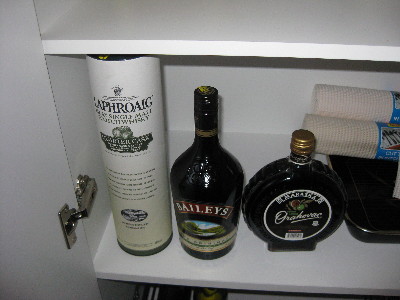
I had a highly Croatian day yesterday (visit chez Nick of my friend Marija cum familiā; visit of Nick chez Andy and Reena cum familiā). At the end of the day, I had a dwarf lime tree, to complement the dwarf orange tree and compact lemon tree; and I had a bottle of Orahovac, to complement the duty free Laphroaig and Baileys.


Mm, Orahovac. It's not gueuze (mm, gueuze), the vindication of all Belgic lambics. This is West Balkan walnut liqueur: dunk some green walnuts in some rakija (grappa, if that helps), leave in a summer window in Dalmatia for several months, and savour the woody syrupy goodness.

I'd had a shot glass of it at Hrvatski Dom, Footscray with my third Croatian friend Tim; it formed a trio of on-the-house welcomings together with paint stripper (er, Slivovitz, plum brandy) and cough syrup (er, Kruškovac, pear brandy). I fell in love—not least because it was neither of the above; and as lovers often do, I embarked on a quest, through the wilds of Dandenong (which has a large number of Croats, Serbs, and Bosnians), to find a supply of the golden walnutty nectar. The search proved fruitless, though it did generate what was my unupdated Facebook status message for the next several months. I complained about this strategically to Reena next time I saw her—and it paid off: now, from Boccacio Cellars, Balwyn to my humble abode, I have an added source of solace.

The taste was already familiar to me, because Greeks make walnut preserves, as one of their long suite of "spoon sweets": take any edible fruit (and a few things that are neither—such as walnuts), and turn into a sickly sweet preserve that you can only ever consume one spoonful of at a time.

When I described Orahovac to my mother this morning, she reported that people in her village did the same with sour cherries and brandy. Odd that I'd never heard of it; I know of vissinadha (βυσσινάδα), sour cherry cordial, but not that there was a Greek version of crème de cassis. (Hercule Poirot's favourite drink? He can have it: it's closer to Kruškovac than Orahovac in my book.)

(Mm, Orahovac.)

2009-03-28

Animadversions on the Dutch and the Greek National Anthems

George asks me in comments whether the Greek suburb of Oakleigh put on any kind of a big deal for Greek Independence Day, on the 25th—or whether moving to a Greek suburb was all in vain. Well like I said, the point of moving to Oakleigh wasn't that it was Greek, but that it was what I could afford. But no, I saw no blue and white bunting when I walked out the house in the morning, and no parade of folk dance troupes when I walked back into the house.

It's something George is familiar enough with from his time in "the foreign" (στα ξένα), but which he may have thought relieved in places with a higher concentration of Greeks. In Greece, time is punctuated by Greek holidays. More punctuated (at least I remember it in the '80s) than Australia is now by Australian holidays—although I vaguely remember Australian time used to be more punctuated as well. There was a clear sense that time was suspended when there was a holiday, secular or religious (and there was no shortage of saint's days): work stopped, if work didn't stop the holiday was still publicly acknowledged, there'd be parades or special masses that people turned up to or different salutations in the street; the holiday was something that you noticed, something that delineated the time around it.

It was noticeable to me when we moved back to Australia (before I stopped noticing at all), that time did not stand still in this country on Greek Independence Day, or the Feast of the Dormition, or the Commemoration of the Athens Polytechnic Uprising. These were just another day in this country. You went to school or work in the morning, you went home in the evening, there was no blue and white bunting. The first generation Greek grumbled that their time in Australia was joyless, and this was some part of what they meant: the Feast of the Presentation of Our Lady, or the Greek Declaration of War on Italy, were not punctuations in the month, were not acknowledged in the street or on the telly. They did not change the world around them.

Melbourne town used to do some token stuff around the Antipodes Festival, the celebration in the CBD Greektown, the weekend after Greek Independence Day, of souvlaki and folk dance troupes and Greek pop stars looking to diversify their income stream. I'm not even sure it's still on: I've stopped paying attention. It did punctuate the roads around Lonsdale St: they became quickly impassable. But the sense of occasion was much diluted.

Since I had just blogged about the Dutch National Anthem, I spent an afternoon on Greek Independence Day checking out the manifestations of Het Wilhelmus on YouTube—to confirm the diphthongs of the Dutch. (As I predicted, the diphthongs really did set my teeth on edge.) On YouTube, there was much diversity of riches to behold. There was the inevitable slideshows on the anthem, against pictures of windmills and clogs. There was the backlash pomo remix version, with windmills burning down. There was the way overliteral slideshow. There was the historically informed version, with the anthem sung like the 16th century canzon it was, and pop-up notes on the engraved propaganda of the time. There was the 17th century clavichord version. There were several more contemporary renderings: the boy band on the chat show, the pop musician in concert, the dance remix. A *lot* of soccer game versions. And then there were those having (even more) fun with it: the death metal version, the guitar hero version, the Bohemian Rhapsody version, the pastiche piano improv version, the soccer club song version, the gospel version. The hooligans on a bus version, which makes the pledge of allegiance to the king of Spain sound even more odd.

And the Hendrix fingerpuppet version. ZOMG, I was rolling on the floor with this one: it's its own special kind of sublime. All the more because it was vestigially plausible: Hendrix could have played Amsterdam after he did the Star Spangled Banner at Woodstock. Although he just wouldn't have the same emotional investment with it.


But there are mountains of depth to the Dutch National Anthem. The Dutch will tell you (through the Wikipedia article) that this is a gentle, peaceful song, devoid of nationalist aggression and arrogance. Yet the song was begotten in the start of the Dutch Revolt. William protests that he has always honoured the Spanish King, because at the time the text was written in his name, he was on the run from the Spanish King in Saxony; his Catholic peers were being executed because they weren't genocidal enough against their Calvinist compatriots smashing up churches; and halfway through the song, William proclaims he is David to Philip II's Saul, who one day would have his realm in Israel.

Not to mention the ambiguity of the second verse: William may well be singing that his blood is German, not Dutch—Nassau is in Germany; but in 1574, the difference between Dutch and Deutsch wasn't as salient as it is now. And the tune, so majestic and serene, was passed from Catholic to Protestant French soliders as they fought over Chartres, before it become the Calvinist rallying cry. Things are complicated with the Dutch National Anthem, which makes it all the more great a song.

I YouTubed further south, to see how the erstwhile Southern Netherlands compare. Belgium has the Brabançonne; I find it harder to be enthused about a song that so unimaginatively praises constitutional monarchy ("King, Law, and Liberty!"), and sounds like a generic 19th century march.

Inevitably, the Flemish and Walloons have their own anthems; the "Lion of Flanders" is aggro, as you would expect of mid-19th century Flanders ("They'll never tame him, not while Flemings live; not while the Lion can claw and use his teeth"); the Song of the Walloons is curiously defensive ("We have first-class industry, and are disproportionately prominent in scholarship; we give charity surreptitiously, and are heart-broken when Walloonia is denigrated"). The thing I find heart-breaking is, the Song of the Walloons is now officially in French: the cause of the Walloon language, at least, is lost. YouTube is the battleground between the Belgiums that you'd expect; one slideshow features a map of Greater Flanders (France isn't returning Dunkirk in a hurry, you know), and a rather prominent No Roosters (= Walloons) sign.

My thoughts, on Greek Independence Day, strayed back to how the Greek National Anthem, and how it might be presented on YouTube. The Greek anthem is a much longer poem than Het Wilhelmus, and far better as poetry. (Dionysius Solomos gets called the National Poet of Greece; despite that, he actually was a great poet.) There is something incantatory, something pretty chthonic about how it starts (although the word order is forced on the wrong side of sprezzatura). This doesn't really come across in the Wikipedia renderings, so:


I know you, by the edge,

terrible, of your sword.

I know you, by the glance

violently surveying the earth.

Lifted up from the bones,

sacred, of the Hellenes,

and valiant once more:

Hail! O hail, Freedom!


The music for the Greek national anthem... is regrettable, something out of an operetta. The anthem works despite it, not because of it.

I didn't find progeny on YouTube to match Het Wilhelmus: lots of sporting events, lots of slideshows, mostly militarist, some historical (and militarist), some with the Turkish flag wizzed on. And very little space for deconstruction: the closest I found was an a capella rendering by a comedian à la the great singer Kazantzidis, and the peanut gallery was split between being offended and delighted at the satire—and not entirely sure who the target of the satire was. (That the deconstruction was its own legitimate form of homage seems to have halfway occurred to only one commenter of the 42.)

There are some straightforward reasons why the Dutch are so happy to subvert, or reinvent, or riff on, or twist the lyrics to—and most of the time, keep affection for, their national anthem. There are some straightforward reasons why the Greeks are in deadly earnest about their anthem, will not tolerate it being sung by anyone other than an army or a soccer crowd (there is no tradition I know of of public solo singing the anthem), and have just two topics of their relevant YouTube slideshows. As I've said elsewhere, my ears may understand Greek spoken; but my eyes don't see the world Greeks speak of. (Greeks at this point often shake their head in pity at the privilege I am missing. Seeing the world through eyes that are not theirs, I reciprocate with brusque dismissal.) And my eyes find the Dutch construct more interesting.

(I'd go further and say that the Greek earnest and self-doubting response to their past is why something like Geoffrey Chaucer Hath A Blog cannot have an equivalent in Greek. Greeks may revere or resent the Hellenes of Yore; but they find it hard to make light of them.)

2009-03-27

Late March Distractions

Life has run away with me. Which is normally a preamble to me suspending operations on this blog. chaq qaS, 'a wej qaS. Maybe, but not yet. (That's for the couple of you that expected more Klingon out of me. It's all you're getting this posting.)

Life has run away with me in lots of ways. There was the World Is Much Too Small Way:


NICK: [walks from Melbourne Uni to Fitzroy, having been roped into a focus group]

NICK: *pulls up to the traffic lights before the focus group*

NICK: *notices next to him a vaguely familiar Levantine-looking woman with a short haircut. ignores*

...

NICK: *hang on, her hair didn't used to be short...*

ZOE: ... Nick?!

NICK: ... Zoe?!

Hail fellow well met, has it really been two and a half years, woah this is freaky, you've got the same email address right, well (looks at watch) gotta go ---

ZOE: Yeah. I've got to head to this house in Napier St.

NICK: Oh. I've got to go to this place in Napier St too.

*blink*

ZOE: ... You're not going to a focus group, are you?

NICK: [grins] F*ck off!

The even funnier thing was when we both walked in to said focus group, and the mutual contact looked at us both, clicked, and mouthed to me, "that's not... the Zoe?" Like I say, small world.

*waves if you're reading this btw Zoe*


There was the Failed Sleep Readjustment Way:


SISTER: So why did you invite me over today if you hadn't had any sleep?

NICK: ... Zzzz...

SISTER: Did you want me to make you a cup of tea?

NICK: ... Zzzz...


There was the Sudden Work Deadline Way:


... Nah, I'll skip the illustrative dialogues :-) --- they make fun of me, as they usually do, but with work it pays to err on the side of caution.

The deadline's still inconceivable, but I've accommodated to circumstances; it tends to take me a day --- and some gentle course correction. I convince myself the world is X, and it takes a couple of statements of "since last Thursday, the world is Y" before I realise that the world might in fact no longer be X.

I blame the coming Singularity, because the rate of change isn't going to ease off.


And finally, there's the New Toy And Associated Challenges Way, now that I have a power supply for my eeePC. The summary of the challenge is given in a separate Geek Dept posting.

I'm typing this on the eeePC, in fact. The 8.9 inch screen is fine; the keyboard will take some getting used to, and it's moving me away from touch typing (which I've been slowly inching towards over the past 25 years) back to two-or-three finger typing. In fact, in the standing room only train (one more reason I'm not normally a morning person), I was down to one-finger typing. And a lot of grumbling.

2009-03-25

Amsterdam Miscellanea

I wrap up my reports from the Netherlands with some miscellanea.

The Netherlands was not tolerant of Catholicism; that's why they split from what became the Spanish Netherlands, which is now Belgium. That's why so many former clandestine Catholic churches in Amsterdam (Our Lord in the Attic, Moses and Aaron, Begijnhof Chapel) are now tourist attractions.

A couple more echoes of that came up in the web searches supporting my blog posts on the trip. Like, William the Silent (the subject of the Dutch national anthem) had been both a Catholic and a Calvinist; the rebellion he supported gave birth to the Netherlands, but he was pained at the split of the Low Countries. Or, the geopolitical mess that is Baarle functioned as well as it did because both Dutch Baarle (Baarle-Nassau) and Belgian Baarle (Baarle-Hertog) are Catholic—and were the selfsame parish until 1860.

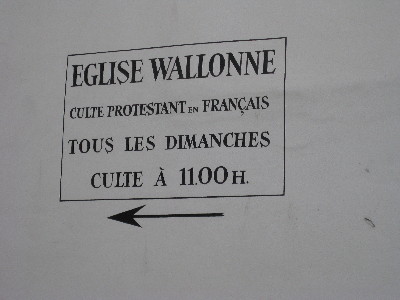
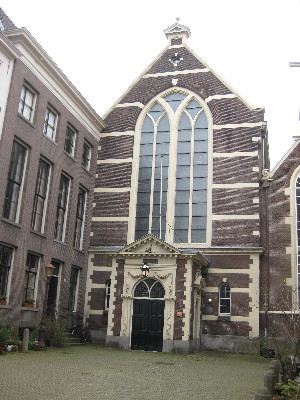
The Dutch were not tolerant of Catholics, but they were plenty accepting of Walloons. Provided they were Protestant, of course:


Given the rift between Dutch-speakers and French-speakers in Belgium (which the Walloons had plenty of blame for), I found this poignant.

❦❦❦

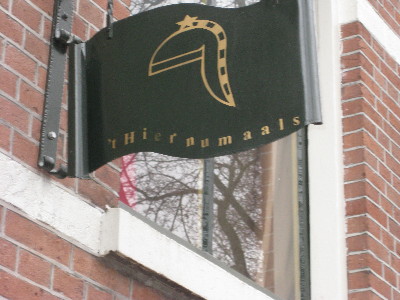
A couple of street signs in Amsterdam had automatic apostrophe syndrome: the initial apostrophe of 't < het "the" was pointing the wrong way: ‘t instead of ’t. Which is what happens when you use smart quotes in Word, and don't know about manually fixing the apostrophe direction. The same happens with ‘n’ in English for "and", instead of ’n’.

Once I saw it, I was determined to photograph the evidence the next time I saw it. I immortalised an apostrophe pointing the right way, as a baseline against which to castigate Dutch signwriters:


Unfortunately, I never did see another example of the wrong apostrophe. I'll link in comments if one turns up online.

❦❦❦

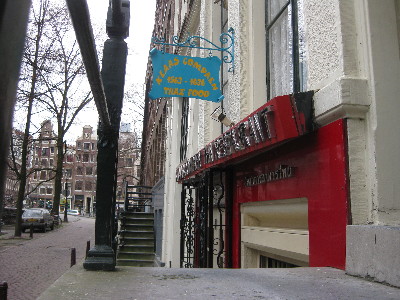
Who was Klaas Compaen, 1563–1636? Apparently, a Dutch pirate who spent time in Thailand. Fittingly his name, complete with dates of birth and death, figures above a Thai restaurant.


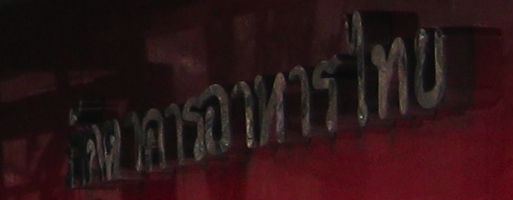
I have no idea what the Thai bit is saying:


I suspect it's not "Klaas Compaen, 1563–1636".

Confusion about the chap: Wikipedia (Dutch, and English building on the Dutch) dates Claes Compaen as 1587-1660, and places him everywhere but Thailand: English Channel, Morocco, Sierra Leone, West Indies. The recent monograph on the chap (Snelders, Stephen. 2005. The Devil's Anarchy: The Sea Robberies of the Most Famous Pirate Claes G. Compaen, and The Very Remarkable Travels of Jan Erasmus Reyning, Buccaneer. Williamsburg (NY): Autonomedia) doesn't mention Thailand or Siam in the Google Book Search either. There surely can't have been two Compaen pirates, could there?


❦❦❦

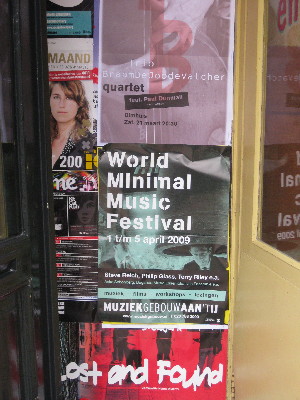
The school of composers taking after Steve Reich and Philip Glass have become a cornerstone of contemporary classical music. Well, ante-contemporary, because most composers have already moved on from the more rigorous forms (including Glass—let alone John Adams). But this was the most important thing going between 1950 and 1980, and it is heartening to see the Amsterdammers recognising it in festival.


That's, uh, Minimalist music. Not minimal. There'll be plenty of music there, I trust; it'll just have a single chord progression.

❦❦❦

We noted earlier the distinction between the Netherlands and Holland. Holland may well have run the Netherlands; but Holland is not the Netherlands: there's Friesland (where they spoke Frisian, which is not Dutch), and the whole East of the country (where they spoke Low Saxon, which is not Dutch), and Maastricht (where they spoke Limburgish, which is not Dutch) and Flevoland (where they didn't speak Dutch, because a hundred years ago it was underwater).

I have been careful to maintain the distinction between Holland and the Netherlands. Most people, most of the time, in most languages, don't bother. It's Ολλανδία [olanðia] in Greek, for instance. Κάτω Χώρες turns up in schoolbooks as the literal rendering of the Netherlands; but noone uses it, and the Low Countries (þe neðere landen) also includes both the erstwhile Spanish Netherlands, now Belgium, and the strange case of Luxembourg. Same story in many a language: using the checklist of the Wikipedia list of articles on the country by language, you have

  • Bulgarian Холандия [xolandija],
  • Arabic هولندا [hulnda],
  • Manx Yn Ollan,
  • Hawai'ian Hōlani,
  • Indonesian Belanda,
  • Hebrew הולנד [hulnd],
  • Japanese オランダ [oranda],
  • Pontic Ολλανδία...
(Pontic has a Wikipedia! Cool! Ancient Greek doesn't have an [official] Wikipedia. Uncool.)


Didn't photo this, because by the time I was leaving Amsterdam I was over photography (doesn't take much); but at the airport, I noted that the English-language signs were unabashedly referring to Holland, not the Netherlands. This makes sense, and is the same story as Chinese speakers of English and "Peking".

Chinese people know full well that their capital city has been called Beijing since around 1600. But when the more Anglophile Chinese speak English, it's more important for them to prove that they know what English-speakers call Beijing—which is how the locals pronounced the city in 1550. So they make a point of using the English "Peking"—even as English speakers (following the lead of the Chinese government) make a point of using the current Chinese "Beijing".

Same with the signwriters at Schipol Airport, I surmise. They know Holland isn't the Netherlands. But to be as welcoming as possible to English-speakers, it's more important for them to acknowledge that English-speakers don't know Holland isn't the Netherlands. Ergo, http://www.holland.com is the Netherlands Board of Tourism & Conventions; http://www.netherlands.com seems to be some cheap hosting shell surrogate.

❦❦❦

That's that. I look forward to getting over my jetlag; amortising my sleep (two four-hour cycles) helped, but I currently find myself being a morning person.

Now to the challenge of maintaining this blog without being overseas...

2009-03-24

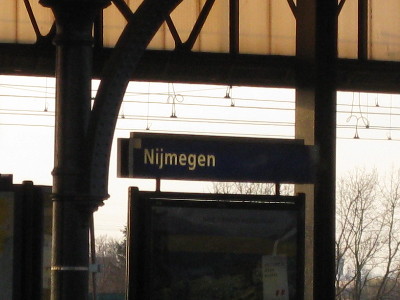
Nijmegen: "Too small to blog about"


A horrible thing to say about a town. But yes, Nijmegen is small: 140,000 people or so. I see from wikipedia that some would lump in Nijmegen in the Randstad, a metropolis that if you squint long enough encompasses the whole of the Netherlands. That strikes me as special pleading: yes, everything is close to everything else by train. For example, if you want sushi in Nijmegen, you get on the train to Arnhem, a mere 15 minutes away. But you are still going through a bunch of forest to do it; and the Randstad is so called because its cities (stad) are on the edge (rand) of a bunch of trees and/or water. So no, in my book, Nijmegen is small.

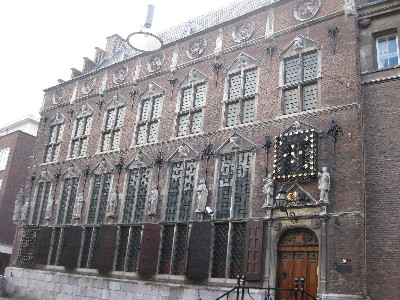
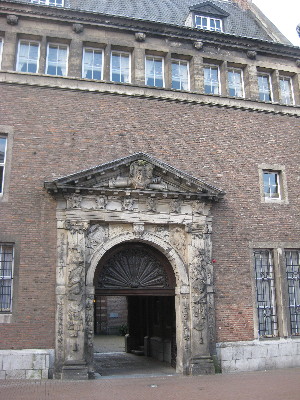
It's cute, which comes with being small. Well, the mediaeval Stadhuis (town hall) is cute:


I was struck by the fact that Nijmegen has an Italian (and Spanish) name, Nimega. The Spanish name could have just been a reflection of the Spanish rulers' discomfort with Dutch (and Dutch Low Saxon) diphthongs (Dutch Low Saxon: Nimwegen)—

I had no idea that the Netherlands spoke not only Frisian, to the north, and Dutch, but also Low Saxon to the East—which, in anything but name, is Low German. Dutch in fact was originally the language of just Holland; and the Netherlands is bigger than Holland. You'll notice I've been scrupulous about saying Netherlands. More on that later.


—but the fact that Italian uses the word too made me accurately conclude that Nijmegen was a mediaeval centre of commerce. The Stadhuis is classy enough to reflect that.

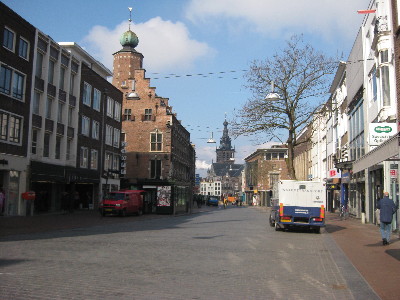
And the downtown is cute:


Pretty compact; and I was astonished when Sonja (Sebastian's girlfriend, chez whose laundry I was crashing) ducked into a doorway opposite the local Dixon's: the downtown shopping centre is all residential upstairs from the shops, and indeed in inconspicuous wedges between shops.

(I was also astonished that a British electronics chain store, which gave me the wrong bloody adapter for my eeePC in Heathrow, would turn up in Nijmegen. But that's globalisation for you.)

The little drinkeries open at night were even more cute, except for that hellhole playing loud crap remixes of '80s tunes and with whooping Nijmegen Uni students being nuisances. Sebastian and Sonja were suitably apologetic, but not enough to make me want to stick around there. But the first drinkery was cute, what with its "would you like some free mints?" and special smoking room and easy-going bar staff; and the deserted final drinkery (a real local's place, dark and cozy and pleasantly grotty) was even more cute.

I was arrived in Nijmegen to drink and reminisce with Sebastian, not necessarily in that order. The drinking glass sizes threw me off: what they call a small beer glass was indistinguishable from a shot glass, and what they call a large beer glass wasn't much larger. I clearly wasn't in Australia. But I did learn all the Dutch I would ever need there. Well, more than I needed, since they all spoke English, but enough to ingratiate myself with the bar staff:

"Twee Amsterdameltje vaan Dommeltsch en één bruin Duvel, alstublieft."


Which translates to:
"Two small-sized water tumblers (which you have the temerity to regard as "large" drinking vessels) of the local generic lager, which I'm not even going to dignify with my attention; and a single goblet of the slightly but not very stout rendering of one of the fine assortments of Belgic ales you have on tap, my good man, and I think I have just exhausted my knowledge of Dutch."


*hic*

To my amazement, I woke up the next morning. I didn't have *that* much to drink, but I was out of practice: A mere four mid-sized glasses of beer (the last out of deference to the pleasantly grotty place, since I'd already bailed out to lemonade in the college bar). And that Gueuze in Brussels on the way up, of course. Mm, gueuze.

The education precinct of Nijmegen is not cute. The Max Planck, at least, attempts the monumentality of squares (and fails, because gray brick is not monumental, it's a suburban reception centre):


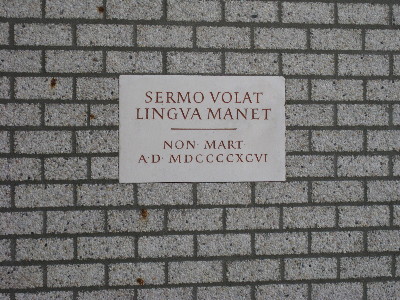
I didn't have the heart to photo the building itself, it was blah. The Latin as cute: at least someone was bothering not only to do Latin inscriptions on buildings in AD 1996, but to date things on the Nones of March. A lot less people know what the Nones of March are than know the Ides of March.

The inscription itself, I wasn't as happy with. It's a take-off of the old standby Verba volant, scripta manent: spoken words fly away, written words stay behind. (Unless they're on digital media more than five years old, but I digress.) The version here was, Sermo volat, lingua manet: speech flies away, language stays behind.

Now, that could be a Saussurean distinction between langue (the abstract linguistic systems that linguists study), and parole (the stuff that actually comes out of people's mouths). Very Chomskian line to take if that's what they meant, but psycholinguists actually use parole more than most linguists to work out what linguistic structures are; so it's an odd slight to make, especially in Latin. Or it could be some optimistic statement (not that distant from the first) that words are temporary but languages are forever. Given the rate of language extinction in the world, that's not too prudent a statement either.

Nijmegen Uni (formerly Nijmegen Catholic U, now Nijmegen U named after Catholic Bishop Radboud) is not even trying to look monumental: it's just bad mid-20th century concrete. I was looking forward to the experience of a German (or Dutch) mensa (university cafeteria). I didn't quite get there in Nijmegen U, but at least I know to avoid the filet américain (see enteraining fulminations at Yahoo Answers, where the answers may not be correct, but they are funny). Bad enough as steak tartare on a plate; but in a salami tube as a squirtable topping? Just say no.

As already alluded to, lots of Australian linguists there, some of whom even asked me what my PhD topic had been...


Wenn sie fragen, wer i g'wesen bin:

Tambour von der Leibkompanie!


(That's being deliberately abstruse too. Some other blog post perhaps.)

Oh, and I got to say goodbye to Sebastian and Sonja about four times. I kept planning to leave Nijmegen and getting stranded. At least I caught up with my blog posts for the day.

OK, one more Dutch Sojourn posting to go.

2009-03-23

A Wilhelmus to the Netherlands

When I was an undergraduate, one of my lecturers was the quite Dutch Tobias Ruighaver. At the conclusion of his course on computer architecture, I stood up with a couple of musicians in the lecture theatre, and gave a stirring rendition of Het Wilhelmus, the Dutch national anthem. I think Tobias was more interested in the Amstel beer we'd also gotten him; but the performance got people talking for at least a semester.

I completely failed to get the Netherlands, of course; I should have bought that Undutchables book at the airport, I think it would have illuminated some things. Still, now that I'm back in Melbourne Town, and jetlagged (I slept like a log on the plane—but on the wrong leg of the flight), I bid you all please be upstanding for my rendering of the Dutch national anthem (a bit more T.S. Eliot than the original):


I'm William of Nassau,

My blood is Dutch.

I'm true to my country

beyond death's reach.

A prince out of Orange,

free, unafraid:

my word is my bond to

the king of Spain.

Fine Dining In Amsterdam

I was not going to leave Amsterdam without crossing off some of the local specialities off my list.

Fries was not on my list, but since I didn't know what I'd get in Brussels, I thought I'd try some here. And a good thing, because the fries in Amsterdam are free to proclaim to the world that they are FLEMISH FRIES!
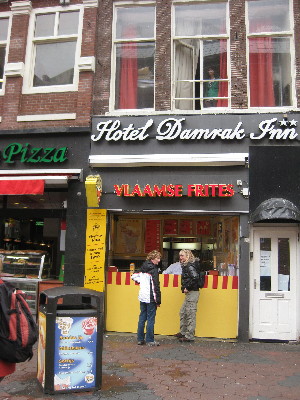


Not French Fries! Definitely not Belgian Fries—the very idea! Nay, while there is a frying pan and some soggy mayonnaise to spread, the Flemish cause lives.

Of course, this is gratuitously unfair; for all I know, fries were invented in Flanders before Belgium was a glint in the Duke of Wellington's eye. But it was an obvious dig to make; and as far as I can tell, "Flemish Fries" is really what they're called in Dutch (and not just in Flanders.) I wonder what the Walloons call them. Probably just pommes frites, and not, I dunno, frites de liberté or frites de flamandais maudits.

(Checks Wikipedia on history of fries.) Well, yes, reports on fries in the Lower Countries are claimed for 1680, way before the existence of the Belgian state; and they are placed in the Meuse valley, between Dinant and Liège, both of which are in... HAHAHAHHAHAHA!!! Walloonia! Oh history, you are so delightfully tricky...


The list of local specialities included Argentinian steak. For reasons I cannot fathom, Amsterdam tourist precinct is packed with Argentinian steakhouses. I wouldn't have pegged Amsterdam for a big Argentinian community, and I don't see that Argentinian steak is the best match for aromatic coffeehouse-induced munchies; but I counted at least seven Argentinian steakhouses.

I had steak in the place I had my Sunday morning coffee and apple pie (La Gauch, just before Centraal Station); the minimum 200g fillet, because I don't foresee a situation in which I could do anything constructive with a half kilo slice of cow. For an empty tourist joint, the steak was just fine. Not tender enough to scoop out with a spoon (as my friend Steve found a steakhouse showing off in Buenos Aires); then again, I'm not sure I'd actually want a steak that tender. But yes, quite tasty.

Next on the list was jenever, the Dutch version of gin. You can get an Old jenever, which is yellow and mellow and not a Donovan song; or you can get a Young jenever, which is still working through its teenage rebellion. Since I had only 24 hours more in the Netherlands (of which most would be spent at the airport, asleep, or getting lost walking around town), I enquired whether a jenever might be possible from my Argentinian hosts.

ME: Could I possibly have a djenever.

HOST: A djenever. Or even a yenever. [looks around] I will get you one, sir.

HOST: [Calls over waitress] Doordrecht Utrecht Rotterdam Leiden yenever.

(By the way, mine host has hit the sweetspot of gutturality, such that I can't be sure whether he's speaking Dutch or Arabic. I will assume Dutch for the remainder.)

WAITRESS: ... Jenever?!

HOST: Amsterdam Groningen Nijmegen den Haag shop Arnhem Almere jenever!

WAITRESS: [runs out the restaurant as I pretend to be completely unresponsible for the commotion]

WAITRESS: [walks back with a bottle of jenever that looks suspiciously like the bottles of jenever I saw later on—at the bottle shop around the corner]

WAITRESS: Stuyvesand Leeuwenhoek Vermeer serve Rembrandt Tasman Dampier jenever?

HOST: van Dijk van Diemen van Gogh van Morrison shot glass Amstel Rijn Flevoland customer Poffertjes Clogs jenever!

As a result, I had before me a clear glass of young jenever, next to my pepper sauce and steak. This was a quite young jenever. Young enough that it should have been grounded. Young enough to crash its car in my gullet and do a runner. Interesting experience. Not a million miles away from my grandfather's moonshine grappa, but with juniper flavouring going on.

The third thing on the list was Rijsttafel. The guidebook explained it well: it was Indonesian food for Dutch colonial appetites—

"Hm, this is a lovely satay skewer, mijn heer Indoneesisch hawker. I will take 50 for lunch please. With a couple of carts of rice. Marieke, are uw dining with? Better make that 100 skewers, and three carts. She is watching her carbohydrates, uw know. So, gijf me now please all your spices."


I didn't get to have Rijsttafel, or to reach a more mature evaluation of the history of Dutch colonialism. I struck up a great conversation on the train back from Amsterdam with a Turkish linguist at the Max Planck. (My thesis came in handy: I'd at least heard of a few more Turkish towns than average.) She actually mentioned that they were having Rijstafel at her place that evening, but I already had a date with Argentinian cuisine.

The last thing on the list was Stamppot. I got a lot of incredulous reactions on that one. It's distinctly Dutch comfort food, which is why noone in Amsterdam would go anywhere near it: "We did not become the cosmopolitan diamond and aromatic coffeehouse capital of Europe to eat our grandparents' cabbage mash". It'd be like a tourist in Greece asking for fasoladha. (Bean soup. Hearty stuff. You should try it if you're in a Greek restaurant: mess with your host's mind. Wonder if it's even allowed in Plaka...)

Well, I was that tourist. And Amsterdam did not make it easy for me to be that tourist: not a whole lot of places serve stamppot around the Centrum. (And even outside the Centrum, you saw a lot more Italian and Indonesian and Thai than, you know, Dutch.)

I finally found a place to my linking: the Roode Leeuw Brasserie, within the Hotel Amsterdam on the Damrak. It was an island of class in the tourist theme park: the menu actually bypassed English in proclaiming its cuisine régionale nederlandaise. (Well, only for the title: the menu items were still bilingual with English.) Within, red wood panelling, statues of horse carts, place mats that subtly hinted through archival photography that the Red Lion Brasserie has been here a smidgeon longer than the Burger King next door (Est. 1911); lion silhouettes (none red); and a clientele mostly over 70. (There was one other lost-looking scruffy tourist, and a couple of businessmen under fifty. And me. Who despite the crows feet, am still not over 70.)

The waitress was slightly surprised at my request for stamppot, which was on the cuisine régionale nederlandaise menu outside but not on the lunch menu inside. She said (not sure whether in Dutch or English) "I will get you some". I'm pretty sure she didn't run around to the corner bottle-o to do so.

A quarter hour later, I was about to peruse the afternoon papers, to see whether I could guess the meaning of Dutch in newspapers as well as I could on cigarette packs, when my stamppot arrived. With a server so surprised at the request, that he gave me a 30-second disquisition on stamppot and its social setting.
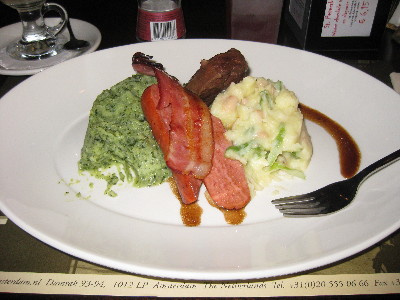


SERVER: Here is your lunch sir. It is a heavy lunch. This is stamppot: this is mashed cabbage, and this is mashed potato and lima beans, with bacon and sausage and beef. It is what we eat in January, when it is really cold outside; so we eat it after we go out skating.

ME: Well, unfortunately I could only get here in March.

SERVER: Oh, no problem sir, we serve it all year round!

But not to many tourists, I suspect. And you know, it was a heavy lunch. Definitely comfort food, and the cabbage-based mash was surprisingly pleasant; but you wouldn't want to eat it every day. Unless every day involved skating, I suppose.

Lunch was accompanied—because I like to try anything once—by Dubbelfriss and Amsterdam koffie. Dubbelfriss was a European-sized helping of lolly water. It was friss because it was fresh (and Friesian). It was Dubbel because it mixed two flavours of lolly: I got raspberry/cranberry. The Dutch for "raspberry" is framboos, which is somewhat reminiscent of the French framboise. The Dutch for "cranberry" is cranberry, which is somewhat reminiscent of globalisation.

The Amsterdam koffie did not my knowledge involve anything served in aromatic coffeeshops. It was coffee, full cream (again with the cream), and honey liqueur.
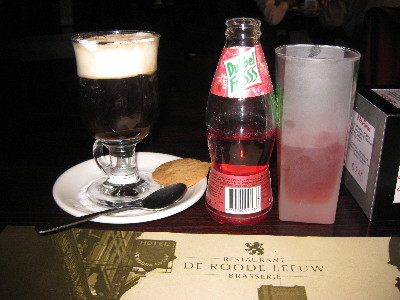


Definitely liqueur and not just honey. I'm pretty sure the base coffee was Douwe Egberts too (or as I have mangled it at least once, Doogie Engelbarts); so heavy vanilla substrate to the cream and mead. Yes, I approve.


Back to diet next week, I know.

Jottings of Amsterdam, Centraal to Rusland

Here at opɯdʒɯlɯklɑr, we're all about the heterochronicity. So as I sit in the foyer of Max Planck Institute, Nijmegen, waiting for a taxi to launch me on the path back to Amsterdam...

and in the plane over the Western Desert returning to Australia...


... I will continue blogging about what I saw when I was already in Amsterdam on Sunday.

And insert some comparisons with what I saw when I was back in Amsterdam Thursday into Friday.


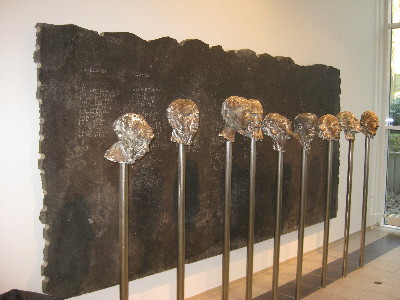
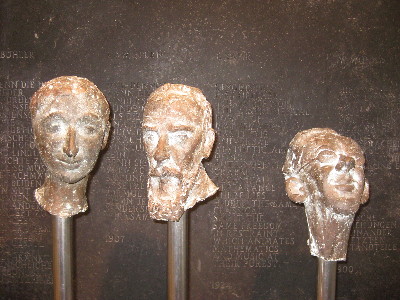
Here at opɯdʒɯlɯklɑr, we're also all about the resentment at not having become an academic linguist. OK, not all about it; but with MPI an elite linguist hangout, with longstanding ties to University of Melbourne Linguistics, and complete with memorialised linguists' busts (and psychologists—it's the Institute for Psycholinguistics after all),


... regrets, I've had a few, but then again, too abstruse to mention. The PhD students at the next table are picking through their good fortunes at being in Nijmegen. I hope they don't get disillusioned like I did, really I do.

No, focus. When last blogged, I had just rocked up to Centraal station, and been sore astonished at the multiplicity of bikes. I then wandered south, to see what I could see.

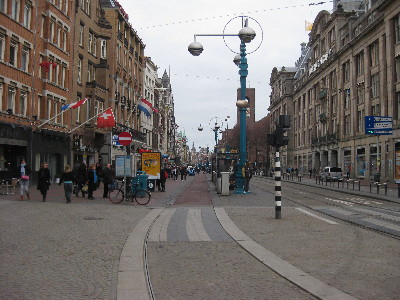
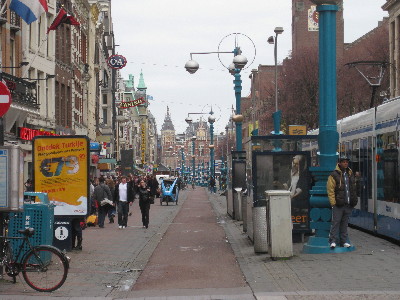
What's south of Centraal? The Red Light District. I swore I wouldn't bother going there, because I wanted a better sense of the soul of Amsterdam than AMSTERDAM XXX BY NIGHT would provide. But bang, there I was. I didn't immediately stumble across the brothel windows—that was a street down; but I did come across the sex shops that I'm declining to photograph in this shot—


—not because I'm above that kind of thing, dear reader, but because I dare surmise you might be.

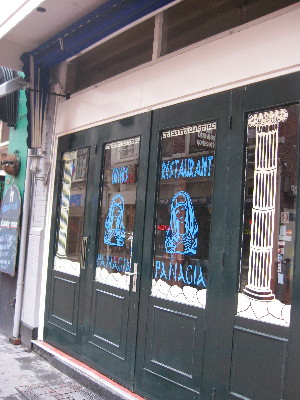
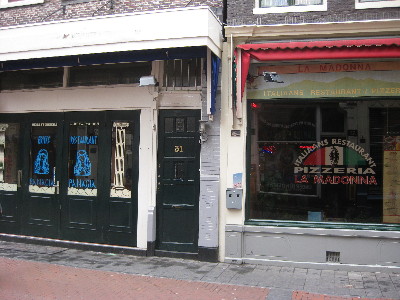
The Red Light District, I found rather puzzling. There was a lot of incongruity to process here. (I mean, you're showing that video cover right on the street window? Really?) I did find it funny that two shops down from said video covers, there was a Greek restaurant dedicated to the Virgin Mary:


and an Italian restaurant dedicated to the Virgin Mary:


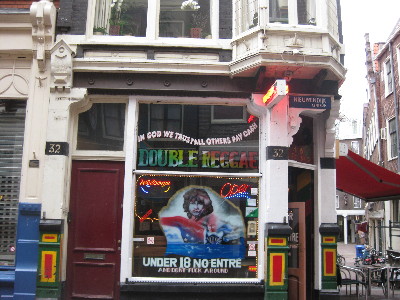
in a losing battle. Not least because they were faced off by one of the innumerable aromatic-smelling coffeeshops that blanket the precinct, even unto Rusland St (where my hotel was, 1 km further down):


The battle is in fact to represented by a T-shirt. I'll refrain from republishing gratuitous blasphemy in a public blog, so since someone else has encountered the T-shirt, I'll link off site.

But you know, sex shops and aromatic coffeeshops, and prostitutes in lingerie incongruously tapping on the window as you walk past (Lady, I'm lugging a suitcase halfway across Centrum, and it needs A Good Time right now even less than I do)—do not convey the frisson of risk and edge that they might. I chose the word tacky rather than dodgy, and there was a reason for that. Sebastian (who I was visiting in Nijmegen) crystallised it for me when I expressed my disappointment to him: it's a clean, sanitised, manicured experience of sex and drugs and souvenir T-shirts. It's a tourist theme park, really.

To my relief, when I came back and got intentionally lost walking around town, I saw the flipside to Centrum. (I had a couple of destinations, but got gloriously lost by following the ring structure of the roads bordering Centrum.) I didn't get a sense of the soul of Amsterdam—in the end, how could I in a couple of hours; but I saw that the flipside is a town that still has too many bikes, but also a place here people get work done, go out to dinner, and get home by 10. Not a particularly striking looking town, but lived-in. (This is not Vienna, which had a point to prove in its architecture; Amsterdam ran the world as a business, and was satisfied with individual affluence.) By the Plantage district, which was parkland until past the Golden Age, the town even loosens its belt a little, and allows for some greenery, and mansions that aren't single file.


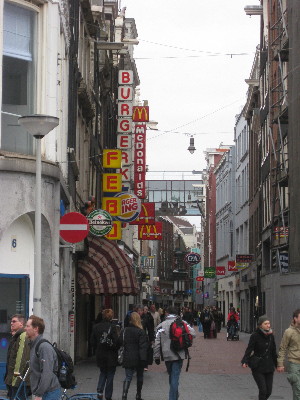
What other superficial impressions of Centrum? Nieuwendijk was a jumble of souvenir shops and garishness; the fashion stores wedged amongst them tried to look classy, and failed. I didn't even want to take photos as I went down it; just a dismissive look back when I got to the Dam:


I was more forgiving when I went back: Nieuwendijk at 10 pm was defanged and normal for where it was, and Nieuwendijk on a Friday morning actually made some sense, as a street tourists would happen upon.


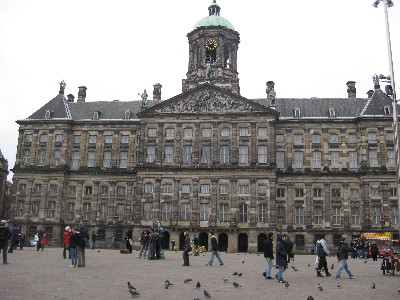
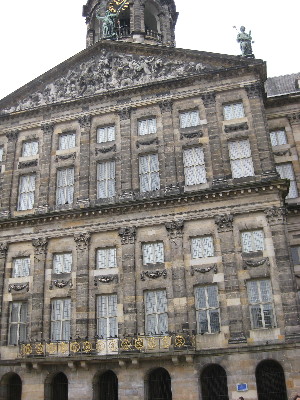
The Dam was more my style: I approve of the stateliness of the Koninklijk Paleis


although I have to wonder how they filmed that scene in public where... oh, "above that kind of thing". Right.

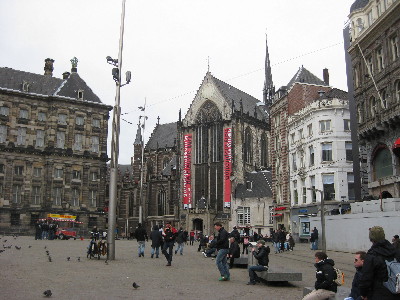
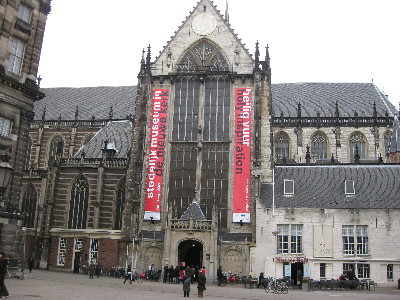
The Nieuwe Kerk is also suitably commanding:


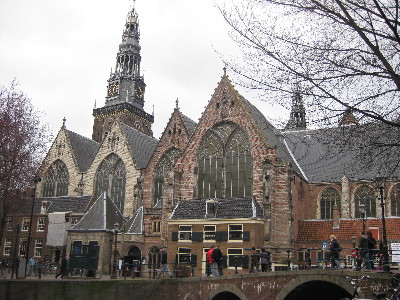
That's the New Church in the Nieuwe Zidje: New as in 1408, as opposed to 1306, and the Oude Kerk in the Oude Zidje.


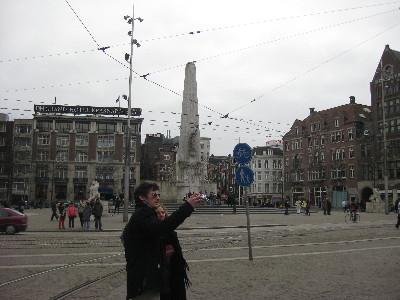
It's an old town. Even the post-1945 monuments at the Dam look suitably in place—the marble lions don't have their innards deconstructed or their manes braided or anything.


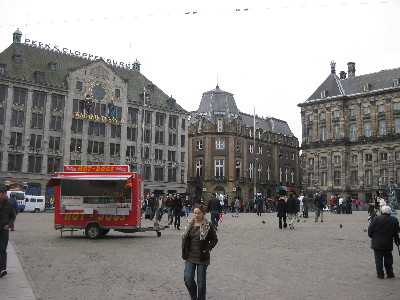
Even the Madame Tussaud's and department stores look dignified here.


(I can't say the same about the hot dog stand, but the town planners can't take responsibility for everything.)

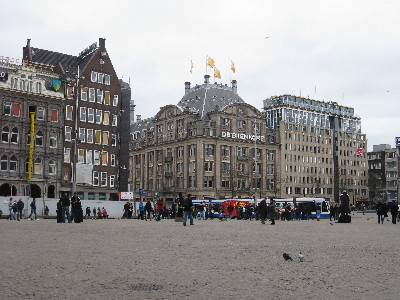
And in comparison to Nieuewendijk, the Damrak... well, it's a step up:


Not a complete staircase up, mind you—


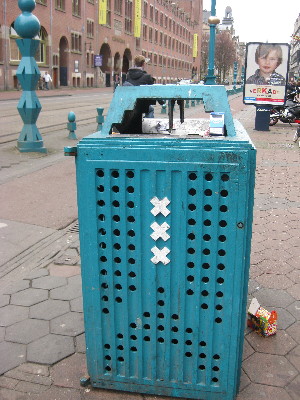
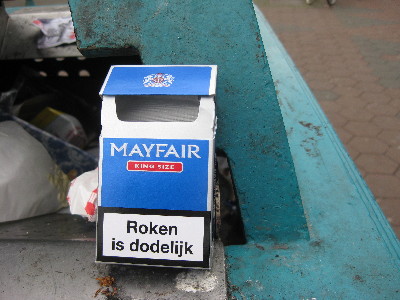
—but somewhat more orderly. The Damrak also hosted one of my proudest linguistic moments, when I worked out what a Dutch cigarette packet said on a bin (proudly emblazoned with the city symbols, XXX):


Roken is dodelijk. Reeking is deadlike. OK, ok, I worked it out via German, Rauchen is tödlich, Smoking is deadly. As Sebastian told me later (I dont just bore you, dear blog readers, with this crap; I also bore anyone I'm visiting), the German packs say that Rauchen kann tödlich sein: they are reluctant to assert a 100% fatality rate. No such caution in the Netherlands or the Anglosphere: there's lives to save, don't you know.
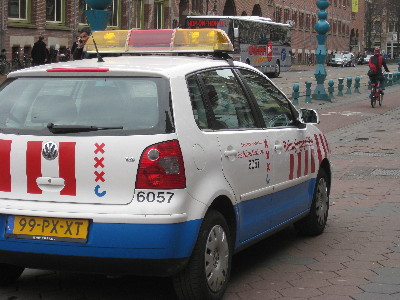
Those XXX's? They're meant to be St Andrews' crosses. They're everywhere:


And while they long predate the use of XXX as a Google searchword, the similarity has not gone unnoticed in the Red Light District. (I won't even mention what they do with their depiction of Amsterdam traffic bollards.) This is just about the only Red Light District use of XXX I could find that would not itself attract an XXX rating:

2009-03-20

Some shoutouts

For those of you keeping score, a shout out to my tuthree loyal blog readers, for staying subscribed even though I had not updated in nine months.

A shoutout to my friends who have been waiting for a status update on Facebook for about a year, and will have to settle for this instead.

A shoutout to my friends who optimistically thought I might at least do updates on Twitter. Eh, yeah. Get back to you on that.

A shoutout to my sister, for landing the promotion and dodging the bullet. I kept glibly saying she'd be fine; it's great to know that in the end, she was.

A shoutout to my friend George, who pleads antiquity of computer for not being able to read the blog, but did have the incisiveness to comment "You, having a blog just for when you travel—a fine perversion that is!"

A shoutout to Keith Jeffery, whose charger I borrowed to confirm that the eeePC I bought actually worked.

Er, yeah. I bought it in the end. Temptation mumble mumble. £150 with 4 + 12 GB drive, surely a steal. And surely it *was* a steal: the charger they were puzzling over for not working didn't work because it was a 9.5V charger for the eeePC 700, and not a 12V charger for the eeePC 900. The bloody thing will cost me $40 extra; it already cost me €15 in taxi money because I didn't check that shops in Amsterdam are closed Mondays till 1 pm (though that did at least get me out of Centrum and into the actual city of Amsterdam). And, uh, haven't gotten to play with it much yet. When I'm back, it shall be the envy of every café-goer in Melbourne! 'Cept that they'll all have one already...


A shoutout to Flevoland, for remaining above water. Next time I'll try and visit. (Andrew Treloar just biked over; alas, I am ill at such numbers.)

A shoutout to Sebastian for hosting me tonight.

A shoutout to The Lower Countries, for being The Lower Countries.

A shoutout to the Australian and British taxpayer, for their unwitting sponsorship of my work travel.

A shoutout to work, for having me both travel and use my brain, though not necessarily simultaneously at all times.

A shoutout to my work colleagues, for putting up with me in not one blog, but two.

And a shoutout to you, dear reader, wherever and whenever you may be.

OK, enough hippy crap. Booze waits at la bella Nimega.

Bruxelles–Brussel–Roosendaal

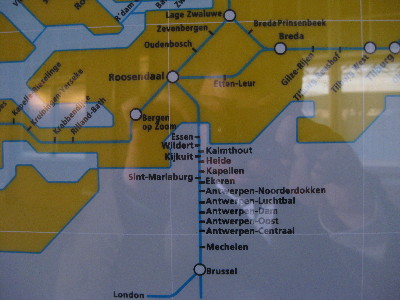
I am now on the train out of Brussels, and not sure when I'll get a free internet connection again. The train, rather more packed than the one I came in, is hurtling across the Waloon–Flemish divide, and on its way to Roosendaal in North Flanders, oops, the Netherlands, where I'll change trains for Nijmegen, and some choice ales therein.

(Dutch train conductors dress like train conductors. Belgian train conductors dress like South American generalissimos. I have no idea what's up with that.)

It was a productive work day on top of being a productive blogging day; worked fairly solidly 10–3, with an hour break in between to eat tarte à citron. As often these days, I spoke with more authority than I actually have, but to my mild astonishment, I got out of it a coherent story for our work collaboration. I also got some incoherent notes that I will have to transform into something legible later on. Dank u wel pour l'hôpitalité, David and Franz.

(We're at Mechelen station already? And clearly north of the linguistic divide now: no bilingual signage.)

Anderlecht was not that bad by the light of day, once I was taxiing out of Chaussée de Mons: there were some stolidly proud buildings left. Things got more chic the closer I got to the European Precinct, where my meeting was. It's actually a shame I wasn't more mobile when I was last in town: the monumental architecture I like was not in Groote Markt, but further south.

(The South American generalissimo has just checked my ticket, and has said something to me in Flemish about my itinerary. I have no earthly idea what. Eek ben portugees alstubleijft?)

After work, I secluded myself for half an hour to do a couple of emails and blogs. As you saw, the building (European Schoolnet headquarters) was across the road from the Greek Embassy. This was pretty fortuitous, given that the cabbie I came in with asked whether I was Portuguese. (The one thing to note about my French accent, apart from that I don't know what I'm doing, is that I nasalise only 20% of what I should; so Portuguese was the wrong Mediterranean swarthiness to pick.) I didn't have the patience or the language skills to launch into how I was Greek-Australian, let alone the cool way my friend George put it: "the guy looks like a Greek greengrocer, but acts like an Englishman." Instead, I just said grec. And the cabbie didn't even notice the embassy he ended up parking at.

(17:50, and the sun is already low enough to be a nuisance in my eyes. Found out Amsterdam is 52°N—about as far north as Terra del Fuego is far south. Better keep that Gulf Stream going, people.)

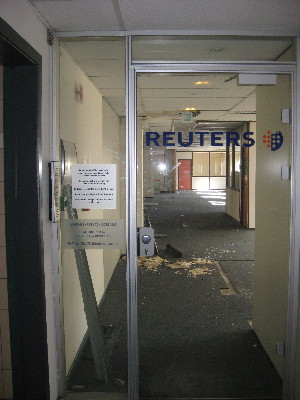
European Schoolnet is in premises formerly occupied by Reuters. John Cowan, I don't know whether this is in any way a metaphor or not, but this shot's for you:


I decided I'd blogged and emailed enough by 15:40, and bade David point me to the nearest cab rank. Yes, he could have ordered me a taxi, and indeed offered to; but I wanted one last chance to be bamboozled in French, before retreating back to the Anglosphere. (The Anglosphere really does include the Netherlands; it certainly includes the Max Planck Institute, Nijmegen.)

And my chance was offered. If it's a day of the week in Brussels ending in a Y, there's a protest going on. The front cabbie at Schuman station cab rank heard my request of "Brussel. Station. South.", looked at his van, looked at the traffic jam congealing down Law Street—

yes, Law Street. If they're going to say it's both Rue de Loi and Wetstraat, I'm going to say Law Street and Gebotstraße. Remember, German's also an official language of Belgium. And that was Mountain Avenue I was staying at last night, too. But Fred Thompson can stay in French. He Funny.


(Antwerp. Time does go fast. The station lighting makes it look like a Philip Glass opera set.)

—and announced "Sir, there's a protest on. Just look at that. Take the metro, sir, it'll be quicker."

Euh, bien. It was still 15:50, the train wasn't leaving till 17:18, plenty of time to get lost in the subway. So I walk the way he gestured, fail to see a subway entrance, then realise that the cabbie was gesturing in the direction I would end up—not in the direction of the subway entrance that would actually get me there, which was Right Behind Him. As I turned around and walked back, the cabbie behind the "Take the metro, sir" cabbie leapt forward: "I'll take you sir". Work's paying for this (eventually), so that was fine by me too.

ME: It is seeming, every times I am in the Brussel, there is the another one protest.

CABBIE: Capital!

ME: (Well, I guess it is symptomatic of globalisation and its malcontents, as a late manifestation of capitalism... oh, he means Brussels is the capital of Belgium! Right!)

(Le minibar wheeling past was emphatically Flamandic in its linguistic behaviour. No, I'm not in Brussels at all.)

The cabbie was helpful ("This time, it is the sans-papiers persons demonstrating!" That's illegal immigrants, right?). The cabbie was also utterly nuts, which is how we managed to detour around the traffic jams and up several one way streets the other-than-one way ("I know another trick!" "There are always solutions in this life!" "My colleague, he needed only to reflect that there are ways to get around traffic jams!" "In life, one must pause to reflect, non?" "Oops!" *beep*): all in time to get to Bruxelles Midi by 16:20. I was pretty surprised how well we were able to hold a conversation. Well, he held the conversation, and I said "yuss" and "not one problem" a lot. I also tried to explain that where I come from, we don't have a protest every day of the week ending in a Y, and workers embrace the go-slow rather than the overt strike. But I think he thought I was Irish, so I may not have contributed to international understanding there.

(OK, Antwerp sun, that's really low in my eyes. Stop that now.)

The cabbie joyfully deposited me at the station ---

ME: I is to having sufficient time for waffle perhaps!

CABBIE: tulˈtɑ̃! tulˈtɑ̃!

ME: *blink* (Oh! tout le temps! All the time in the world! Yuss!)

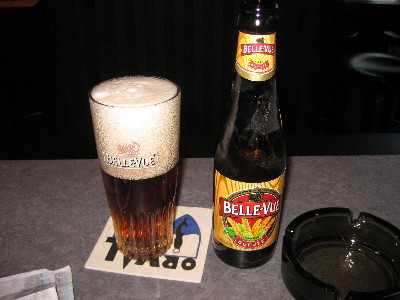
--- and I chose to use my tultã not for a waffle, but for gueuze. Mm, gueuze, thou one true lambic and vindication of all quarrels Belgic. Waffles, I can get at Flinders Street Station thank you very much. (What do you mean, but those aren't real Belgian Waffles? Bruxelles Midi was flogging waffles through Häagen-Dazs; how's that any more authentic, when Häagen-Dazs isn't even a real name?)

Mm, gueuze:


And to complete my prandial sampling of Belgium, I thought I'd have a hamburger from le Quick burger joint after all, since I declined them so emphatically last night. Un Pepper Supreme Solo, s'il vous plaît.

(Pretty close to Dutch border if not already over it, and those are some pretty serious trees. Ah, a canal or lake or something. Weelkoomeen een Needeerlaand.)

(And a dude bicycling while SMS'ing. Definitely Neeedeerlaand.)

(Note to self: Wildert Station. Must check if it is actually in Neeedeerlaaand, or Beelgiijë.)

The time I saved with the death-defying cabbie of four-dimensional driving abilities, I lost because le Quick forgot my order. Which was not as unpardonable as responding to my Bad French in Good English, and no, I don't want a coffee in compensation, just my burger before the 17:18 to Amsterdam via Roosendaal leaves.

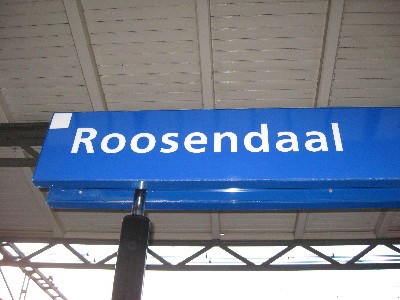
(Roosendaal pretty soon; I declare this blog posting at an end at 18:24, 2009-03-18 CET.)

(And unlike Neeedeeerlaaand, Roosendaal really is spelled like that.)


PS (at Roosendaal): Wildert Station is not in the Netherlands:


But given the behaviour of the locals, there is a case to be made for annexation...

OK, blog posting now ended for sure.

2009-03-19

Study of the Artist as a Middle-Aged Pie-Eater

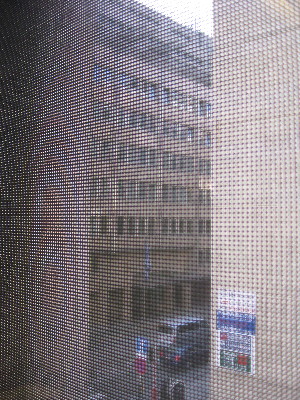
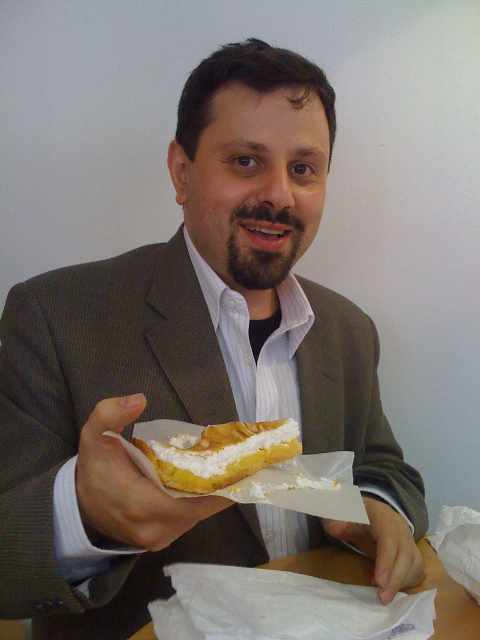
Courtesy of David Massart, whose office in Brussels I'm visiting today (with a view out my window of the Greek Embassy, of all things), a couple of shots of me getting stuck into a tarte à citron.

The Greek Embassy through mesh:


The Greek flag in closeup, through mesh and artificially enhanced. (Or the Shroud of Turin, for all the clarity of that image.)


And your humble servant. Life-sized, because surely I deserve it. What unwelcome crows' feet those are...

Name That Doggerel

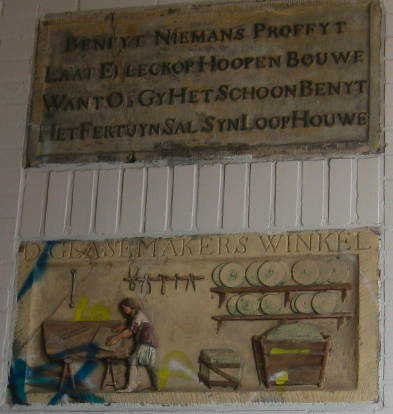
In response to comment from Philip Newton, here is a closeup of that house-identifying doggerel. (It was actually next to a cafe, in an awkward vault location):


Over to you!

Friends wot blog

Twitter Updates

Calendar