Rebetiko music was a fusion of styles, and the fusion can be seen in progress through the '30s. The antecedents of rebetiko are murky, but the most visible antecedent is Smyrneika, the music of Anatolian cafés, which came with the Anatolian refugees to Greece in the '20s, and was taken up as the emblem of the dispossessed in the underworld.
A tidy narrative, but there are more currents in Rebetiko than that. Markos Vamvakaris, who is deservedly termed the patriarch of rebetiko, promoted a Piraeus Sound that was at some distance from Smyrneika. He shared a musical vocabulary with them, and recorded a few tracks with Smyrneika singers; but the Piraeus Sound was more rhythmical, more upbeat, more Western. He only infrequently uses the Maqam Saba—the bluest of modes in rebetiko music, so blue it even has a blue IV note.
(That's nothing; the Arabo-Persian original even has a blue VIII note. Yes, you read right. But I digress.)
The refugees from Anatolia recorded plenty of Amanes—the slow, chromatic laments that were emblematic of Smyrneika, and which I've looked at before, in the context of Muslim Cretan music. Vamvakaris on the other hand recorded just one amanes, and made a point of binding it with Peiraeus rather than Anatolia: Πειραιώτικος Μανές, The Peiraeus Amanes.
But Markos' path took him westward rather than eastward—not without some heavy shoving by the censors of the Greek government. By 1937, his style had matured into what is recognisably the classical style of rebetiko; it had foregone much of the raw impact of early recordings, but it had gained in musicianship and smoothness.
Not that Vamvakaris in 1937 was completely consistent; some songs are too trivially cantabile, some are powerful riffs reminiscent of his earlier music. One song in particular though, Είσαι μελαχρινό και νόστιμο, "You're dark and cute", is incoherent in a way surprising for Vamvakaris, early or late.
The song starts out with the Classic Peiraeus sound. A two beats to the bar, jaunty riff on the accordion followed by the bouzouki. The riff is in the Peiraiotikos Dromos scale—a variant of the Maqam Hijaz, and Vamvakaris' favourite: it too, after all, is named for Peiraeus:
But in the introduction to the song, the exotic intervals of the Peiraiotikos are defused: The flattened II and sharpened IV are glossed over as passing notes; the riff is solidly anchored on the major triad. The riff wears its tonality on its sleeve.
Then Markos starts singing (0:22). And what he starts singing has nothing to do with the riff: Where the riff was straightforwardly tonic-anchored, all I and III and V, the song is lost far from the tonic: V at best, and more VII and II. That doesn't translate to a simple Dominant chord, which wouldn't be a problem in Western music: the band is still on the tonic, and these are Hijaz VII and II, not Major key. With a tonic of A, the voice gravitates to B♭ and G♯: it teases the listener, with a leading tone a semitone below the tonic, and another leading tone above, outright dodging the tonic in bar 18. So while the riff has defanged the Peiraiotikos' exotic notes, the voice has let the exotic notes take over, and has undermined the scale's tonic.
Where the riff has jaunty sixteenth notes, the voice drags in slow quarter notes—even more so in later verses. Where the riff hops up and down the triad, the voice moseys up and down the scale, a third each bar, adrift. Where the riff has a tonic triad note twice a bar, the voice holds off landing back on the tonic until the very final bar in the phrase. And that's in the first verse: with each subsequent verse (0:33), the voice adds a bar to the eight-bar phrase (bar 29): —so where the riff was foursquare to the bar, the voice ends up on the tonic one bar too late, in a nine-bar phrase that sounds like it forgot to keep count. And the riffs and verse keep alternating through the song, establishing and dismantling and establishing once more two different kinds of musical order.
It took me a little while to work out what on earth Markos was doing, until I realised that what the voice is doing—slow-moving, metrically free, stepping by thirds, untethered from the tonic—was the antithesis of the Peiraeus sound. In Είσαι μελαχρινό και νόστιμο, Markos is singing an amanes.
It's unsurprising for an amanes to dodge the tonic like that, or to ignore metre; that's what an amanes does. What is startling about Είσαι μελαχρινό και νόστιμο is that Markos is singing an amanes with a hasapiko introduction, to a hasapiko beat, in a hasapiko tempo, with a hasapiko sensibility, and against a hasapiko tonality. He is singing an amanes in the context of the Peiraeus Sound, which utterly clashes with the amanes. I may not be excused the anachronism, but Markos is here committing a mashup.
And the incongruity of the combination makes it startling, it isolates what was commonplace within its native context. The tonic-dodging and metrical freedom become a statement, rather than a convention; a dialectic rather than a recitation. I don't know what made Markos experiment this way, and it's not a path he went further on, either. But it foregrounds, as nothing else Markos did, how hybrid rebetiko music is; how the one Peiraiotikos Dromos could have two quite different interpretations, before they were blended in the Peiraeus Sound.
I haven't mentioned the lyrics, btw, because by this stage, the lyrics aren't particularly notable—Markos is done singing in praise of getting stoned and beating girlfriends up. But, in case you're interested:
When I was finishing my undergrad and moving through to linguistics in 1993, the war in Abkhazia was underway. There was plenty of grubby conduct on both sides, and Abkhazia was in the end thoroughly ethnically cleansed; but outsiders with no stake in the Caucasus had sympathies for the most superficial of reasons. As a linguist, I wished the bizarre consonants of Abkhaz well. Yes, it was that superficial—though I did also know someone who knew Viacheslav Chirikba, Abkhaz specialist on Abkhaz, linguistics lecturer in Leiden (and now in Sukhumi), and representative of Abkhazia to Europe for years.
Robert Haupt was the Soviet Union/Russian correspondent at the time for the Fairfax newspaper group (The Age, Melbourne, and the Sydney Morning Herald). This was a pre-Web age, and his dispatches, which I consumed with pre-Web leisure, alternated between leisurely whimsy and urgency, from a correspondent in the midst of the disruptions shaking the Soviet Empire. When he finished his five year stint, Haupt published a memoir of his time in Russia, Last Boat to Astrakhan (see review 1, review 2). Halfway through his time in Russia, Haupt wrote an editorial on the Abkhazian War. My sympathies were with the Abkhaz consonants; his sympathies were with a sustainably-sized polity, which meant Georgia, and he treated Abkhazian independence as "a sort of Ruritanian joke". His sympathies led him to diss Abkhaz consonants:
The amazing thing is that even in Abkhazia the Abkhazians are a minority. In fact, they constitute 17.1 per cent of the region's population, Georgians making up 43.9 per cent. The total number of Abkhazians anywhere is just over 90,000. Put together, they are a football crowd. About half the Abkhazians are Sunni Muslims, but judging from my meetings with some of them before the civil war it was a lightly-worn faith, with few mosques and veils and with the prohibition on alcohol honoured not so much in the breach as by the barrel. The Abkhazian language is an issue. A strange tongue, apparently related to Circassian, it sounds like the noise a Chinese speaker might make on the point of being strangled. When the Soviet Union existed, mandatory Russian obscured the problem of whether the official language here was to be Abkhazian or Georgian. As Moscow's grip slackened, disputes arose, particularly over what was to be the language used at Sukhumi University. Georgians point out that their language, having a written literature going back to the 5th century BC, has some claims to precedence as a means of instruction over a tongue that achieved a fully written form only in 1928.
I've said worse a decade later about Montenegrin, but I was scandalised at the time. Given the practicalities of bureaucracy and business and scholarship, Georgian does have more of a claim as an Ausbausprache than Abkhaz—spoken by only two thirds of that "football crowd"; the current moves to make it the language of government business in Abkhazia are not meeting with success, and the business of Abkhazia is being conducted in Russian.
But what had happened at the start of the Abkhaz war was no Ruritanian joke. Abkhaz would have had more Ausbau in place, if Georgian paramilitaries had not torched the Abkhaz national library and national archives.
Abkhaz is a small language, with a small written footprint—much smaller than Georgian. Burning down the place where all books in Abkhaz were deposited made it even smaller, and was intended to. The National Library has since managed to restore a lot of the 40% of books burned—in no small part because Soviet Abkhazia had made sure a copy of every Abkhaz book also went to Moscow. The library is still damaged and scaled down, but basically functioning.
It is otherwise with the National Archives (account in Russian). Its fate is heartbreakingly documented by Thomas de Waal:
Of the 176,000 archival documents in Abkhazia, 168,000 are estimated to have been destroyed. What the Georgian paramilitary did not burn in the National Archives (despite the efforts of both Abkhaz and Georgian neighbours), was in the archives stored in the Communist Party Archives. Georgian and then Abkhaz troops did away with those archives as the war went on.
There is a Greek component to this blotting out. Abkhazia had a substantial Pontic community before the Stalinist purges and deportations, as documented by Daniel Müller: 7% of the population in 1926, 10% in 1939 (as ethnic Abkhaz started to leave the region), but just 2% in 1959. As I noted in the Other Place, the historian Vlasis Agtzidis has recently published his doctoral dissertation on the Greek press of the Soviet Union. His focus is Κόκινος Καπνας, Red Tobacco-Worker, the Greek newspaper of Sukhumi.
The entire print run of the Red Tobacco-Worker was one of the many items to go up in flames in October 1992, after Agtzidis had already been to Sukhumi—though as the introduction notes, the print run had been microfilmed in Moscow just in time. The newspaper was of course only one of thousands of testimonies of the Greek history of Abkhazia that was destroyed.
As de Waal's accounts tell, the archive's last custodian was himself half-Greek (and spared deportation in 1949 through his German mother): Nikolai Ioannidi. Ioannidi was the director (or deputy director) of the archive, and was working on a history of the Greeks of Abkhazia. He published the first volume of Греки в Абхазий in 1990, the first published account of the Stalinist purges of Greeks (see comment #15, Pontus and the Left). The manuscript of the second volume turned to ash in his office safe, before his eyes.
And Ioannidi spent his last days in an empty room in the University of Sukhumi, drinking Greek coffee and brooding over the remnants of the National Archive, uncatalogued, unrestored, unrecognisable. De Waal reports Ioannidi's death on 1 July 2007, eight months after he had interviewed him.
De Waal paints a tragic picture of Ioannidi, but I will take his epitaph instead from the Pontus and the Left blog, in the discussion about the historiography of the purges of Greeks. Ioannidi did manage a second book shortly before he died, about the exile of the Abkhazian Greeks to Central Asia in 1949; the discussion on the blog was about the opinion of some historians that the exile was connected to the defeat of the Communists in the Greek Civil War. Commenter M-P (one of the blog owners) attributes the opinion to Ioannidi in his first book (comment #20). (Agtzidis also mentions that as Ioannidi's position in an article on the purges, fn. 188). Commenter Dimitris (comment #21) retorts that Ioannidi was merely posing it as a question, and rejected it in his second book.
Yet even while disagreeing with Ioannidi, M-P paid him tribute—the kind of tribute Ioannidi would have welcomed:
Ioannidi was a Soviet historian. He wrote during the Soviet era, relied on Soviet archives, and because of his age and circumstances, he was not influenced by post-Soviet ideological trends. Until the end of his life he struggled with other comrades of all ethnicities against the nationalisms sweeping through Abkhazia.
IT IS A STRANGE SENSATION when you feel that a dead man is trying to send you a message, but it happened to me a couple of weeks ago, shortly after Australia's Attorney-General announced that no further inquiries would be pursued into the circumstances of Paul Keating's piggery. The dead man was Robert Haupt, one of the ablest and most respected journalists in recent Australian media history.
From the teaser, it looks like Haupt had written something prescient about the scandal. Haupt's analysis about Russia is challenged in Jennifer Marohasy's blog, just as Ioannidi's analysis was challenged in Pontus and the Left's blog. But the dead do still send us messages, through what they have left behind; and they do not ask that they be right all the time, merely that they be remembered.
The fires in Sukhumi denied others their rememberance. Haupt and Ioannidi have not been so denied. Requiescant.
I have been wanting to write, since reading of it, about the deaths in Athens. And unhealthily (because of such recursion is our society enmeshed), I have been wanting to write about the reactions to the deaths. What I would write would be reactionary, and vindictive, and uninformed. I don't particularly want to say I'm not entitled to my own opinions about what happened, or that I cannot identify with class struggle because I am, after all, the class enemy. But the dead deserve more respect than that, and better reasoning than I can come up with on the other side of the planet. It is as offensive to make them a departure point for my sloganeering, as it is for the parties that I took offence to.
Instead, I wanted to post what someone else has said: someone who has a stake in the country, and the protest march, and the struggle on the streets of Athens. Someone whose response—I admit it—I could make sense of, but would still challenge my complacent notions.
The following article by Stratis Bournazos, which I am translating with permission, appeared in the Sunday issue of Avgi [Dawn], the newspaper affiliated with the Coalition of the Radical Left (SYRIZA), on May 9, and is republished in the column's blog.
"What is a diamond worth when people's souls are coal. Once you're in Dante's Hell, there's no way back to Earth."
It's Wednesday night, and I'm listening to the Winter Swimmers (Χειμερινοί Κολυμβητές). They wrote that piece for another reason and another time, but I'm thinking: what are words worth, when three people have burned? So our souls don't turn to coal as well: that's what they're worth. That's why I'm writing this, with an unbearable sense of burden. For the dead. But also, and mainly, for us.
A lot happened on Wednesday, a whole lot. We could say even more. On the huge crowd that deluged Athens. On the rage. On the savage joy. On people's laughter. On the gas that choked us. On the crowd surging, shouting "burn the whorehouse, burn the Parliament" (a harbinger of an uprising? or the prelude to a dangerous backlash against representative government?) On the fluidity of things. On how we got from the sadness of the First of May to the enthusiasm of Wednesday. On that, and a lot more. Until we learned of the dead. From that moment, nothing is the same. For all of us, the three dead have haunted our day. Their names: Paraskevi Zoulia. Angeliki Papathanasopoulou. Epaminondas Tsakalis.
It is a horror that three people found such a death. Because it was no accident, it was the result of a process of blind violence, of a conscious indifference for human life. It was going to happen. It was almost predictable—just as it is predictable that we will in the future mourn deaths from the indiscriminate use of tear gas. In protest marches for the past few years, a certain party has exalted and exercised violence for violence's sake—sometimes to the protesters' reproof, sometimes with the protesters standing aside. They have done so without caring whether there are people in danger—inside, next door, upstairs, further down.
So for the first time in our entire recent history, people have died in a demonstration not because of State violence (the case of the K. Marousis store in 1991 remains controversial), but because of anti-State violence, because of the actions of people who took part in the march, who were part of it in a way—however marginal, and who acted in its name. The Molotov cocktails and fires had a pretext: they were an act of protestation, an act of anti-State, anti-capitalist, anti-government violence. We can disagree with them, but how can we deny it?
A little after the news was confirmed, various items started circulating. That the bank had no emergency exit. That there was no fire security. That the employers forced the workers not to strike. That the door was locked. Even if all that is completely true, it is politically and morally shameful to resort to it as an alibi, to claim that Vgenopoulos [the bank owner] is ultimately at fault, or to adopt the statements of Rizospastis [the Communist newspaper], enraging in their ridiculousness, that "the three employees were killed by the urban class, whatever sheepskin their instruments may have been disguised with." Let our judgement not be clouded: this time the ongoing scandal of employer irresponsibility is not what matters. It wasn't a lightning bolt or a cigarette butt that started the fire.
Thousands of stores throughout Greece lack fire security and emergency exits. It's illegal, and it's terribly wrong. But if it was the riot police that had thrown tear gas into one of them, or the Golden Dawn [neo-fascists] had thrown in an incendiary device, and we were now mourning the dead—would we be blaming the lack of emergency safeguards then? We should not trample on our common sense or our decency.
And as for the other opinion heard—that the bank should have shut down beforehand because it was a "target": public opinion can say that, but we don't get to say it. We, who have been shouting "To the street, to the street, break the terror of the State"—we don't get to say that stores should close down, barricade, become impregnable forts, or else they will turn into deathtraps. We certainly don't get to blame the owners responsible, because they failed to regard the protest march like an earthquake, a hurricane, a looming storm, a mortal peril. If we think like that, we have fully capitulated to a perversion of the meaning of protest: we have yielded to the dominion of fear and terror.
We left-wingers of all shades, anti-government, anarchist, libertarians, we are all struggling for social emancipation, for the spread of freedom, against the capitalist barbarism which crushes peoples' lives and dreams, against the exploitation of people by people. Aren't we? So what do our values have in common with the fetishisation of violence, violence which is raised to an utmost and unitary goal in itself, and—most terrifying of all—has contempt for human life? In dismissing human life, there is no emancipation: there is no service done to the struggle for freedom, justice, and a better life. We cannot but stand face to face against this, making no excuses.
We. I'm talking about us. Each of us, wherever we have staked our ground. Representatives of the government and the establishment can see the dead as an opportunity to get out an awkward spot. Investors can fear for the consequences in tourism. Scholars and scientists have to analyse the sociological, psychological, and other causes of the phenomenon. But the question is, what do we do. All of us, who have protested worker "accidents", army suicides, the attack against Kouneva, the violence of the riot police, the murder of Alexis Grigoropoulos, the deaths of immigrants, and so much else, all with the common theme of defending human life and dignity: we don't get to forget the three dead, or offload the blame anywhere we can, as quickly as we can—on Vgenopoulos, on the State, on "agents provocateurs". We don't get to speak cynically of collateral damage, and we don't get to tally them up against the other dead. And that is nothing to do with bourgeois niceties: it touches on the core of our stance, in politics and in values. After all, what were we shouting in the march on Wednesday? "You're talking about market dives, we're talking about people's lives!"
If we have a sense of how tragic what happened was, if we feel contrition, if we allow ourselves to mourn without looking to drown our sorrow in a sea of analyses and excuses—that would be a start. Even if it is belated, because many of us—and I include myself—should have thought of all this much earlier. Even now, we must convert this tragic experience into both individual and collective thought; each of us must acknowledge their responsibilities, different though they may be. We must try to understand. We must speak with honour. We must stand up where we ought to, morally and politically. Without trying to deceive the Others—or above all, ourselves.
They are not the only people who consider themselves Greek but speak a Turkic language. As the Wikipedia article notes, the Pontians of Tsalka in Georgia who speak Turkish are also called (Tsalka) Urums; and a large number of the refugees from the 1922 population exchange were Karamanlides, who spoke Karamanli Turkish (and wrote it in Greek characters). When the refugees of Salonica waxed sentimental about their football team PAOK, they didn't just say ο ΠΑΟΚ μας in Standard Greek. They also said τεμέτερον ΠΑΟΚ in Pontic—and bizim PAOK in Turkish. Nikolaos Contossopoulos is the foremost researcher on Cretan dialect of the 20th century; but his folk were Turkish-speakers. He concluded, he told me once, that Pontic has undergone syntactic influence from Turkish (an obvious but not necessarily a popular conclusion), because Pontic syntax sounded just like his elderly relatives trying to speak Greek.
Which goes to show something blindingly obvious, but lost in the modern East European process of nation-building: language is not the same as ethnicity (and neither is the same as nationality).
Turkic languages are the languages of Muslims, as far as everyone in the region is concerned, and a Christian speaking Turkic violates the easy dichotomies of nation-building. Which means that if Turkic-speakers internalise an ideology of being ethnically Greek—or indeed, of being Rum, Christian, as an ethnicity—then they won't take nationalist pride in speaking Turkic. They will see themselves as speaking the "wrong" language. That's not untenable in an Ottoman or Russian context: after all, the Turkic-speaking Greeks did continue speaking Turkic for centuries. But if they find themselves in a majority Greek-speaking context, they will be pressured to drop Turkic for Greek, and they won't have much of a motive not to.
And indeed, that's what happened with the Karamanlides in Greece. Greece was never well-disposed to minority languages to begin with, and the Turkish that used to be spoken by the refugees is barely mentioned in scholarship: it never became an emblem like Pontic, or even a bugbear like Macedonian Slavonic. It was quietly, and efficiently, dropped.
The Turkish of the Karamanlides passed unlamented—and unrecorded. Greek linguistics had its own priorities, being practiced after all by Greeks who saw the world in a particular way. Contossopoulos spent his career on someone else's dialect—which is after all what most linguists do; but working on his own family's dialect was not an option. Nor, I venture to say, would he have been dismayed that it was not.
Karamanlides speaking Turkish was a paradox to nationally-minded Greeks; Karamanlides dropping Turkish might seem a paradox to cosmopolitan-minded non-Greeks. The mother tongue, we assume by default, is the driver of identity and its rallying point and its emotional centre: how sad it must be to hate your own mother tongue.
And I admit to being troubled at the notion of hating one's mother tongue. Yet loving one's mother tongue, chosing to value it as identity, is as much a construct as valuing religion or culture, or what Greeks nebulously call ethnic consciousness, εθνική συνείδηση. It's innate to seek out one's own, but who one's own are is something learned, and acquired.
And engineered. The Christians of the Ottoman Empire had to be taught they were Bulgarians, or Greeks, or Macedonians, or Albanians. What the people of village X thought they were 500 years ago is different to what they thought they were 100 years ago, and often what they think they are now. And the change was often enough initiated, because someone from Athens or Sofia came to town, and told them so; or because the local landlord made a choice, and his villagers followed suit.
But the question of what people "really" are, of how their language or quirks or DNA contradict their current self-identification, is pointless. If for whatever reason the villagers of X or Y now consider themselves Greek, well, they're Greek; telling them a hundred years on they've been brainwashed means nothing. (The same goes for the search for Greeks in FYROM, it should be said: the Vlachs there in particular have changed their minds too.) Telling the Karamanlides they should have held on to a Turkish-speaking identity in Greece means even less. They suffered for being Christian in Turkey, they suffered for being aliens and speaking the wrong language when they fled to Greece: if they've come to hate their mother tongue, they aren't obligated to hold on to it for my linguistic edification.
That's problematic for me to say: the Karamanlides have had to jettison their linguistic heritage, because they were told to, and they found themselves in the coercive linguistic context of a monolingual nation-state. All Other Things being equal, maybe they shouldn't have had to make that choice. But All Other Things were not equal; and it's hard to know how much of an attachment they'd formed to Turkish while in Turkey. Love Of Mother Tongue, like everything else, is taught, and they wouldn't have found many such teachers.
And that's all terribly confused, because on the one hand I don't seek to be an apologist for nationalism, let alone to presume how the Karamanlides felt at the time; but on the other what the (former) speakers themselves now think should not be dismissed either. On the one hand, I can't get over the notion that hating your mother tongue is dysfunctional; on the other, it's as dysfunctional to expect Greeks in Greece to speak Turkish. The essentialism of nationalism—or at least, of unreflective, pitchfork-yielding nationalism, is not just hateful, it's counterproductive; and not just counterproductive, but obscuring. There's a reason linguists don't want to hear about the political dimensions behind what counts as a separate language: the flags get in the way of seeing the isoglosses.
Yet flags matter too, and "Nationalism Bad" is itself an unreflective stance. People are invested in their identities. No less genuinely so, because the identity is changeable, and engineerable. I responded negatively to the commenter at Sarantakos' who was happy that the Muslim Greeks had to leave Greece, because they had a family tradition of national fickleness, having converted in the first place. There was enough fickleness in the other direction, or alternating between the two, to make such atavistic purity tests contrary to the national interest—and not merely inhumane. Patriotism is not a matter of genetics, it is cultural, acquired, and contingent. That doesn't mean it's not real; and it doesn't mean either that the descendants of the Karamanlides are somehow lesser Greeks, or that their Greekness doesn't matter to them.
I got started on this post because I'm posting at The Other Place about the Urum. The Urum, like the Karamanlides, are Greeks Speaking The Wrong Language. As I'll explore there, they seem to have sensed in the '20s that they Spoke The Wrong Language: so they didn't pursue Ausbau like every other minority in the USSR did. That may be a pity and brainwashing; or it may be redressing an historical anomaly (as Pontus And The Left put it). But it was real. Now, there are signs at least some of them are taking pride in their language after all—with the support of the Greeks Speaking The Right Language. That's real too. Both groups are now turning into Ukrainians Speaking Neither Of The Above (Russian): the Greeks there, Greek-speaking and Tatar-speaking, now have different Otherness and different threats to their identity to deal with.
I've had an odd week, and as revenge against the elements, I've done a slightly odd thing.
It's Greek National Day, and Greek bloggers turn their thoughts to debates on nationalism. The Magnificent Nikos Sarantakos' Blog was no exception, and during the discussion that developed, I made a glancing mention of the Cretan Muslims, a topic I've already brought up on this blog. My reference was to the apparent conversion of some Cretan Muslims to Christianity in the 19th century; Nikos responded by pointing to a short story by Ioannis Kondylakis on his site, "How the village turned Christian" (although it does not refer to conversion, but to Muslims abandoning villages for the cities).
The story is cute in a way; it's not quite the multi-culti, Why Can't We All Get Along story that our century would look on with favour, but given the sentiments of its time and place, it does a nice little subversion of the old narratives. (And the figure of the wine-drinking bon vivant Muslim is familiar enough from Kazantzakis' Freedom and Death.) It turns out the village the story is set in, Modi, is the village Kondylakis was a schoolteacher in, at the end of the Ottoman Empire; but I wouldn't assume this is exactly newspaper reporting. Still, if you read it attentively, you can see the harassment payback being described.
I decided to translate it, and I decided to be slightly odd about it. The story is of its time and place, and I'm of mine, and I decided not to translate τούρκος and ρωμιός as "Turk" and "Greek". That's the dichotomy we know now, but the dichotomy in the Ottoman Empire was credal, and not ethnic as we now understand it: the Cretan Muslims spoke Greek, and translating τούρκος as "Turk" leads to the absurdity of "Turkish–Albanian" instead of "Muslim Albanian". (The insistence on calling Muslim Albanians Muslim had a simple reason: there were Christian Albanians too, and the common creed they shared with Greeks was more important than the common ethnicity they shared with the Muslims.) Kondylakis has his characters speak of "Romioi", but the narrator knows what they meant by that, and calls them "Christians". I've gone the next step, and called the Tourkoi "Muslims". (If that makes the story sound like it's set in Bosnia and not Crete, well, there's a reason for that.)
That's not the odd thing I've done. Maybe ideological, but not odd. The odd thing is, I wanted to render the occasional code switches into Turkish of the Muslims with some English equivalent: a language familiar to English-speakers, but clearly foreign.
So my Muslim Cretans lapse into French.
You don't approve, well, tant pis.
***
He had often heard from his father the story of why he had to sell up in Modi and move to the mountain village of Akaranou. The reason was "a Muslim—begging your pardon—and a pig—by your leave"; that's how he would speak to express his hatred of that Muslim in particular, and of Muslims in general. Modi back then was still a Muslim village. There were a few Christians, but they were humble lowlanders, "thirders"—that is to say, they cultivated Muslim farms against a percentage of the income. Serfs, almost. The only one who had some measure of human dignity and pride, because he had enough property not to have to work for the aghas, was his father Mikhalis Alefouzos. But precisely because he had an independent spirit, and his spine did not bend readily, he drew the dislike of Kerim Agha, the richest and most powerful Muslim in Modi, a fanatical and tyrannical man, who wanted Christians to feel that they lived only through the sufferance of the Muslims. For that reason, whenever Alefouzos passed him by and greeted him with a simple "Good evening, Kerim Agha", he'd shake his head and stare at him with a threatening glance, as he went on his way. One day, he said to another Muslim present:
"That man there, par Dieu, Alefouzos: he's a revolté; he dares look us in the eye, he's no soumis."
When the period of Egyptian rule brought some relief to the standing of Cretan Christians, Alefouzos was encouraged enough to commit an act of great daring. He bought a pig and fed him for the Christmas feast. A pig, in Modi! A pig in Kerim Agha's village, and right next to his villa! A pox on it! Qu'on foute sa mère, the infidèle!
The first squealing of the pig spread horror in the Muslim village, and the hair of many a Muslim stood on end. There was a council of the aghas at Kerim Agha's, and they decided the rebel Alefouzos should be expelled from the village or murdered. But before everything else, the pig had to be killed. This was intolerable. The past day, while Kerim Agha was smoking on his pipe in his courtyard, he saw its filthy snout poke through his half-closed courtyard door. A pox on it! Nique ton grand-père!
"One day, par Dieu, it'll come up to the mosque and bid us good day!" another agha said. "It pokes its way wherever it finds an opening, oink oink!"
"I must I kill, My Aghas, the cochon", said the Muslim-Albanian bulbashi, a kind of police sergeant, who represented all authority in the village. And he fully approved of the decisions taken in the meeting.
The following day, as he passed in front of Alefouzos' house, he drew his gun and killed the pig.
"Why you no tie up, Lady, the bête inside, pox on it, que Dieu le damne, but you let it poke among our feet?" he said to Alefouzos' wife, who had heard the gunshot and appeared worrying at the gate.
Alefouzos was stubborn, and in a week's time he brought another, bigger pig, from Platania.
"For God's sake, are you looking to get killed, Mikhalis?" one of the fellow Christians in the village asked him. "Don't get up their noses, they'll murder you!"
"They're not killing me", Alefouzos replied calmly. "The Janissaries' time is past."
But the time of the Janissaries was not as past as he supposed. The bulbashi killed the other pig too, now with the excuse that it up-ended his hookah pipe. And Alefouzos concluded that, if he kept insisting on buying pigs, he would be helping the Muslim Albanian at target practice.
But Karim Agha, who was livid, finally got his release one day, when he met Alefouzos in the street:
"What is this effronterie you're doing! Pigs, you infidèle, is that what you're bringing to the village!"
"It's no effronterie, Kerim Agha", Alefouzos said with a respectful but steady tone. "Our faith tells us to eat pork, begging your pardon…"
"Your faith! F… your faith!"
And at the same time he lifted up his pipe and struck it down at Alefouzos. But he avoided the strike and held the agha's hand.
"You raise your hand at me, dog-worshipper!" Kerim Agha cried and started hitting him rabidly. Other Muslims ran to him, and Alefouzos was soon led to his house, unconscious and blood-drenched. After a month, as he went out one night to feed his oxen, he was shot by parties unknown and wounded in the shoulder; he came close to dying, and was bed-ridden for a long time. Certain that the Muslims had decided to do him in, he was forced to sell up and seek refuge in the mountain village of Akaranou.
His son Stamatis had often heard this story from his father, and from childhood he built up in his soul hatred of Muslims, and of the Modians in particular, and he dreamed of vengeance. Kerim had died, old man Alefouzos had died too; let both of them fare well in the Netherworld, where they assuredly took their hatred with them. But just as Alefouzos had left a son behind, so had Kerim left behind a son, Arif Agha. The two of them would settle their families' accounts. But Arif was completely different to his father. A kindhearted man, who loved wine and entertainment, he was on good terms with Christians and Muslims, and split his time between Modi, where he had a wife and children, and Chania, where he had lovers and drinking buddies. His only care was to have fun and to borrow or sell, when his income was insufficient for his needs.
Stamatis had inherited his father's industriousness and his particular vindictiveness against the Muslims of Modi. He was of around the same age as Arif, a young man of thirty-five, of Herculean build, with a rough blond beard, and eyes full of spark and cunning.
One day the Modians suddenly discovered that Stamatis Alefouzos had bought back his father's property, and in a few days he settled in his father's house next to Arif's villa. One of the first things he did was to bring from Akaranou a sow with six or seven piglets, so noisy and incessantly moving, that you'd think the whole village was full of pigs. And indeed it was, for whichever Christian Modians didn't already have pigs bought some, and whoever had pigs tied up let them free to wander in the village and the surrounding farms, to visit the Muslim café, to enter Muslim courtyards to the houseladies' great distress and horror, and to destroy the aghas' vegetable gardens.
Now there was no more bulbashi, and the time of the Janissaries was so distant it was almost forgotten. Modi was turning from a Muslim into a Christian village, because during the latest rebellion many Muslims were killed or stayed back in Chania. The Muslims were succeeded by Christians from the mountain villages, following Stamatis' example and buying the farms the Muslims were selling. As he saw the Christian population of the village growing and the Muslim population falling, Stamatis exulted. And one day he said to Arif, with a mocking smile:
"Hey, Arif Agha, if only your père décédé was alive to see what has happened to the village!"
Arif frowned.
"And what has happened to the village?", he said in a choked voice.
"Why, it's turned Christian, I tell you! Look, look!"
And with a triumphant gesture he pointed to a herd of piglets going past, following their slow-moving mother. But Arif observed the piglets without spitting or swearing, as his father would have.
"If your père was alive," Stamatis added, "he'd be fit to burst."
But as he saw that Arif was not getting angry, but instead was saddened by his mockery, Stamatis' stubbornness abated. And he abandoned the act of vengeance he had planned long ago—to send Kerim Agha's son his best piglet as a present for Eid ul-Fitr.
But Stamatis' soul must never have rejoiced so much as on Christmas Eve, when Modi echoed with the sound of pigs being slaughtered. To bolster his rejoicing, he kept repeating, grinning from ear to ear as the saying goes:
"For the first time today I can see that Modi has turned Christian!"
And he always had the notion that, despite the apathy Arif displayed, he must have been devastated within. It was no small thing, to kill two pigs right in front of their door! But after a few days Arif, returning from Chania, stopped on horseback before Stamatis' door.
"Good evening, neighbour," he said to Stamatis as he appeared. "Bring me wine to drink as your guest. I'm in a good mood tonight."
Stamatis went to bring wine, but Arif stopped him.
"And something good to nibble on."
Then he learned down from the horse, and said quietly:
I'm not posting about Quebec or Acadia for a while, for absence of stimulus, and seasonal illness: I've stayed home sick three days so far this month, and those days have not been spent blogging (nor reading those books on Acadian I'd borrowed.)
I'll still post on identity construction, closer to home; and the emphasis is on "construction". Actually, the emphasis is on folk music, but you'll see what I mean.
This post is even more meandering than usual for an Opɯcɯlɯklɑr post on identity, so the nickel summary is: Cretan music is neither as homogeneous, nor as primordial, as it is currently presented. (Obvious parallel to the construction of Greek identity, which I mercifully won't spell out.) That's bad, but the fact that it's changed is not bad: it's life.
I no longer listen to Greek music, pop nor folk nor art; truth be told, I don't consume much art any more at all. But in my teens and twenties, I did a lot more. And I'm grateful to the Greek State, for Government TV screening folk music from a different region of Greece every Sunday: you could easily get a feel just by watching from home, for how diverse Greece is musically. (I doubt my younger cousins, watching in the era of privatised TV, got the same opportunity.)
Thinking back, though, I don't remember any music from the Ionian islands on TV: none of the mandolins or barbershop trios that make the music of Corfu and Zante so unmistakably Italian, so divorced from what was happening in the mainland. That omission should have given me pause at the time, but I was like ten. A smart ten, but not clued about every subtlety in identity construction.
And living in Crete, I got particular exposure to Cretan folk music, which continued when I returned to Australia. Cretan folk music is played on the lyra, a pear-shaped knee-fiddle. Like the fiddle, it derives from the rebab and the rebec, and its antiquarian name is not the Greeks' fault (for once), but the Venetians: lira di bracchio. Three strings, d-a-e′, stopped by the fingernails; a hoarse, full sound. It's accompanied by the laouto, a strummed instrument closer to the Arabic ud than the Western lute. The laouto mostly machine-guns powerchords to the beat, but at its best, it swaps riffs with the lyra—the lyra more melismatic, the laouto in shards.
This would be pretty representative of current practice:
And so has it been as long as I rememember. As it turns out, not much longer than I remember.
When the family went to Greece in '89, my mother asked the local record store owner for a mixtape of Cretan music. (Those of you under 30 may want to google what a mixtape is. We didn't have iPod Shuffles back then.) The store owner asked if he might not put some music on the B-Side by his father, the renowned lyra-player Giannis Dermitzakis. Sure, we said, he was renowned and all.
What on earth was this, I wondered when I got to the B-Side. Guitar accompaniment? (And rather more arpeggiated than I thought tasteful.) Why was the lyra tone so nasal and hollow? And what was with those annoying jingle bells, dogging every bowstroke? This was some kind of joke, right?
This, in fact, was what Cretan folk music sounded like until 1920.
To go further, this is what rural Christian East Cretan folk music sounded like until 1920. Maybe without the guitar; but Dermitzogiannis' guitar was no more inauthentic an accompaniment to the lyra than the laouto powerchords are. The laouto, and before it the boulgari (cf. the Turkish saz), was borrowed as a rhythm section from a distinct musical tradition, tabachaniotika: Muslim Cretan folk music. (Or Urban rather than strictly Muslim, and tabachaniotika may not be its original name: see extensive debate on Rebetiko forum.) The laouto was borrowed to replace the jingle bells, the gerakokoudona "falconry bells", which were attached to the lyra bow and served as its rhythm accompaniment.
And the lyra itself really did used to sound that nasal and hollow. The construction of the instrument changed in the '30s, giving it a deeper sound; struck by this, contemporaries called it the vrontolyra, the thunder-lyre. The construction also gave it a fourth string, and violin tuning (the viololyra); the fourth string did not last, but the retuning did, and the lyra was able to take over the West Cretan repertoire, which until then was the exclusive domain of the violin.
It had to be, because the orginal lyra (now called the lyraki, "li'l lyra") only had a six note range. Sure it had three strings, but the side strings were drones: the tuning was d′-a-e′. And once you know that, you realise that the dances of a Cretan night out really aren't all from the same tradition. The West has its syrtoi, leisurely melodic dances with a reasonable range fit for violin. The East has fitful, manic, repetitive riffs, which typically fit comfortably in six notes. Not the same kind of music at all.
There's more diversity than that. Crete has bagpipes, I've read (askomadoura): but I've never heard them. Apparently my part of Crete, Lasithi, was renowned for its drums (daouli); never heard them either. I'm from the Eastern tip of Crete, and our village musician played the violin, not the lyra. The Tabachaniotika mostly left the island with the Muslims, and they took their boulgari with them, but a couple of songs stayed around.
The boppy Filedem started as a Muslim song, "Friend Adam (File Edem), don't slaughter so many Christians during Ramadan" (unsurprisingly, I can't find a performance online). Then it got appropriated by the Christians to needle the Muslims: "A Turkish lass goes to the mosque, she prays to change her creed; Turkish lass, your veil conceals your beauty, Filedem " (here by the Lesser Xilouris brother, Psarantonis)—
and then was popularised as the anodyne "I'm in love with a married woman, God enlighten her so she may leave her husband, Filedem Alas" (here with the Greater Xilouris brother, Nikos, and '60s flutes)—
The other survival of Tabachaniotika is the Staphidianos, as "I rejoice in my torments, I celebrate my bitterness". It's clear this is rooted in Muslim music once you know it—it's an Amanes (it also gets called Χαλεπιανός Μανές, the Aleppo Plaint), with the unmistakable melismata of the Orient, and a gloriously expansive melody. This recent instrumental version on lyra is clear enough:
Compare and contrast, moreover, six versions of the Aleppo Plaint: in Turkish, sung by a Greek refugee in the States; two early Greek versions; two tabachaniotika Cretan recordings by the boulgari player Stelios Foustaleris (there's a post about it)—with not a lyra in sight; and finally a recent lyra-and-vocal recording.
I don't like any of the six, btw, because I always get stuck on the recording I first heard, which was a glorious, full-throated plaint. It was on Manuel Dermitzakis' mixtape in fact, so good luck finding out who recorded it.
OK, one more embed. An Arabic performance of the same tune. Linked to the Greek youtube by my friend Aktinotos:
One further deviation from the current Cretan mainstream has flourished—because it fits the Cretan heroic self-image. The south-west of the island, where blood feuds flourish and where no doubt they eat people alive, has Rizitika, "Foot-of-Mountain songs", unaccompanied ballads of virility and vengeance. No instruments are allowed there: they're presumably deemed too frivolous to sing of slaughter to. Those songs—a couple at least—have circulated around the island, although not in the dances where a lyra is played. I have an electrifying recollection of walking past a café late at night in my mother's village, where twenty men around a table were belting out "I shall leave mothers without sons, and wives without husbands".
There's nothing authentic in men from placid Zakros singing a ballad from the murderous other side of the island. Nor is there anything authentic in the Great Nikos Xilouris recording it with instrument backup (and a misplaced dove graphic on the YouTube vid):
But then, there's nothing authentic in any of it. There's nothing authentic in taking a cleancut young man from the Rethymnon countryside, tussling his hair, and making him the icon of an island, and of a nation's left-wing resistance. That's the Nikos Xilouris legend, and I can see at a more cynical remove the image manipulation that I couldn't at the time. (That he died young contributed to the image building of course, no less than it did with his contemporaries in rock.) But that doesn't meant there wasn't also a Truth to that image.
There's nothing authentic about taking one folk musical instrument among six or seven, and enshrining it as the Sole True representative of an island. The paper where I found out (at 26) that modern Cretan music has been reengineered shocked me—because I'd assumed authenticity. The paper was driven by the complaint of a West Cretan fiddler, that the same State TV which had promoted Cretan lyra performances when I was a child was blocking Cretan violin performances—because only the lyra was felt to be distinctively Cretan. So the lyra changes into a semi-violin, steals the violin's repertoire, and then boots the violin off the stage. There is a rationale to that, but much less of a Truth.
Nor is there anything authentic in what Kostas Mountakis did to the lyra repertoire, bringing it in line with the new tuning of the instrument. The most manic of the East Cretan dances is the pidikhtos, the Jumping Dance. Or the Kastrinos, the Iraklion Dance, or the Maleviziotis, the Malevizi Dance; or, swapping straight lines for zigzags in the back-and-forth steps, the Stiakos, the Sitia Dance. In all its manifestations, the base riffs show you a dance that fits within six notes with notes to spare: That's not the version Mountakis recorded. The version Mountakis recorded starts that way, but it's also worked out octave runs, and there's no way that's what used to be played on the lyraki. But of course, the Pidikhtos as augmented by Mountakis is now the standard version. And that's not authentic either, but that's a pretty narrow and thankless notion of authenticity anyway. Greece needed a young Cretan with tussled hair and a heroic voice as an icon. Men in Zakros cafes needed songs to sing out into the night sky. The music is a vehicle, not a museum piece.
True authenticity is not about repeating Mountakis' Pidikthos note for note, as Ross Daly did in a recording I heard once. Ross Daly is cool in very many ways—
—not least being an Irishman who decided to turn himself into the Xilouris Bros' Ginger Uncle, and does interviews on Athens TV with a Cretan accent heavier than any native-born Cretan who's made it to Athens TV. From his fanclub page, here's Daly forty years ago, with Nikos Xilouris in the middle, and his teacher, Mountakis, at the right: But repeating his teacher's dance note for note is not getting the point of the music. True authenticity is appropriating what was played before you, and making it your own; and that includes adulterating it. Which is what Mountakis did, and what the transmogrifications of the Aleppo Plaint do.
(Daly has more than made up for his failure to innovate on Mountakis, by inventing a new lyra modelled on Indian string instruments, with sympathetic strings. He also has written up a more knowledgeable summary of Cretan music than this. Including something I didn't know until tonight—that the use of the violin in my village on the eastern tip of Crete was not an aberration: Zakros too was violin and not lyra country.)
True authenticity in Cretan folk music is not about playing the selfsame riffs in the selfsame manner as a hundred years ago. It's about having some muso friends over for some roast meat and raki shots and some riffs. And having those riffs pattern into recognised dances. It used to be a lyra in the Eastern countryside and a fiddle in the Western countryside and a boulgari in the towns and just your vocal chords and a rifle in the South-West (and I have no doubt the roast meat was human there). Now it's thunder-lyra and lute. It used to be stern men with headkerchiefs and a knife at the ready; now—why, now there's even female lyra-players. And the recordings now (not just hers) have dialect consultants, to make sure the rhymes aren't in too standard a Greek.
But the music lives: that's why it changes, because it's not yet in aspic. You can still have musos over in the village, and you can still go to a Cretan music night out in Iraklion. And on a night out in the '20s, lyra players would also play waltzes, and with the mass mobility of Modern Greece, lyra players now will also play mainland kalamatianos dances; none of it's authentic, but I'd rather the inauthenticity of a living tradition, than the authenticity of a museum, or the artificial scrubbing a culture clean of its inconsistencies. Like a Crete that only plays the lyra, or a Greece that only speaks Greek.
I say that, as a Western Multi-Culti; yet even that artificial homogenisation becomes living, and its own organic tradition; so I'm guilty of aspic myself in hankering for bagpipes and boulgaris. The modern monoculture of lyra and lute dates from the '30s; but at its best, it has come up with wonders. An ethnically homogenised Greece is a pernicious artifice, but new diversities and parochialisms and sentiment have emerged, because that's what human beings do. The Ottoman Selanik, where Ben-Gurion saw for the first time a Jewish working class that could make it on its own, is gone. It was been replaced by Thessaloniki, Mother Of The Poor—the new home of the Asia Minor Refugees. But Mother-Of-The-Poor is not more fake or less heartfelt than Mother-Of-Israel because it is newer, and it's certainly not a pale imitation of Athens. It is its own beauty, it too is a home.
The mistake in making a fetish and a museum piece of culture, is it fails to acknowledge that culture changes. The past of Salonica is Jewish, not Pontic. But its present is Pontic, and its past before the Jews was Byzantine, and it's all Salonica, and all valid.
I was shocked to find there were no thunder-lyras in 1900. But there were no rebecs in Knossos either. There was a Cretan music before bowed instruments and manic riffs, although we'll never know what it was like. That doesn't legitimate banning violins and bagpipes and drums from any representation of Cretan music, nor Corfiot mandolins from representation of Greek music: that's the levelling impulse of centralisation, and its main offence is that it's boring. But that is not to take anything away from the greats of the thunder-lyra, from Mountakis or Xilouris or Skoulas or Garganourakis. Saying Cretan music is only the thunder-lyra is a lie; saying there is great Cretan music on the thunder-lyra is not.
Especially when the thunder-lyra remembers that there have also been other Cretan musics, and it too chooses to take up the Aleppo Plaint.
An Anon commenter responds to my latest Will Be Offline notice with:
Don't worry too much, heartless Anglo. :'(
By the way, since you're an avowed Aussie multiculturalist (and because I *actually know*, rather than "eh know", nothing about Australia), could we have your opinion on the first piece here:
Anon, you fail to let me know whether you're a Canado-Anon or a Greco-Anon (although the first line gives me a hint: this is about that .qc business, no? Attain sovereignty, and all objections are removed. Especially by ISO, who restricts two-letter suffixes out to politically sovereign(ish) entities.)
For that, Anonymous Yet Assiduous Reader, you get yourself yet another meandering and self-doubting rant on my identity!
I worry about the lack of structure of these postings in particular: they're unstructured because they are emotional, more than I expected. But I've embarked down this path of querying Quebec and Acadia, it's fair that I query myself too...
I have occasionally read Dean Kalimniou's columns (reposted from in the English-language supplement to Neos Kosmos, the local Greek paper). He and I do view the world differently. I may not be linguistically as assimilated as most Greek-Australians, but I am probably more culturally assimilated (not many Greek-Australians hang around in the Humanities, or the government IT sector).
I'll illustrate my bias with my reaction to one of his recent posts, condemning My Life In Ruins as Orientalist (from Ms Big Fat Greek Wedding):
The vast majority of the audience in my cinema was comprised of diasporans, mostly women. [...] They were also the ones that laughed loudest at the racist jokes that portrayed Greeks in the most negative fashions. For some reason, we love to hate ourselves, or rather the people who we represent the place where our parents came from, ever so slightly, and take pleasure in seeing them denigrated. I for one do not. Its time that our compatriot film makers are encouraged not to resort to cheap and tacky racist taunts and scatology when portraying their own kind, in the search for some non-existent approval by the dominant group.
I'm sure My Life In Ruins is dumb in ten different ways before breakfast, and I would probably loathe it, not least for its inane take on a real country with real people in it. And yet... I find the resentment of diasporans against the metropolis entirely understandable and inevitable (and as I've hinted, I carry some of it with me). It's not just "Orientalism", and that facile word lets you off the hook too easily when it comes to the ambivalence of the second generation towards the metropolis. We're not seeking non-existent approval by the dominant group. We poke fun at the metropolis because we are *becoming* the dominant group, we are assimilating. We are not Greeks, and Vardalos is not Dean's compatriot the way he would like her to be. That's that whole "seeing the world with Australian eyes" thing I go on about.
We are not yet Anglos either, which makes us... interesting. That's why we care about poking fun at the metropolis, rather than dismissing it as "Wogs begin at Calais". We are also still Wogs; the Chaos and/or Joie De Vivre of Greece shocks us all the more, because it's behaviour we find alienating, in a place we were told was home. (The "We" is rhetorical, and I have spent long enough in Greece to know better—though not long enough to feel differently.)
That's my take, not Dean's; Dean sees the world more as a Greek (to the extent of dropping words like "monophthalmic" for "one-eyed"), so I don't see the world the same way as him. But, to the article in question:
I ignored the Olympics, and I found sports events no real solution to the real problems Greece faces—but that's because I'm an ambivalent semi-outsider, and the Olympics did a world of good for Greek self-confidence. Australian journos did snipe at Greece, because they still buy into the old Orientalist tropes. Part of the reason is that they have access to the local replicas of pre-Western Greece. (That doesn't excuse it at all, but it did give them more ammunition.) Part of it was defensiveness about Sydney 2000 being The Bestest Olympics Ever. And yes, part of it was because they were pricks.
But Dean's real contention, essentialist ("inherent?!"), and tub-thumping, and not unlike what you'll hear in any number of Greek cafés, is that Howard unmasked the Real Australia of racism and intolerance, and that multiculturalism stuff had noone fooled.
All I can say is, there is a racist Australia (which certainly includes Greek-Australians: ask at that café what they think of the Indians, the Vietnamese or the Lebanese); and there is an urbane Australia. The Howard years allowed the multicultural discourse enshrined by the left to be questioned, and brought forth some clumsy moves by the government to assert cultural continuity with Anglo-Australia. (That inane citizenship test where you had to name prominent cricketers.)
But the urbane Australia suffered a set-back; it did not vanish. The new government is not quite going back to the orthodoxy (I'm thinking of Rudd's latest statements in the Australian History Wars). Even so, you don't kill cosmopolitanism off that easily, though you might make it an enclave. For my part, I have not been penalised in my professional or personal life for being swarthy. Granted, I'm not that swarthy. But then, in several ways, I'm not as assimilated as I make out to be either; my cultural predilections have been noted by my friends, they have been queried, but they have not been ridiculed. (*That's* multiculturalism for me.)
And on the other hand, the racist Australia had suffered a set-back; it had not vanished. Yelling "in this country we speak English", as Dean reports, is an attitude that had not died out in the '80s, it was just more delegitimated than it was in the '90s. And there are parts of Melbourne where even the Anglo kindergarten teachers don't dare say so. I can find plenty of people to ridicule my cultural predilections; I don't seek them out. I still believe that time is not on the side of those who would reject me; meantime, my friends, Greek or Anglo, are my friends because they don't reject me.
Dean is right that my story still isn't on the TV though. Neighbours and Home and Awayare still noxiously whitebread, especially when they try not to be. I tune that out too. Is that blinding myself? Perhaps; but is Neighbours really setting the agenda of Australian identity any more, the way it could 20 years ago?
Neighbours. Hadn't seen it in a decade. Happened across it a month ago. Sixteen-year old gets pregnant, boyfriend is unsure whether to commit (why you little shit...), they eventually get back together, they refuse to marry become of some inarticulate pseudo-feminist stance filtered through soapie conventions and hormones, then decide to get married spur of the moment without bothering to tell their folks.
I'm unassimilated enough in my value system that I was reaching for things to throw at the telly by this stage. The thing is, the script writers were trying to be inclusive to my socially repressive viewpoints, by having a Korean student as part of the gang voice her misgivings, and that "where she comes from", family is an important part of weddings.
And the idiot sixteen year old's idiot sixteen year old blond friend angrily dismissed her for being a stick in the mud, and that was the last you heard of that (until the parents accidentally come across them and look suitably crestfallen, roll credits).
I knew which side the scriptwriter was taking. I growled, and switched the telly off.
(Um... I've probably just revealed I would be a bad fit for Quebec—or indeed, for the modern post-industrial world. Thing is, if you have multiculturalism, you will have different views of culture. You don't get to impose uniformity. You do get to require more respect of difference than I've just displayed, I admit. :-)
Yet things do change. Ethnics were predominantly figures of fun in the '80s in the media. I was horrified to rewatch Kingswood Country last year: yes it was supposed to be pointing fun at the old lovable racist, and the show was making some effort to subvert bigotry by showing its ridiculousness; but anyone who calls his son-in-law "oy wog" is now so beyond the pale, he's in Siberia. And even in the '90s Wog craze, there was still a sense that Ethnics were Abnormal. The Anglo waitress in Acropolis Now was overtly the only Normal Person in the show, and even though I found the outlandish Greek stereotypes recognisable and hilarious, having the Anglo be the reference point bothered me. I think it bothered other people too, because the Anglo waitress soon became a caricature of her own (greenie, socially conscious).
To these instances I can only counter the past season of MasterChef Australia, with its Greek chef making nouveau-Greek fish soup, and its contestants including a Torres Strait islander without comment—who was free to be a lawyer and play golf without being made a curio or a token. I'm not saying it was Kumbaya Rainbow stuff, but it was an Australia more recognisable to me, one in which Anglodom was not the fixed reference point, even if it was still the default.
How could Anglodom be any sort of reference point in a cooking show anyway...
That Greek chef founded the Press Club restaurant a couple of years ago, btw. Which launched Greek Fusion cuisine. ("You will find traditional ingredients alongside modern gastronomic tricks, with culturally conventional recipes revamped for the 21st century palate. ") That, I venture to say, is a diaspora thing right there.
If my diet ever ends, I may even go there one of these nights. (5 kg to go...)
John Cowan has asked me to post about Greek-Canadians. This is a challenge, since I know just about nothing about Greek-Canadians. But ignorance is not preventing me from posting about Acadia either, so here goes.
Canada was one of the list of destinations for Greeks to seek a better life in—back when Greece was not yet an affluent First World country, for Albanians and Nigerians to seek a better life in. We have family friends who have left a grandfather behind to his final rest in Montreal. But Canada was not big on the list of destinations. (And of course, back then there was no notion that Quebec was a distinct destination from Rest Of Canada.) The big destinations were the US before World War II, and Germany and Australia after World War II. As John reports, only a third of the Greeks that went to Australia ended up in Canada.
The Greeks in America are pretty much assimilated by now; the Greeks in Australia are starting to assimilate wholesale. The Greeks in Canada are presumably assimilating now as well, multicultural discourse notwithstanding. The tourist trap Greek restaurant I went to in Montreal (that pedestrian mall bit in Prince-Arthur) certainly didn't feel particularly Greek: I couldn't recommend a single dish to my fellow diners as characteristically Greek. But that was probably as much a function of the location as assimilation. I didn't duck into the Acropolis Ouzeri off East Sherbrooke, which my friend George would do when in Montreal. That apparently is more Greek.
Because I don't know much at all about Greek-Canadians, I'm going to take the one thing I do know, and use it as an excuse to talk about identity Yet Again.
The Greek diaspora are peasantry that fled a poor country; the first generation have maintained their peasant values, and ignored the heathens around them. The second generation got conflicted and rebelled, and the third generation (or maybe the fourth) picks at fragments of the peasant past nostalgically, now that they no longer have to flee poverty and dispossession, and have that past weigh down on them.
The Greek metropolis was peasantry and proletariat, and it was also bourgeoisie and précieux. The bourgeoisie was not compelled to migrate anywhere. And as Greece got more affluent and more integrated into Europe, fewer Greeks were compelled to migrate anywhere, and had the mindset associated with being compelled to migrate anywhere. And Greece moved more and more westwards.
Which means the Greek metropolis now, a run of the mill affluent European nation (though still not as secular as most), is not the Greece that the diaspora left behind. And as a consequence, Greeks of the diaspora are not the same people, with the same experiences or expectations or values, as Greeks of the metropolis.
The connection with Canada (and it is tangential), is that Canada is the only place where this distinction translated into something like conflict. The peasant diaspora was reasonably small there, compared to the States or Australia. OTOH, after the 1967 coup, there was a significant number of Greek intellectuals and bourgeois that fled to Canada. I don't know why Canada in particular, but I presume Trudeau had something to do with it.
But of course, a Greek bourgeois of 1970 is already quite different than a Greek peasant of 1950. They did not have much common experience or values or expectations, and not much patience to explore what commonality they did have; and they had a generation of drift to add to their lack of common background. I'm presuming there was a lot of "you're going to tell *me* how to be Greek?" from both sides.
In Australia or the US, the bourgeois could just stay away from the peasants' parties and newspapers and communities. But in Canada, with proportionately more of the bourgeois and proportionately fewer of the peasants, the numbers were close enough that the intellectuals could form their own communities. I think there were even separate parishes, but I won't swear to it.
In the 1990s and 2000s, there are plenty of bourgeois Greeks in Europe and America and Canada, following the university or the IT trail. It's a new, brain-drain wave of migration; but it feels funny talking about this wave as migration at all, with the circumstances so different from the 1950s. "Émigrés" seems more approrpriate.
The migrants get to go back to the metropolis every decade. And they are nonplussed when they do—although less so, now they get Greek Satellite TV, and can see Greece as a run of the mill affluent European country, live in their living rooms. The émigrés summer in Greece, and are quite plugged in when they go back. The migrants built replicas of the motherland in their Greektowns and their minds, to play-act like they never really left. The émigrés haven't really left, not least because where they've come from is not as different from where they've ended up.
The migrants' children had some disconnect between their life at home and their life in the World, because they are in the World in a way the first generation is not. The migrants' children would have difficulty adjusting to life back in the metropolis, and will stay put. I know I couldn't adjust. In fact, when Greek Idol wanted to manufacture controversy, it would bring in not just Albanian migrants and Gypsies, but also Greek-American and Greek-Australian and Greek-German kids—because it wanted to see the fur fly with the locals.
Greek Idol—or Fame Story as they Engrish'd their name—was a lot closer to Big Brother, and Greek X-Factor is now taking pains to say that oh no, it's not like Fame Story at all. I'll note that the Greek-American and the Greek-German won. The Greek-Australian was apparently too punk and too reserved to get ahead. Yes, Australians can manage to do both, relative to Greeks...
I recognise that émigrés (who are a sizeable chunk of my readers) are just as heart-broken to be away from home, and their offspring is likely to end up just as foreign to them as the migrants' kids are now to the migrants. And I'm really not trying to poke at them (or metropolitan Greeks—who from my vantage point admittedly look pretty similar), just because we're different.
But still, we are different, more than we admit. And the discussion between the two groups doesn't happen as much, because—outside Canada—the two groups don't really have much occasion to talk to each other. (And inside Canada, the two groups aren't on speaking terms.) Given that identity radiates out of the metropolis, it's not exactly straightforward for the diaspora to articulate a defence of their outdated identity. There's a nicety floating about, "oh, you diaspora Greeks are more Greek than we are!" In a sense, that's deeply true. In another sense, I can't help feeling that they don't really mean it.
The flip of "oh you diaspora Greeks are more Greek than we are!" was to be had on Hellas-L. Hellas-L was a storied mailing list for émigrés in the late '80s and '90s: it was an crucial way for them to stay in touch with each other, back before there was a Web, or much of any internet presence in Greece. I subscribed for a fair while, although I posted very rarely; it's where I know Nikos Sarantakos from (permanent resident of Luxemburg). I did notice a dearth of diaspora Greeks there; the diaspora was interacting with émigrés elsewhere, to the extent they were interacting, on soc.culture.greek in USENET. Though USENET rarely fostered quality discussion, and the more uniform culture on Hellas-L allowed a lot more hilarity to happen. (Humour is very culture-bound.)
Now, My Big Fat Greek Wedding (which I have held back from watching) poked fun at the foibles of a Greek-American family. Given how far assimilation has proceeded in the States, I suspect that for most Greek-American the foibles it satirised were well in the past. In Australia on the other hand a lot of people I knew were enthused about it, since the foibles it satirised were still part of their daily life.
I don't quite know what metropolitan Greeks made of Γάμος αλά ελληνικά, "Marriage Greek-Style", as My Big Fat Greek Wedding was released as there. I'm assuming they would have laughed at it rather than laughed with it, the way Greek-Australians did; it must have been fairly removed from current Greek reality. I do remember though that on Hellas-L, one subscriber (name available on request) was indignant that her Greekness could in any way be associated with the movie's shenanigans. "They should have called it My Big Fat GREEK-AMERICAN Wedding"! she fumed.
The subscriber in question was a Greek... in Houston. But *she* wasn't Greek-American, you see. And of course, she wasn't: they were a different identity by now. Just as the Cubans of Miami are by now a different identity than the Cubans of Cuba, or the Vietnamese diaspora from the Vietnamese now coming to the West for study. The ensuing discussions on Hellas-L included much talk of why they couldn't stand to show up to the local communities' functions. In Canada at least, they had the numbers not to need to. Come to think of it, they probably had the numbers not to need to Stateside, too.
It occurred to me at the time that the diaspora didn't have a voice there to voice its own plaint. It doesn't have much of a voice in the metropolis then or now; I remember Greek-Americans ringing up the metropolitan cable channel in the early naughties, indignant about the anti-American bias and conspiracy theories of the news coverage. They weren't engaged with as peers with a valid alternate point of view: they were talked down at as ill-informed naifs.
Not that I expect much more of the hectoring Giorgos Papadakis. Blogosphere blowhards will not supplant the newsgathering of journalists, but they can't supplant the superciliousness of TV pontificators fast enough.
The diaspora have voices enough among themselves, even if the metropolis isn't particularly tuned it. (How many metropolitan Greeks—or émigrés—have heard of Greek-Australian writers?) Yet fittingly, it was a metropolitan singer who gave voice to the sorrow and alienation of the diaspora. Not just any singer of course, but Stelios Kazantzidis, who made his career singing of the sorrow of migrants. (In the metropolis. He was the child of refugees, so he knew something of dispossession; then again, he was a singer, he was articulating dispossession for a living, not a vocation. But who he was doesn't matter; what his listeners got out of him matters.)
At the end of his career, Kazantzidis turned from laiko (urban pop) back to the Pontic music of his heritage. Like Elvis doing a gospel album, I suppose. And you'd be hardput to say Pontic is intelligible to Standard Greek speakers; but my father understood enough of Πατρίδα αραεύω σε [lyrics] to tell me, "that's song's about me."
(Btw, the YouTube quotation of the chorus is using the Wikipedia Orthography of Pontic: εα for [æ], which in scholarly transliteration is α̈. The convention was cooked up just this year, but I can see it taking over the world, the way the world now is...)
Five houses I have built. I am unhoused from all. Refugee since the cradle. God, I will go mad.
My motherland I seek you. Like a man accursed. A Greek in Foreign Land. A Foreigner in Greece.
I placed my houses twixt the torrent and the bank. Wells built of marble. Water flowing like my tears.
Now here I thirst to drink. And water I have none. I am ashamed to reach and moisten my poor lips.
My motherland I seek you. Like a man accursed. A Greek in Foreign Land. A Foreigner in Greece.
Anon, commenting on my post mentioning the προσκυνημένοι, "those who have Bowed Down" (converts to Islam), responded:
> Φωτιά και τζεκούρι, ε;
Yup. And that made me think of Hamidiyah.
For those not fortunate enough to be Greek, Anon is referring to what a fighter ordered during the Greek Revolutionary War (was it Kolokotronis?): "Fire and axe to those who have bowed down!"
Εγώ, οντας εβγήκα εις τον Αγιoν Γεώργιo, έγραψα γραμματα εις το Γενναίo καί εις τον Κoλιοπoυλoν, οπού ήτoν συναγμένoι, καί επεταχθηκαν εις το Λιβαρτζι, την επαρχία την προσκυνημένη (Καλαβρύτων) καί τούς διέταττα: «Τζεκούρι καί φωτιά εις τούς προσκυνημένoυς». Καί έτζι επέρασαν εις το Λιβαρτζι. Τοτε έστειλεν ο Μπραΐμης καταπατηταδες νά ιδεί πού είμαι καί τί ασκέρι έχω, καί έδωσε ενος Ρωμηού 300 μπαρμπούτια διά νά μαθει πού είμαι νά μού ριχθεί επανω, καί εγώ τον έπιασα καί έστειλα εις την δημoσιά καί τον εκρέμασα εις τά Καλαβρυτα, δύο ώρες απέξω. Τον εκρέμασα μέ ένα χαρτί πού έλεγε το φταίξιμο τoυ «προδοτης τού έθνoυς» καί τούς άλλoυς δύο τούς έστειλα εις το μoναστήρι, εις το Μέγα Σπήλαιoν, διοτι δέν ήτoν βεβαιωμένoι προδοτες, καί επήγα καί εγώ εις το Σπήλαιoν.
When I went out to Hagios Georgios, I wrote letters to Gennaios and Koliopoulos, who had gathered, and they advanced to Livartzi, the district that had Bowed Down [= Kalavryta], and I ordered them: "Axe and fire to those who have Bowed Down". And so they passed over to Livartzi. Then Ibrahim sent "squatters" to see where I am and what sort of an army I had, and he gave a Greek [Romios] 300 guns [coins?] to learn where I am and attack me. And I seized him and sent him to the public road and hanged him, two hours out of Kalavryta. I hanged him with a piece of paper that spoke his fault, "traitor to the nation". The other two I sent to the monastery, to Mega Spilaio, for they were not proven traitors; and I went to Spilaion too.
The Greek Revolutionary War was a war between millets, credal communities, not ethnicities; so there were Albanians on both sides, and Greek Muslims were an especial target. I don't know if the Romios he hanged was Muslim or Christian—the choice of word suggests Christian. And Christians fighting with the Ottomans would have gotten even more wrath.
OK, that's some context. Let's turn back to my blogging propensities now.
There are of course personal reasons as well as intellectual for why Quebec and Acadia intrigue me: not just the rationale behind how to construct identity in Australia, but also how I reflect on the construction of Greek identity. As I've said many a time, I see the world through Australian rather than Greek eyes; so I occasionally think wistfully, as a multiculturalist ideologue, on what a Greece might have been like in which Those Who Have Bowed Down were allowed to stay, and could contribute to Greek national life. Because through Australian eyes, that is righteous and proper.
There are at least a couple of Greeks guffawing at what they've just read, and I'm also Greek enough to know why. Greek Muslims before 1922 could have participated in national life in an ideal world, but didn't; same goes for the remaining minorities in Thrace and the Dodecanese. With fault on both sides, and even more fault on history's side. I said discourses of purism are no way to run a North American country; but they are how you run a Balkan country.
And this stuff isn't just cooked up by the politicians, and "if only we could talk like brothers and sisters all would be well". This stuff is bred into you. I recall my own bewildered reaction, the one time I met a Greek-Australian convert to Islam (complete with skullcap, at a Muslim wedding). I was thinking as we talked: "But, but... we're talking in Greek, he's come from where I've come from... but he's The Other! What do I say to him?!"
I've talked to ethnic Turks, and have felt no awkwardness: it's been fun in fact to ferret out the cultural commonalities. But in this case, the awkwardness was precisely in that there was too much cultural commonality.
It's the same awkwardness when a Cretan Christian sees footage of the Cretan Muslims of Al-Hamidiyah, in Syria. (Right on the Lebanese border, and they're usually spoken of as being in Lebanon.)
Crete had a substantial Muslim population, and from what we can tell they were converts, who kept speaking Greek. (This inevitably is disputed at Wikipedia, which is why the article is currently redirected to "Cretan Turks".) There's a guesstimate that in 1800 they were half the population. By the end of the century, they were more like a third: Crete had become autonomous after the latest rebellion, with the successor to the Greek throne as regent, and some Muslims were seeing that staying Muslim was not a good long-term strategy in Crete.
Crete was united with Greece in 1913, and the Cretan Muslims left in 1923, with the population exchanges between Greece and Turkey. (The population exchanges were run on credal rather than ethnic grounds, because that's how identity worked in the Ottoman empire.) But twenty-six years before that, when autonomy was granted, things were already uncomfortable enough that (apparently) a group of Muslims had already petitioned Sultan Abdülhamid to let them settle elsewhere in the empire. The settlement they founded in Syria, they named after the Sultan.
I don't know enough about intercommunity relations in Ottoman Crete. Diver Of Sinks does, but he shouldn't have to read the books on my behalf. Kazantzakis' novel Freedom and Death, which I have read, weaves his childhood reminiscences of Ottoman Iraklion into a grand nihilist epic. His Muslims are human, they are neighbours, they talk to his heroes in the street. But they are not his heroes, and they are not his brothers. There's an awkwardness to their relationship. And as Cretan Christian identity has become Hellenic, and Cretan Muslim identity has become Turkish, that awkwardness has been compounded. It's even more compounded with Hamidiyah, because the footage does not show them acting like Syrian Muslims.
That awkwardness that Cretan Christians feel (or at least, that I feel) when they see such footage goes something like, "They speak my dialect better than I do, they have maps of Crete on the wall, they long to be allowed to return home, they're obviously my countrymen"—and the Greek researchers who've been over to Hamidiyah approvingly note that at this point that they have remained monogamous, and have not assimilated into the Arabic culture around them...
"...but they're The Other!"
That's the best reaction you'll get out of a Greek Christian, btw. A couple of comments at the YouTube video were like that. Notably the one Cretan saying the Hamidiyah Muslims were more his countrymen than the damned Athenians, Vive la Crete Libre!
Most of the comments at the YouTube video, on the other hand, were variations of "Fire and axe!" Like I say: This stuff is bred into you.
Infuriatingly, the YouTube videos that I'd seen (and read the comments on) are already offline. There is another thread about the same video, and "Fire and axe" does make it to the comment thread there too.
The original poster claims that according to them and their documents, the Hamidiyah Cretans were Christian rebels exiled, not fleeing Muslims, and they converted when in Syria. A Cretan online journal claims they were Muslims beforehand, but had joined the Christians in rebellion. I'm skeptical about that, especially if they left after Cretan autonomy in 1897, and this could be the Hamidiyah Cretans reinventing their past (which everyone gets to do), to idealise their homeland.
There's complexities galore if they were Muslims and have convinced themselves they had been Christians. But even if they did only convert in Syria as dispossessed exile—they're The Other now. And even if the Hamidiyah Cretans aren't the Other, the Muslim Cretans of Turkey certainly are. So the awkwardness does not go away.
It doesn't get resolved either; it just gets forgotten, as nation-building goes about its work. But when Greeks express satisfaction that they did not become '90s Yugoslavia because they are ethnically homogeneous—it's a useful reminder that homogeneity came at a cost. And just like me at that Muslim wedding, that homogeneity doesn't quite know what to do with challenges like Hamidiyah.
An Index to Alasdair Gray's translation of Dante
-
The late Alasdair Gray posted a translation into colloquial English of
Dante's *Divine Comedy* into English, but it's hard to read on Blogspot
because Blog...
Border patterns … revisited
-
Border patterns, also known as freeze patterns, have been known to humanity
for thousands of years, typically decorating the frame of a painting,
mosaic, o...
The Word becomes flesh
-
What is wanted here is silence.
That the young woman is pregnant is suggested by her unlaced gown, shorter
in front than in back. Her labor has begun, ...
-
I had problems trying to log into Diablo III. I could enter my password,
but when I entered my Authenticator number, I got Error 14009 Can't
download Agree...
A word about Heroes
-
Catherine showed me her homework today and it made me cry. Here it is for
you:
My Hero
A hero is someone that helps people and everyone loves, they are nic...

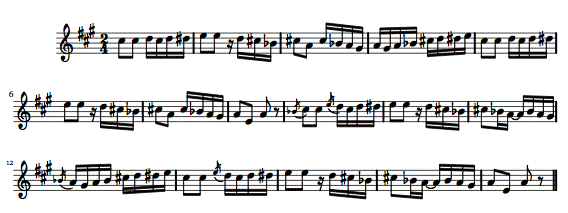




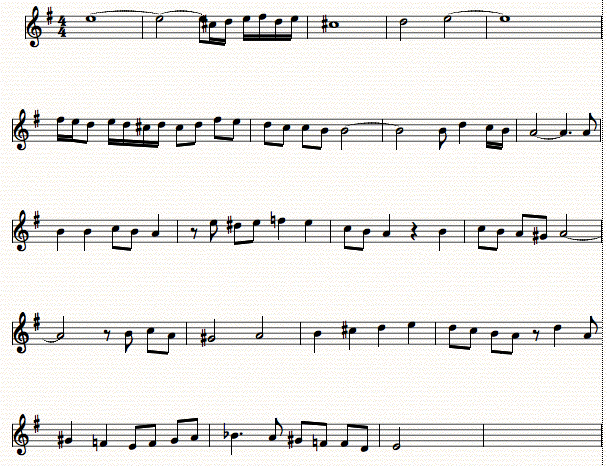



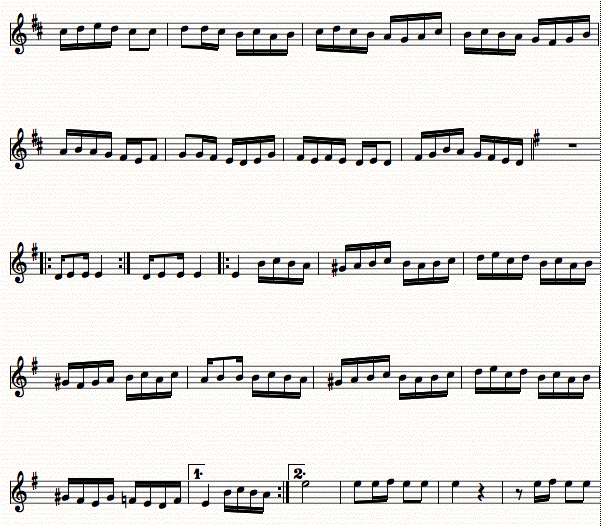




 Loading...

 Posts
Posts


