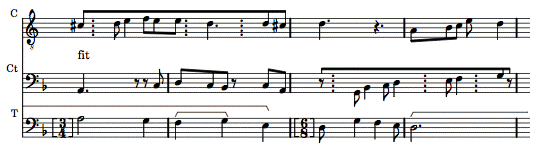
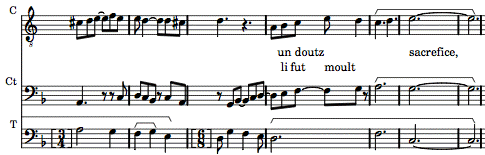
Le basile, like Pluseurs gens voy, counts as Ars Nova rather than Ars Subtilior, and there aren't the rhythmic games hallowed in Subtilior. The rhythms are still wackier than Pluseurs gens: there is enough syncopation across barlines to justify the Mensurstich notation, and there is confusion about whether voices are off by half a bar or not, which the score indicates with alternative barline arrows.
This rendering also doesn't sound quite as smooth, because of clashes in accidentals: the score needs more ficta accidentals than the source transcription shows, but I didn't want to take over with my own editing. And some of the jarring intervals look to be in the source, unrelated to accidentals.
I can't say Le basile has grabbed me in the way the Subtilior pieces have, or even Pluseurs gens: it's not as tight as the latter, and not as funky as the former. But the more musically cluey may think differently.
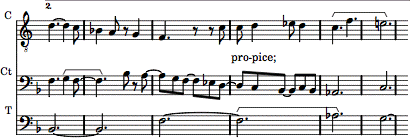
This piece has broken LilyPond, btw, even more than the previous ones: the combination of Mensurstich, changing metres, and syncopation across bars has proven too much for the software, although I haven't been able to replicate the error in a score snippet. So you'll see a couple of barlines within the staff that shouldn't be there—bar 2, for starters.
This is the last of the transcriptions in my friend Christina's Honours thesis. The other pieces definitely by Solage don't present the same rhythmic challenges; so she did not feel it necessary to retranscribe them from the four-square existing score published by Apel. That means I don't get to put Fumeux fume par fumée up; but Daniel Buxeda Rodriguez already has. I think the license allows me to put it up on YouTube as I have the others; I'm checking.
So, if you'll pardon a few wrong notes, and a synthesised French Horn, here is Solage's song on the basilisk:
The scores, midis and so forth are all linked to at my Solage page.
With Pluseurs gens voy, we're backing away from the crazy of Ars Subtilior, going back to what the Ars Subtilior was a mutant offshoot of: the Ars Nova of Machaut. Accordingly, there is less weirdness about the notation in this ballade; the one exception is in the middle section, where the Cantus, and possibly the Tenor, are half a bar off from the Triplum and Countertenor, which in turn are half a bar off from the first section of the piece. This is noticeable, because it is punctuated by rests in the Cantus; but having the first beat of a bar as a rest does not presuppose metrical shift. So it doesn't sound implausible the way the Ars Subtilior shifts do.
Because Pluseurs gens voy is more musically conservative, it isn't as attention-grabbing as the preceding pieces. I don't even remember hearing it in the Gothic Voices recording—it sounded like the Machaut pieces they alternated with Solage's. But apart from what looks to be one complete blunder, it is a tight, smooth block of part-writing, the four voices interweaving at close range, without drawing undue attention to themselves—and not marking time between syncopations as obviously as in the Subtilior balldes. Now that the Cantus has a descant, and there is less rhythmic complexity to deal with, the two top voices are freed up to imitate each other.
(You'll hear the blunder btw: bar 18, the Cantus is c♯, the Countertenor is d. At least that's what my source transcription has.)
In all, it's a serious-sounding, earnest piece—though the lyrics are playful: "I see many people who clothe their thoughts in nice dress; one wears an embroidered cote, the other a villain lined in gray, they wear coats great and small—to each their own: a Jaquette is good enough for me." Where Jaquette was some member of the nobility or other.
This is the third of the Solage ballades, and the tricks of notation get worse and worse. We have one voice in a different metre than the other two (6/8 vs. 9/8, 3/4 vs. 2/2)—and not with the same measure length either; so the bars in the three voices coincide only every three or four bars. Of the two voices that do coincide, one is written twice as fast as the other (6/8 vs. 6/4). We have routine interruptions of bars by other bars, some interruptions running for a dozen bars. We have several runs of 2:3 duplets.
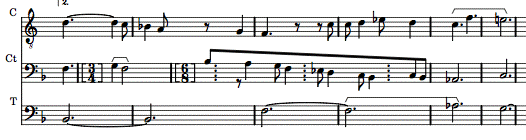
We have interruption a 3/2 bar interrupted by a 6/4 bar, and the next 6/4 bar interrupted by the completion of the first 3/2 bar: We have a 6/8 bar interrupted halfway by 11 bars of 6/8; its completion is another half bar of 6/8, which is itself interrupted by a new bar, one eighth note in: And Solage saves the best till last: the 9/4 cantus runs into... this:
Which is... well, I'm not sure what it is.
1
2
3
2
2
3
3
2
3
1
2
3
2
2
3
3
2
3
1
2
3
2
2
3
3
2
3
2
e2:
f3
a3
g4
f3
e3
e2
d4
d2
c2:
d4
2
f2
a2
g2
e2
f2:
e2
d6
group
group
group
group
group
group
group
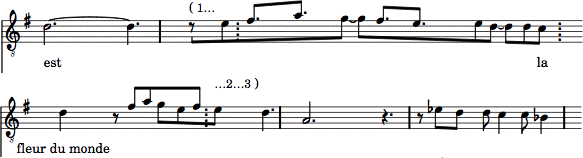
Um. OK.
And what does it sound like? Brassy and fanfaring—as befits its subject matter. (Yolanda Plumley has written on the politics of the song, extolling the Duke of Berry, including echos in its lyrics from other songs in his honour.) Each of the three metre changes sounds like a new landscape opening up before you. The bar interruptions are mostly mid-bar, and don't sound particularly untethered like Corps feminin's—at least until that passage I've tabulated above, which sounds stumbling, because of the alternation of eighth, dotted eighth, and quarter notes. As for the mismatch of metres, the music is slow-moving enough that that passes unnoticed—one of the particularities of Ars Subtilior that's more Gedanken than real.
Calextone has some polyrhythm going on, but the disruptions are localised—they resync after a couple of bars, and the metres are displaced by a beat or a third of a beat, which makes for some very pleasant syncopation. Calextone also has some interrupted half bars, but blink and you'll miss 'em: there's only a couple. So Calextone is a little complex in notation, and sounds recognisable to us.
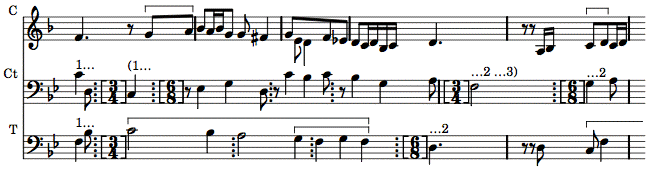
Things with Corps feminin are different. The top voice is passionate and melismatic—and again, mostly well-behaved metrically. The one beat interruptions from Calextone show up again in the cantus, and syncopate it forward as well. But there are also a lot more interrupting half bars, in all voices; so the disruption of the beat in different voices is greater, and lasts longer. Just three bars in, in fact, you get a double interruption in the countertenor, vs. a single interruption in the tenor. Let me illustrate: The cantus is going along with five melismatic bars of 6/8. The tenor does half a bar of 6/8—then switches to three bars of 3/4, and then finishes its initial bar of 6/8. I've inserted "1…" and "…2" to indicate these half bars; Christina had a bracket notation, but that was clashing with the bars used as ligatures, and the point of this notation is to make the original more accessible, not less.
The countertenor, like the tenor, does half a bar of 6/8—"1…", then switches to 3/4. After just one beat of 3/4—"(1…", it gets bored of that, and switches back to 6/8 for three bars. What undermines the double switch to our ears is, his three bars of 6/8 𝄾 𝅘𝅥 𝅘𝅥 𝅘𝅥𝅮 sound like syncopated 3/4 to us now; but switching metres was a way of doing syncopation back then anyway. After that, the countertenor has to sync back up with the other two voices. That means first finishing off the other two beats of his 3/4 bar—"…2 …3)", and then finishing off his original 6/8 bar—"…2"—one measure after the tenor finished his.
I don't know if graphics will make this any clearer, but:
C
1
2
1
2
1
2
1
2
1
2
Ct
1
1
1
2
1
2
1
2
2
3
2
T
1
1
2
3
1
2
3
1
2
3
2
1
2
Why on earth is Solage doing all this? Because he can, of course. And also because the notation made it easy. If you wanted to change from 6/8 to 3/4, all you had to do was change ink colour, from black to red. If it was that easy, and if you were in an experimental phase already, then of course you'd switch ink after one note, just to see what would happen.
And what does it sound like? Like I said, the cantus is impassioned, and its syncopations work. The other voices sound—well, random. They're too displaced to sound syncopated, so they just sound like they're from somewhere else. Not unpleasant, at times effective—but untethered.
The Taruskin Challenge bloggers have a great post on why music historians view the Ars Subtilior innovations with distaste, though in general they approve of innovation. Their take: historians are unsettled by old art that comes too close to contemporary art, and doesn't stay in its historical box. Historians don't like stuff that resists fitting into historical boxes to begin with. There is a lot to this: we can't make sense of music that sounds mediaeval, but is also more adventuresome than Richard Strauss—it disrupts our notion of lineal progress. We're frustrated because we don't see the progress leading somewhere; but where we expect 14th century progress to lead to is madrigals (or, as the Taruskin Challenge say more knowledgeably, John Dunstable before we get to the madrigals); not Stockhausen or Babbitt.
To be fair to ourselves, though, we're also frustrated by the things Solage does, because we can't hear them make any difference. What performance of Corps feminin will bring out the fact that the Countertenor has 6/8 interrupted by 3/4 interrupted by 6/8, and make sure the catch-up half-bars sound like the completions they are? Given that it's just an accompanying voice, what performance *should* bring it out? The syncopation will come through alright; but our ears are ears molded through the path that led away from Solage: can we hear the bar resumption business at all? For that matter, could Solage's audience hear it, as opposed to seeing it? Or to use a fairer example: the first bar of the cantus is in 6/8, the second in 3/4. There's supposed to be a world of difference between Dum-dee-dee Dum-dee-dee and Dum-dee Dum-dee Dum-dee. Can you hear it in the recordings that have ended up in YouTube?
Perhaps, but it's work to bring out the subtleties, even more work to hear them; and these guys are obscure. As the Taruskin Challenge puts it, "a new breed of composers—none of whom are known today outside of the academy". (And these are musicologists to whom Machaut and Dunstable are old hat.)
It's work to transcribe these guys too. I got quite lost in the line above, and that was not as bad as it got; by the second page, I was obligated to break a couple of lines mid-bar. Lilypond was valiantly avoiding it, but it was making its staves a soup of dots; the alternative of course has made its staves a rather thinner broth. The MIDI this time is a prog rock combo: guitar, flute and bass. The default instruments in GarageBand are embarrassing enough that I've forked out the money for the Symphony Jam Pack. So the arrangements from now on will still sound embarrassing, but embarrassing in different ways.
The PDF is available for download at my site, and also at IMSLP.
The Ars Subtilior was a brief period in the end of the 14th century, when composers went nuts. The Ars Subtilior composers wrote music that was more complex that anything heard before—and often anything heard centuries since in Western music: more modulations, more polyrhythms, more music scores shaped as eye music.
It was a short-lived movement, and even its name was bestowed it by a twentieth-century musicologist: the 15th century backed away from its experimentation. Likewise it was a geographically restricted movement: basically the antipope's entourage in Avignon, although one of the Ars Subtilior manuscripts is from the court of the French kings of Cyprus. And it has remained a bit of a niche even in contemporary recordings. CDs are few, and the first CD I knew of played down the intellectual stuff in its selection, in favour of the imitations of birdsong.
I was introduced to the Ars Subtilior by my friend Christina Eira, who I did my linguistics PhD with. Christina had done her Music Honours thesis on a new transcription of Solage's music.
[McCarthy, Eira. 1986. An analysis and alternative system of edition of the seven ballades of Solage, MS Chantilly. BA (Hons) Thesis. University of Melbourne, Department of Music.]
Solage was one of the main composers in the Ars Subtilior school; Christina's transcription aimed to reflect more closely what Solage had originally written, rather than fitting to the expectations of later classical music.
The piece Solage is best known for is Fumeux fume par fumee, "The smokers smoke through smoke", which involves a dizzying series of low-pitched modulations. Annoyingly, it gets more attention for people trying to work out what kind of weed you could get hold of to smoke in the 14th century, so as to write that kind of trippy music, man.
But the piece where the clash between notations is most obvious is Calextone qui fut dame terrouse, "Callisto, who was a mortal lady". The lyrics aren't really the point of Ars Subtilior, but two trends converge in Solage's lyrics: the notion of courtly, romantic love which the troubadours invented, and a proto-Renaissance fascination with Greek mythology. Of course, the actual Zeus did no such thing as make Callisto his vrai epouse "true spouse"; but Zeus' "love-'em-and-convert-them-into-a-constellation" tactics were not much of a topic for a troubadour anyway.
Calextone is in 6/8, and the tenor is mostly slow-moving bass notes. But the cantus strays off from normal 6/8, and the countertenor strays off even more. Beyond the hockets you'd expect in this era of music, there is a middle section where the counterenor is playing 2/2 to the cantus' 6/8. That's a hendiadys (two against three) which isn't that unusual in Western music; but Solage ends up with four beats against three—and syncopation in the four beats, at that. The bass also slips into 3/4 on occasion.
What stands out even more, though, is the cantus and countertenor both interrupting their 6/8, interspersing another new bar off one beat. This happens in the very first bar of the piece:
The cantus starts a 6/8 bar—
gets one eighth note in (1)
then starts a new triplet (1+3)
and another two, adding up to one and a half bars of 6/8 (1+3+3+3)
and then closes off its initial triplet, and catching up with the remaining voices, by adding two more eighth notes (1+3+3+3+2)
So the way it is notated—and Christina's transcription tries to capture—instead of two bars of 6/8, you have half a bar of 6/8, interrupted by one and a half bars of 6/8. This is not as bad as it gets, either. As bad as it gets is further down, when the countertenor does this series of stunts:
gets half a bar in (3)
then switches to a new 3/4 bar (3+2+4)
then starts another bar of 6/8,
gets one eighth note in (3+2+4+1)
then starts two bars of 6/8 from scratch (3+2+4+6+6)
and catches up with the other voices again by filling out two more beats in the interrupted triplet from before (3+2+4+6+6+2)
—while the other voices are not holding dotted half notes, like at the start, but doing their own merry hocketting 6/8 thing, on the beat instead of off it.
This is, like, mindblowing stuff. It's mindblowing enough that the previous editor of Solage, Willi Apel, had no patience for it. I can't scan it in to show you, because the Melbourne Uni Library's copy has gone missing some time in the past ten years. But just as editors don't care about scores being arranged in the shape of hearts or harps, Apel didn't care about this business of interrupting triplets. This is just syncopation, he decided, and that's how he notated it. Which is not doing as much violence to the text as you might think: it *is* syncopation. The new barlines are merely putting into the top voices the metrical context set by the tenor, and it's not like Solage could notate syncopation as syncopation, with the notation he used. And when you hear the music performed, it doesn't sound like bizarre interruptions of bars: it just sounds like 6/8 syncopation. Solage actually gives his game away by starting his off-beat syncopation half a bar before one of his runs of interrupted bars (countertenor, second bar): Or, in a less experimental notation: But the original, polymetric orgy of Solage's Calextone deserves to be seen, so I've put Christina's transcription into LilyPond, and put up a video of the transcription along with the music. LilyPond coped with what I threw at it, although not without some scars. There is no way I could get the final bar to be right justified, and MIDI generation conked out before the end (so there is one countertenor note in the wrong octave).
The lyrics make for unseemly gaps too: the manuscript did not line syllables up with notes, but just dumped one phrase at a time over the music. That's why different performances of Calextone distribute the syllables differently. (Gothic Voices sample, Capilla Flamenca sample.) I tried to reproduce that in Lilypond, which should allow it at least for expressive marks; but that proved beyond me too.
(That lax treatment of text makes for a bad combination with Solange's melismatic runs, and composers at the time were not fastidious about what vowels to do melismata on. /y/ is not melisma-friendly.)
And after repeated frustrations with GarageBand and iMovie, I couldn't be bothered fixing the bar misalignments to the music at the very end. Nor do I feel that apologetic in rendering the three voices as guitar, sax, and bass. I wasn't left with much choice in iMovie 09, which doesn't read MIDI natively, leaving me at the mercy of GarageBand's default instrument selection. (iMovie 09's Precision Editor looks to me a step backward from iMovie 08 anyway, but I get stubborn about things like that.)
After all that, I've put Calextone up on YouTube. It's not as smooth an experience as I'd have liked, and I'd rather you downloaded the PDF, and followed along to a professional recording. Like Gothic Voices', who have recorded all of Solage's works. As of this writing, their recording has been slipped into YouTube as well; but because I'm happy to have forked out the money to buy the CD, I'm refraining from linking to it.
If you do find a vocal recording—like, oh, say, on the Related Clips window of YouTube—it's worth it just to hear the archaic pronunciation of joieux, as [ʒwɛˈjø]. Yes, Solage spoke Joual.
An Index to Alasdair Gray's translation of Dante
-
The late Alasdair Gray posted a translation into colloquial English of
Dante's *Divine Comedy* into English, but it's hard to read on Blogspot
because Blog...
Border patterns … revisited
-
Border patterns, also known as freeze patterns, have been known to humanity
for thousands of years, typically decorating the frame of a painting,
mosaic, o...
The Word becomes flesh
-
What is wanted here is silence.
That the young woman is pregnant is suggested by her unlaced gown, shorter
in front than in back. Her labor has begun, ...
-
I had problems trying to log into Diablo III. I could enter my password,
but when I entered my Authenticator number, I got Error 14009 Can't
download Agree...
A word about Heroes
-
Catherine showed me her homework today and it made me cry. Here it is for
you:
My Hero
A hero is someone that helps people and everyone loves, they are nic...






 Loading...

 Posts


