Blogged elsewhere

Interoppo Research
(IT Standards & Interoperability)

Linking research & learning technologies through standards » Nick Nicholas

Ἡλληνιστεύκοντος
(Greek Linguistics)

Showing posts with label Philology. Show all posts

2011-02-02

Epictetus, Discourses I 1

Well, I don't know if this is a good idea at all. But this is one of my favourite passages of Ancient Greek. Rendered in GoAnimate, with pseudo-Laurence Olivier Text-To-Speech. Epictetus, Discourses I 1, in the Loeb Oldfather translation from 1925.


2009-08-11

Look for Etymologies on the Tiber

The Magnificent Nikos Sarantakos' Blog (to take a break from the problematic of Canada and go back to matters Hellenic) has recently unearthed the origin of that fine Greek apophthegm, πᾶς μὴ Ἕλλην βάρβαρος, "anyone not Greek is a barbarian". (Which was in fact the original definition of barbarian.) The sentence is absent from Greek literature, though the sentiment certainly is not. In fact it's commenters Akindynos, π2, and Δύτης των νιπτήρων who worked it out between them, via Perseus and Google Books: Maurus Servius Honoratus, late IV AD, in his commentary on the Aeneid 2.504.

The apophthegm is tossed in casually to argue something rather far off from Greek ethnocentrism (why Priam would refer to Phrygian gold as barbaric in the poem). So Δύτης των νιπτήρων (or as I like to English him, Ya, Diver of Sinks) speculates this was already an established dictionary definition in Roman times, and that's what's being cited. π2 wonders if it might not be from a philosophy manual of the Second Sophistic, since they still found something novel and exciting in binary opposition back then.

The use of πᾶς μὴ Ἕλλην βάρβαρος in Modern Greek schooling, first as a corroboration of Greek nationalism, then as a slight embarrassment, is a separate issue, though an issue not a million miles away from the negative definitions of nationhood I've been stumbling around.

I'm about to write a post at the Other Place on a Modern Greek word for (we think) dormouse showing up in a Byzantine dictionary, and how at least one Italian classicist utterly ignored Modern Greek in trying to work out what it meant. The dictum for that blunder is, "Look for Latin Etymologies on the Tiber".

So I decided to sleuth this saying myself.

There's a smattering of instances online; not as many as you might expect, given this is really a cliche in historical linguistics.

Google Books quickly hones in on a direct and an indirect origin for the saying:

  • Gregory Nagy, Homer's text and language, 2004, p. 137.
    Palmer once called attention to "the first rule of etymology," attributed to Franz Skutsch: "Look for Latin etymologies first on the Tiber. ..."

  • Refining search: Leonard Palmer,
    The interpretation of Mycenaean Greek texts‎
    , 1963, p. 187:
    there is yet another fundamental principle, which was given pungent expression by Franz Skutsch : 'Look for Latin etymologies on the Tiber.'

  • He's citing himself: Leonard Palmer, "The Indo-European Origins of Greek Justice", Transactions of the Philological Society, 1950, p. 158 fn. 3:
    In this paper I have followed the advice of Franz Skutsch, who once said that Latin etymologies must be sought on the Tiber.

  • That's the kind of throwaway footnote that does end up a meme. So what did Franz Skutsch actually say? Luckily his Kleine Schriften have been Googlified...

... and what he said is a little less apophthegmatic, and a *lot* cooler. Here's the Google Book search result: snippet, but it will do. Kleine Schrtiften p. 214, 1914 (posthumous edition):

... daß man besser tut, Spaziergänge am Ganges, am Plattensee und in ähnlichen Gegenden zu unterlassen, bis die Wege am Tiber alle untersucht sind.
It'd be better for people to avoid going for pleasure strolls on the Ganges, Lake Balaton [Hungary], and other such regions, until ALL the pathways around the Tiber have been searched through.


Yeah, preach it!

2009-06-10

Chioniades and Wilbour Hall

Our story's not about him, really, but in the Year Of Our Lord 1295, Gregory Chioniades [Bio Enc Astronom, Wikipedia] went from Trebizond to Tabriz, to learn astronomy at the feet of the Persian masters. When he got there, he set about translating the Arabic Zīj al‐ʿAlāʾī under Shams al‐Dīn al‐Bukhārī. We're reasonably sure he set about translating via al‐Bukhārī's Persian dictation, because this translation from Arabic has several bits of undigested Persian in it. Including ἀζάνη az āna (hence) and ταχούμ dahūm (tenth).

Chioniades had a lot more chunks of undigested Arabic in it, which is expected, because astronomy was an Arabic affair. If astronomy was a Greek affair, he wouldn't have come to Tabriz, he'd have stayed in Trebizond and brushed up on his Ptolemy. The problem is, Chioniades should have brushed up on his Ptolemy anyway, because the undigested Arabic does not include words you'd expect, like azimuth, nadir, and algebra. It includes words you wouldn't expect, like ἄουτζ awj (apogee), ἀφλάκ aflāk (spheres), τερίχ ta'rīkh (chronology), κουσούφ kusūf (eclipse). Chioniades did eventually do the brushing up he needed to, so his subsequent translations are more Greek-compatible.

Our story's only tangentially about him, but in the Year Of Our Lord 2007, the Blogger Writing These Lines was hacking away at the vocabulary of Greek unrecognised by the TLG lemmatiser, and came across the first of a series of a sizeable number of undigested Arabic words. This led him to the glossary in the edition of Chioniades by David Pingree, and our story is more about him. David Pingree [see also autobiog], head of the Department of the History of Mathematics, was a gentleman with Old School erudition. Beyond mathematics and astronomy, he was conversant with Greek, Latin, Sanskrit, Arabic, and Assyrian; and he translated source texts in all of the above.

The undigested Arabic was in Volume I of Chioniades' Works, which Pingree published in 1985 (book review). There was no Volume II published. Pingree died in 2005, and there was no Brown Department of the History of Mathematics any more. So it looked like there would be no Volume II any time soon. And that, it seemed, was that.

About a week after making this melancholy determination, I was googling Archimedes for some reason or other—maybe his Doric, maybe his palimpsest; and I feel across a web page including PDFs of him. Whoever put this web page together was furious with the poor quality of the Google Books digitisation of Archimedes (the 1904 edition, not the palimpsest). He was furious enough that he rescanned the more distorted pages of Archimedes, and when that didn't work out, he LaTeXed up what was missing. This was impressive enough for me to poke around the chap's web site.

The chap, who goes by the name of Joe Leichter, was not just any Online Mechanical Turk with too much time on his hands. He was one of Pingree's last students. He has put up the Wilbour Hall web site, named for the now defunct Department of the History of Mathematics at Brown, and containing mountains of mathematical texts in Greek, Arabic, Sanskrit, and Latin. And coming out soon was the published version of his PhD: Gregory Chioniades, Collected Works, Vol. II. (Site currently down, and the archive.org copy of the book looks empty, but it was a forthcoming publication.)

Yet the story isn't just about someone picking up Pingree's legacy and running with it. The story is also about what someone picking up Pingree's legacy does for a day job, now that there is no Department of the History of Mathematics at Brown (or that many other places). The answer is, he works for a while at Goldman Sachs, and now teaches computing to law students at the University of Virginia. And from what I'm seeing on the googleage, he's still doing scholarship for the masses.

Joe Leichter is a mensch, born in an age of midgets. I don't know the man, I don't know his circumstances, I don't have his leave to make him a poster boy for the commodification of academia. I can only infer from his accomplishments, and my resentments. In an age when departments of the history of mathematics are museum pieces, when universities award linguistics degrees without a single mention of Verner, when canons have been deconstructed so long that students can't name who was in the canons to begin with, when humanities are a stepchild luxury—and don't you fricking dare smirk, scientists, YOU'RE NEXT—in such a world, there are still Pingrees. There is no place for Pingrees on campus. So the hardier of them will keep doing what they do, off campus. (The rest will at most run occasional blogs on Greek linguistics...)

The world is upside down, and will only get more so. If it's not googleable, it doesn't exist. That's calling much of the scholarly publishing market into question, and the medical payola scandal at Elsevier calls into question the remainder. Just found out about this today, and I'm still in shock. Journal publishers don't disseminate as broadly as a PDF on a website + google, and noone cares about long-term availability anymore (not even the publishers, shirking away from paper): scholarly publishers' key selling point now is their imprimatur, and once you piss that away through payola, you don't recoup the loss of authority by blaming a rogue Australian subbranch, with staff who've since left your employ.

How far away from that is the university as an institution of legitimation? Grades aren't always earned; students don't see the academics off researching; the researchers are busy inflating publication counts, and enrolling graduate students by the dozen with no expectation of them staying in the system. It's corrupt; and it's always been corrupt, even if in different ways: for today's malnourished army of TAs and RAs, and PhDs deserting to publishing, we had the malnourished vagantes, and streetfights around the University of Paris. The difference is, there's competition now. If universities don't do History of Mathematics in-house any more, the few that care about it will get their information outside universities. Via Wikipedia. And if it happens for the History of Mathematics, it will happen for Mathematics, and Linguistics, and whatever else you can get online. Whether for knowledge, or for certification. [EDIT: Editorial in the Australian, right on cue.]

The world is upside down, and will only get more so. Joe Leichter will make his way through it; it may or may not be the way he chose—it wasn't the way I chose, after all; but it looks like he'll keep giving his scholarship, even if that isn't for the sake of a career path. For that, hats off.

2009-05-20

The Ibycus mainframe

In re:
TLG: Ibycus

The Ibycus computer was what Thesaurus Linguae Graecae data crunching got done on throughout the 1980s and 1990s. It was the stuff of legend, an HP 1000 customised in David Packard Jr.'s garage, with spelling and format checkers and text editors in assembler, that crunched through tens of millions of words of Greek in its own temperature controlled room.

It's also the stuff of legend featuring in the "Lernaean Text" (or Hellenic Quest text), the long-running and indefatigable distorted urban legend doing the rounds of the Net for years, claiming that Ibycus (or Imycus) has determined that Greek has 90 million* distinct words. It also says that Bill Gates wants his programmers to program in Ancient Greek, John Sculley is still running Apple and publishing with CNN (?) the Hellenic Quest software to teach the world Greek, and Greek words have deep cabbalistic meanings and no arbitrariness of signs. That's why Nikos Sarantakos calls it Lernaean: however many times you cut off its head (including refutations by the TLG itself), it keeps coming back, because enough people want it to be true.

In the real world, the TLG as of this writing has around 100 million tokens [instances of words], 1.5 million types [distinct words—as in  run ran or ἄνθρωπος ἀνθρώπου] and (depending on how you count them) closer to 200,000 lexemes [dictionary words]. The count will go up as the TLG expands coverage, and the lexeme count will vary with different decisions on how to treat words. The lemmatiser currently tends to conflate variants for more hits in searching, so the count will be on the low side (though I'm including some 30,000 proper names, which is strictly speaking cheating). Still, in the real world, I don't see how anything will take that count from 200 thousand to 90 million. And for strictly classical Greek, it'd be only a little over half that...

In the real world, too, Ibycus was just a mainframe, not the harbinger of a New Hellenic World Order; and my first task when I joined the TLG in 1999 was to help decommission it. The TLG texts were being copied off Ibycus to machines with 8-bit bytes in February when I got there, and my first job was to finish writing replacement format and spell-checkers on PC. Ibycus was unplugged and removed in late 1999, and the TLG page on Ibycus shows the removalists at work. (Unfortunately the machine got damaged in the process, and the TLG couldn't find a museum willing to house it.)

I did have some other photos of the box from 1999, though:


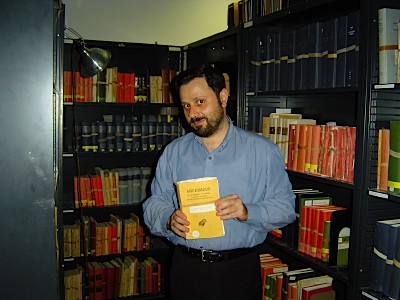
That's me, trying to lay down the law to the HP 1000...

[* EDIT: Had typo'd to "90 distinct words", and thank you to dokiskaki for pointing that out. 90 distinct words would certainly have made life much easier...]

2009-04-01

Scythians

From the Suda On-Line project I contribute to, a cloyingly heartwarming anecdote from the historian Phylarchus:

The Scythians, when they were about to lie down to sleep, brought the quiver, and if they happened to have passed that day unharmed, they placed a white pebble on the quiver, but if [things had gone] troublesomely, [they placed] a black one. Accordingly, in the case of men who were dying, they brought out their quivers and counted the pebbles; and if many white ones were found, they declared the departed fortunate.


When I relayed this anecdote to my long-suffering colleagues (who have to endure every randomness that strikes me online when I should be working, and may well keep a mental stock of black pebbles for when I do), one wondered that that quiver might get pretty damn heavy after a while. The other pointed out that with pre-Classical average lifespans of 30 (especially for warriors), and entering into service at 18, they wouldn't get that heavy.

Hand me my back of an envelope: 12 years, 365 days, 1 g a day: 4.4 kg. Quite doable. More realistic for pebbles, 20 g a day: 87.6 kg. There may be some implementation issues to address with the anecdote. Could the Scythians have pebbles on credit perhaps?


He also suggested this would make for a good white-pebble applet. If anyone out there feels like warming the hearts of their fellow human beings, I claim no copyright (especially since it was my colleague's idea anyway).

(I see Phylarchus has already been blogged... Ah sod, the hippies have already gotten to the notion...)

Friends wot blog

Twitter Updates

Calendar