Blogged elsewhere

Interoppo Research
(IT Standards & Interoperability)

Linking research & learning technologies through standards » Nick Nicholas

Ἡλληνιστεύκοντος
(Greek Linguistics)

Showing posts with label Information Technology. Show all posts

2009-12-28

NZ #1: Wellington (with no mention of Wellington)

I salute you, those of my readers who have not already wiped me from their RSS feeds. A couple of months of radio silence have passed: once again Your Correspondent has fallen off the blogging bandwagon, as has happened before and may well happen again. With the benefit of paranoid introspection, I can even venture a guess as to why I'd fallen off the blogging bandwagon, after returning from New Orleans. Although, Dear Remaining Reader(s), neither of us are inebriated enough yet that I can divulge why.

Not that I can tell this side of the Intertubes, anyway.

But lapsing in blogging calls for drastic measures, to restore my voice and pedantry to the Ether. And so it is, Dear Remaining Reader(s), that I am typing these lines from Cuba St, Wellington, New Zealand.

Following the pattern that sees me find more oddity to blog about when I'm out of the country, I have just hauled myself to Aotearoa, for the next 18 days. My connectivity will be spotty: I'm already having; to rely on citywide commercial Wireless, rather than anything in my hotel, to get online. So there'll likely be less hyperlink treasure trove goodness than usual this time around in my posts.

(The wireless provider I'm resorting to is CaféNet. Of course. It *is* Wellington, after all, and Wellington deems itself to be all about coffee and Peter Jackson.)

A drastic solution to a blogging lull, perhaps, going across the Tasman Sea; and that's not quite the reason I had bought the airline tickets. What was more of a reason is, I am embarrassed to acknowledge that I know exceedingly little about the sister country next door. As is the norm for someone from an elder sibling country (US vs Canada, Germany vs Austria, Greece vs Cyprus, Brobdignag vs Liliput). To rectify that, I'm doing what Australians abroad tend to do: I'm going to entirely too many places in entirely too short a time. The itinerary, as far as I can tell right now, is:

  • Wellington
  • Auckland
  • Wellington again
  • Nelson
  • Blenheim
  • Christchurch
  • Akaroa
  • Oamaru
  • Dunedin
  • Queenstown
  • Tourist Daytrip stuff in the vicinity of Queenstown
  • Wellington Schon Wieder Mal

Lots of downtime in buses. Good thing I'm typing this on something portable.

And while I could spent my first blog post in New Zealand writing about the three-dimensional picturesque of the Wellington back hills, instead I'll write about what I'm typing this on.

You'll recall that I had purchased a 9″ eeePC in Heathrow in March. I didn't actually need an extra laptop, what with me already onwing a 13″ MacBook, which was plenty portable. Nor did I really live out the dream of taking my eeePC to the café or the park, and communing in agile computational portability against a backdrop of live people walking around. And the 9″ keyboard was just that little bit too small to type on comfortably anyway. At least I'd bought an ex-display model, so I hadn't broken the bank.

Persons unknown, and possibly affiliated with the security scanning of my suitcase in LAX, took care of the 9″ eeePC conundrum for me. Once back, I had no 9″ computer, and no 13″ computer. I did have a 15″ MacBook—lovely screen, can almost put two documents side by side, but just that little bit too large to whip out comfortably in public transport—and utterly impossible in planes. Which means that now there was an ecological niche around me for a Netbook after all.

I still didn't actually *need* a Netbook, as such; but in a bout of Holiday Retail Therapy on Boxing Day, I picked up an eeePC 1000H. At 10″, it confirmed what my colleague Steve found when he purchased his 10″ model: the 10″ keyboard is almost comfortable to type on. And mercifully, once more, I got to pick up an ex-display model. It still cost a smidgeon more than last time, and I still don't actually need it...

... but this one's black. I mean, that's got to count for something, surely.

It's also reimmersing me into the world of Linux. The world has changed since 2007, when the eeePC was introduced. Then, there was a serious prospect of Linux (or at least the preinstalled Xandros version of Linux suitable for children and small animals) making serious inroads on the netbook market. A year later, no computer retailer in Australia was selling anything on the eeePC but XP Home. But my household does not enrich the coffers of Redmond. And the Hackintosh on eeePC, which you get when you bit-torrent Some Guy's edit of MacOSX, cudgel into the eeePC as long as it isn't a 900, and cross your fingers, remains what it was a year ago: just like a Mac netbook, only crippled. Having to type in my wireless password each time I wake the computer from sleep really is a deal breaker.

So, I've hoisted eeebuntu onto the eeePC. Which has made my reacquaintance with the world of 1GB distros and 1GB system updates.

Short of an initial hiccup or two (as is inevitable under Linux), the installation has happened, and in all it's a pleasant surprise how much Linux can do these days. The essential software is all there, and Linux even manages to communicate to my digital camera. The applications I've ended up with are rather more opaque to me than I'm used to; I don't yet know what the division of labour is between Banshee Media Player, Rhythmbox Music Player, and gtkpod iPod Manager. And I'm not sure I'm going to feel compelled to find out. But the machine is doing what needs doing so far, and I'll be giving it the baptism of fire over the next couple of weeks.

I've managed not to post about Wellington, and I'm already in Auckland tomorrow. Must post about Maori TV soon though. The mix of classical anchorwoman cadence and tribal warrior metaphor in the sports news certainly took me aback:
"Is Britney Teei old enough to understand that she must regain her mana at the Māori Tennis Championship?!"
There was enough cultural weighting to make the Maori News feel quite alien. And that's greatly cool: alienness in this age is something to be cherished. I think I'll be spending a lot of time watching Maori TV while here.

(And is it just me, or does Maori sound unexpectedly like Japanese? Not just because of the CV syllables either. I swear that u was unrounded...)

Also nice to know Kiwis deride Australian accents on their TV, just as we deride theirs on ours. Ad for Australian Gladiators just came on (not on Maori TV). In a whiny, nasally, Dave Hughes kind of voice:
"Everything's Big in Australia! Big Muscles... Big Talk... and Big Idees!"
To explain: Australians love to deride the New Zealand backing of [ɪ] to [ɨ], immortalised as "fush and chups". Across the ditch, of course, the Australian [ɪ] sounds ridiculously fronted, as in "feesh and cheeps". (Yes, Australians sound to New Zealanders like Speedy Gonzales.) And if that's how Australians sound to New Zealanders, then it has to be idees, and not ideas...

OK, midnight NZ time. More later. Preferably not another two months later...

2009-09-25

Summer Glau's Uncanny Valley

No, I'm not referring to a TV actress' cleavage. In truth, I don't even know whether Summer Glau has a cleavage. No, I'm talking about the robot she portrayed on Terminator: The Sarah Connor Chronicles.

(A post on a TV show?! Well, this is the personal blog, not the linguistics one.)

I don't much watch television at all any more, and when I do, having been washed aside and left behind by mainstream culture, I usually freak out. The double of Shameless and Skins, for example, made me swear off TV for a month.

A couple of nights ago, in taxation-forms-avoidance mode, I switched on the TV and fell upon the start of the Demon Hand episode of Terminator. I vaguely knew the series existed, but had never seen it, and has certainly developed no empathy for its cast of justified psychos. But even if I had, my freakout would have been just as complete. And this is to the scriptwriters' great credit. Man, do I hate them.

So, story is this. The cast of justified psychos is joined by Summer Glau's Cameron, a Terminator sent Vrom Ze Footchar to protect the Messiah kid. The Terminator is a robotic killing machine, as all Terminators have been, even when they grow up to become Governators. There's a little bit of TNG Data humour about how socially maladjusted she is, but the episode still reminds you she is a killing machine. Without her killing anyone.

At least, without us knowing that she killed anyone. I missed the subtlety of this when watching, but Cameron turns up back at Justified Psycho Manor in a cop uniform, and Sarah Connor deadpans:

Somewhere in an alley a naked cop lies bleeding.

Because Cameron had not walked out of Justified Psycho Manor in a cop uniform; if the robot needs a disguise, she'll beat it off you.

So. Cameron is on a mission to retrieve some McGuffin or other, and the Russian dude who knows the McGuffin's location is on the run from the Russian mafia. To find out where the dude is, Cameron joins a ballet class, run by the Russian dude's sister. "You haff donne ballet beforr," Teacher notes. "But yor upper body iss too mekenical, you kno?" Ha de ha. "This dansse is the pas de chat. You are a cat." "I am... a cat." Heh.

On her second visit, Cameron observes Teacher dancing, then kicks away a mafioso threatening Teacher, and having established her bona fides, asks to see Teacher's brother.

They go to the brother, he's freaked out that they could have been followed, no, no, Teacher assures him, she can help us—tell him.

Where is the McGuffin? Cameron asks.

At XYZ, Russian dude replies.

Cameron has the information she needs. Out she walks.

"But you said you'd help us!" Teacher screams.

And the camera follows Cameron, walking down the stairs nonchalantly—no, robotically—as two mafiosi, one in ponytail, run past her, bust in the door, bang bang bang, screams, bang, silence.

"Is he dead?" Sarah asks when Cameron returns to Justified Psycho Manor.

"Yes. His sister too."

"Did you kill him?"

"No. That wasn't my mission."

At the end of the episode (where much more happens, but I'm still freaked out about the outcome of that mission), Sarah voiceovers clunkily that no robot could ever create art, and if they did, they'd be us, and we wouldn't have to fear them any more.

As the voiceover drones on, Cameron puts on her ballet shoes, and dances ballet. Psycho Human Vrom Ze Footcha, who hates robots, is watching her in terror.

As always happens when I am freaked out by TV—indeed, whenever I watch TV at all—I went to the internets for edification, and read the entire Television Without Pity forum on the episode. So this following insights aren't primarily mine, it's synthesised from the discussions there.

The Psycho Human Vrom Ze Footcha may have been freaking out because Cameron is dancing to the same Chopin piece that he had been tortured to in a previous episode. But the episode gives plenty of reason to freak out anyway. Summer Glau was in fact a dancer before an injury redirected her to acting; I don't get ballet, but I'll take the forum members at their word that she did a good job.

Forum members castigated the voiceovers as being obvious and sledgehammer. But in this instance, there's satisfying layering going on, as one poster worked out. (Sorry, I won't go through 20 screenfuls again to work out who.) Sarah's voiceover is not the omniscient narrator's, and she's belied—and then unbelied—by what we've seen. "A robot cannot create art?" Cameron's dancing ballet of her own accord right in front of us. "And if a robot can create art, we need not fear them, they will have become us?" A robot dances what she was taught by someone, whose death she saw no reason to prevent: that's a robot you very much need to fear.

(One forum member went even further: if the robots do become us, they become as violent and irrational as us. Only stronger. Even more reason to fear them.)

That was brilliant of the series. Deep and challenging, the way I had not seen in a long while. Better even than Star Trek's Data—who the forum participants kept citing as an exemplar to avoid for Cameron ("I hope they don't Data her." Harsh, but possibly fair.) It's not tragedy in the proper sense, because the ballet teacher had no tragic flaw; but like tragedy is supposed to, it evokes pity and horror and meditation on one's lot.

And I'll switch the channel if Terminator: The Sarah Connor Chronicles comes on again. It utterly freaked me out.

My only contribution to all that is to note that:
  • My immediate reaction was, "You're a monster, and that annuls any beauty in your dancing". (One forum poster went there too.) But I'm not convinced that's true. Nazis loved music, at least one composer has been a murderer. And while what Cameron did was horrific, it was well within the bounds of human behaviour.
  • What particularly gets me about the ballet teacher being gunned down, as well as the computer guy? The art nexus—kinda obvious from the scriptwriters, but that's how the Big Questions get posed. The fact that we see the Teacher on screen a lot more this ep than the brother, and Cameron had saved her earlier on.

    But also, that the baseline ethics captured by Asimov's Three Laws of Robotics (Law #1:"A robot may not injure a human being or, through inaction, allow a human being to come to harm") are trumped by the elemental ethic of Game Theory. Not the Golden Rule, "Do unto others as you would have them do unto you", but the even more basic: I did you Good, Now You do me Good. I did you Ill, Now You do me Ill.

    Of course, the Three Laws of Robotics are an encumbrance to a killing machine sent Vrom Ze Footchar, and they're an encumbrance Asimov had already envisioned in his Zeroth law, which takes precedence: "A robot may not harm humanity, or, by inaction, allow humanity to come to harm." Still, it was horrible to watch her walk away, and even more horrible to watch her dance. As the scriptwriters intended.
  • Robotics people, and animators, have encountered the phenomenon of the Uncanny Valley. If our robots and animations look not really like us at all, C-3PO and Toy Story, we're amused. If they look almost like us but not quite—Actroids, Beowulf the Movie, we're repulsed. The Uncanny Valley is a valley, because that's the dip in emotional response as simulations look more human, and it's uncanny, because that's our emotional response. Several psychological motives have been proposed for this reaction, but surely part of it is, we are realising something alien is trying to fool us into passing for one of us.

    With the ballet teaching and ballet dancing, I submit that Psycho Human Vrom Ze Footchar (and I so did not recognise Brian Austin Green twenty years on)—is having that kind of Uncanny Valley moment. In the moral rather than physical domain.

It's been two years since this ep screened Stateside; but belated Props to the Television Without Pity forum members, for some high quality discussion. Inamongst the ogling of Summer Glau's bum. I hadn't noticed; I guess she's not my body type, or something. Or maybe I just completely don't get ballet.

Or maybe it was still that Uncanny Valley thing. In which case, even more Props to Summer Glau, for convincing me she is a monster as Cameron.

2009-08-26

Spokesblogger for a Nation

Montreal airport has the same Canadiana as Toronto airport. Airports sell humorous quirky takes on the local culture to inform the curious tourist—The Undutchables was all over Amsterdam airport. Toronto surtitled its Canadiana "Like Maple Syrup for the soul". Montreal surtitled it "Comme sirop d'érable pour l'âme". But it was the same English-language Canadiana in both places, with Anglo writers celebrating an experienced, real culture—Anglo-Canada; and making some marginal befuddled comments about the other Canada. They weren't about some abstract Francanglo-Canada, and weren't giving equal time to both.

Selling just Anglo-Canadiana in Trudeau airport is short changing Quebec within Quebec (though on federal land, to be sure). But it's not Douglas Copeland's and Will Ferguson's fault they didn't talk about Franco-Canada: they wisecracked about the culture they lived in, and they lived in one culture. The onus on the airport, if they really wanted to merit translating "Like Maple Syrup for the soul" into French, was to seek out Franco-Quebecois and Acadians to do the same for their culture. In English, because that's what international airports trade in.

Something like Chiac pour les Dummies, for instance. If only it actually existed. From the guy who brought you Acadieman:

Angry French Guy has mused that he wanted an English-language medium for Quebec to propound its story to the world, because English is what you propound in to the world now; and the Montreal Gazette wasn't it, because it was the medium of the Anglo-Quebecois minority, not of the (majority-French) whole province. The commenter's vision in that thread of a committee of 20, with an Inuit and 16 Francos, sounded plenty unworkable to me. But in the new media dispensation, that English-language medium propounding Quebec to the world gets to be Angry French Guy, and Chronicles of a Pure Laine, and Sovereignty en anglais. And the world—or those of the world that care enough—compare notes with Fagstein, and No Dogs Or Anglophones, and the other minority voices. A statist solution won't get more readers in than Angry French Guy's own use of anecdote and cartoons.

(Fagstein is miles apart from No Dogs, of course (and I no longer follow the latter), and Fagstein is not even tangentially about the National Question. But one of the few times he waded into that issue, on the occasion of the proposal of a .qc internet suffix, he got a cup of Angry French Guy's ire. I'm with Fagstein on internet suffixes btw; but then, I never said I was NOT an evil angryphone... I'm assuming it's all good between them now, at any rate: AFG confers on Fagstein his highest blogroll accolade: "Some Anglos who don't (always) suck".)

In the new dispensation, people looking for explication of some exotic locale don't just look to the academic or the foreign correspondent exegete. They'll google and go to a blog as well. But to do the exegesis of exotic locale X, the blogger has to be fluent enough in English—not just linguistically but culturally—to be engaging; and patient enough to explain things the locale-Xian tires of justifying.

That doesn't just apply to Franco-Quebec, but to any number of cultures you may not be familiar with. Including native speakers of English of course. It's part of why Ta-Nehisi Coates is on my blogroll. That, and he's an amazing writer who does brave explorations of empathy and working the world out as he goes. All the more rewarding when he hits the limits of where empathy can reach, and explains how.

In the new dispensation then, if you as a clueless Anglo want to understand Quebec, you don't just go to Ramsay Cook (which I did) or Jane Warren (which I haven't yet, *very* embarrassingly: I'll explain why later). You (also, or first, or only) go to Angry French Guy. Whether he intended it or not, he's a spokesperson for Quebec. From what I gather, he did explicitly intend to get the Franco-Quebecois perspective out there in English, to counter a deluge of Anglo-Canadian attacks in English. But that makes him a spokesperson for Quebec anyway.

Just like happened with the Iceland Weather Report. When a friend of mine went to Iceland for her postdoc a couple of years ago, I googled around to see what she was getting herself into, and happened across this blog. Informative and quirky, written by an Icelander who was, like AFG, linguistically and culturally fluent in English, and a very engaging writer. She did not volunteer to be Spokeswoman for Iceland, and I shouldn't be sidestepping the Icelandic blogosphere to single her out as the Spokeswoman—any more than Ta-Nehisi should be the only African-American writer I ever read, or I should assume AFG is the only Franco-Quebecois voice of Quebec, and ignore the riches of the French Quebecois blogosphere (which I did briefly tap into at the start).

But I don't read Icelandic and am not going to. So it was easier for me to treat Iceland Weather Report as my go-to source for all things Icelandic. Lazy, but explicable.

Iceland Weather Report was quirky and fluffy and intriguing in the start of 2008 when I popped over, to find out what on earth was the deal with the New Year's fireworks, and how does French cuisine work out when you have to ship in all your ingredients. Our intrepid correspondent was even taking to calling her country Niceland and sounding only mildly ironic. And the blog still is quirky and fluffy and intriguing.

But later in 2008, when I'd tuned out of Iceland, a small financial disruption hit the country; and though our correspondent was not an economist, or a pundit, or an Icelandic political blogger, this financial disruption affected her too, as an Icelandic citizen, and she posted about what things looked like from where she stood.

This got her lots of English commenters with pitchforks, since the UK government had decided Iceland was the New Al Qaeda. Because those English commenters, like me, googled the first English-language blog on Iceland they could find, to work out how this country had evaporated their life's savings, and they were going to let her know it. This also got her some editorial spots in the Guardian—because Guardian journos, just like Englishmen with pitchforks, googled the first English-language blog on Iceland they could find. (That shouldn't come across as a diss: she is an excellent writer, and she deserved the editorial spots.) And finally, it got her sullen phone calls from the Icelandic Central Bank, peeved that she was bringing their country into disrepute internationally with her humble blog.

A lot of unasked-for power and notoriety, for someone who just happened to be explaining the Ways of Nicelanders to Anglophones. To deem her a spokesblogger is a superficial approach to a diversity of opinion and experience, and an absurd expectation to place on any individual; Ta-Nehisi Coastes angrily dismisses that kind of talk, and I don't blame him. But that's the new media dispensation, and that's what Englishmen with pitchforks are googling for.

For all I know, there may be bloggers in Icelandic just as peeved as the Central Bank, that Iceland Weather Report is getting all this attention and they're not. That doesn't mean she should stop doing what she's doing; on the contrary, the new dispensation means you need more people like her to get your message out. And unlike the 20-person panel mooted at Angry French Guy, you can't control what they say; you just hope they're on your side. And that they're fairly representing to the Anglophone world the range of what the Icelandophone blogosphere was saying (as the Weather Report does).

It occurred to me that this Spokesblogger For A Nation thing was taking hold when, just after I revisited the Iceland Weather Report, a commenter on Angry French Guy linked to a short video on one of the balancing acts in the use of public language in Quebec. The video featured as its talking heads an academic, a government official (I am still bowled over by the Quebecois accent), a couple of Anglo activists—and Mr Angry French Guy himself. Who was not wearing a luchador mask (if that's what the avatar is).


AFG didn't ask to be a talking head when he decided he was sick of the Anglo editorialising on the radio, and was going to start writing online. But he's a good writer and a thoughtful critic, and has a substantial following. He deserves to be a talking head as much as the other people on the doco. Not inerrant, not without his blindspots—but then, I don't expect godhood of my talking heads, I expect thought and challenge, and he delivers.

The doco was a bit He-Said She-Said, I gotta say, although it did successfully point out the delicate balance which satisfied noone, of creating "French Spoken Here" signs but not mass-distributing them. But at least I found out from the doco what on earth AFG meant by NDG being where he lives.

(And—unsolicited advice here, I know—NDG means living in a fairly Anglo neighbourhood apparently (Deepest Darkest West Montreal), but AFG doesn't need to bring that up as a defence. If what he's saying is fair to the Anglophone minority in Quebec, it should stand on its own merits as an argument, even if none of his best friends are Anglo. :-)

2009-05-20

The Ibycus mainframe

In re:
TLG: Ibycus

The Ibycus computer was what Thesaurus Linguae Graecae data crunching got done on throughout the 1980s and 1990s. It was the stuff of legend, an HP 1000 customised in David Packard Jr.'s garage, with spelling and format checkers and text editors in assembler, that crunched through tens of millions of words of Greek in its own temperature controlled room.

It's also the stuff of legend featuring in the "Lernaean Text" (or Hellenic Quest text), the long-running and indefatigable distorted urban legend doing the rounds of the Net for years, claiming that Ibycus (or Imycus) has determined that Greek has 90 million* distinct words. It also says that Bill Gates wants his programmers to program in Ancient Greek, John Sculley is still running Apple and publishing with CNN (?) the Hellenic Quest software to teach the world Greek, and Greek words have deep cabbalistic meanings and no arbitrariness of signs. That's why Nikos Sarantakos calls it Lernaean: however many times you cut off its head (including refutations by the TLG itself), it keeps coming back, because enough people want it to be true.

In the real world, the TLG as of this writing has around 100 million tokens [instances of words], 1.5 million types [distinct words—as in  run ran or ἄνθρωπος ἀνθρώπου] and (depending on how you count them) closer to 200,000 lexemes [dictionary words]. The count will go up as the TLG expands coverage, and the lexeme count will vary with different decisions on how to treat words. The lemmatiser currently tends to conflate variants for more hits in searching, so the count will be on the low side (though I'm including some 30,000 proper names, which is strictly speaking cheating). Still, in the real world, I don't see how anything will take that count from 200 thousand to 90 million. And for strictly classical Greek, it'd be only a little over half that...

In the real world, too, Ibycus was just a mainframe, not the harbinger of a New Hellenic World Order; and my first task when I joined the TLG in 1999 was to help decommission it. The TLG texts were being copied off Ibycus to machines with 8-bit bytes in February when I got there, and my first job was to finish writing replacement format and spell-checkers on PC. Ibycus was unplugged and removed in late 1999, and the TLG page on Ibycus shows the removalists at work. (Unfortunately the machine got damaged in the process, and the TLG couldn't find a museum willing to house it.)

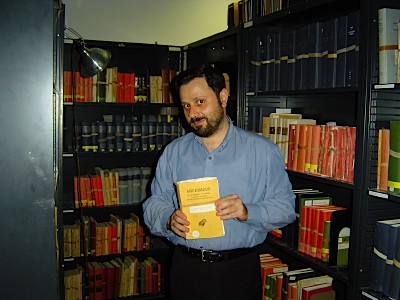
I did have some other photos of the box from 1999, though:


That's me, trying to lay down the law to the HP 1000...

[* EDIT: Had typo'd to "90 distinct words", and thank you to dokiskaki for pointing that out. 90 distinct words would certainly have made life much easier...]

2009-04-26

Death of the Library as I knew it

Extended radio silence, dear readers, has been in part because I was putting some work into my Greek linguistics blog, including finally getting round to typing in the various redactions of the Greek verses of Rumi and Sultan Walad.

In part, it was because I spent some library time with theologians (unrelated to the preceding post!) As many of you know, I've spent the past, oh, six years lemmatising Greek on the side, and the easy way to improve my stats was to go through all the Indices Nominum of the editions of texts in the library, and add their proper names in to the lexicon. (Lexicographers overall avoid proper names, as way too open-ended. There are dictionaries of Greek proper names out there, but there are reasons why adding names this way makes more sense.)

(Pape-Benseler is online now too? You know, this keeps up, the Internet may end up becoming useful or something...)


After this much time working at two universities, I thought I'd exhausted the available editions, but I'd skipped the Theology section of the B Collection at Melbuni library. (On the web page, that's the "Open-access and multi-disciplinary Research Collection" incidentally mentioned in a dot point.) So I spent a couple of evenings with Eusebius and Sozomen—or rather, with their indexes. Lots and lots of Egyptian monks. The real catch is trapping minor variations of proper names between authors, so I can avoid entering them as unrelated names; and I'm grateful for the few editors that do this.

It's a melancholy business, walking into the library these days. Libraries are no longer in the book business; indeed, my day job deals with repositories, which helps libraries not be in the book business (and put Pape-Benseler online). Books get moved out to make room for student lounges. The B collection was already the overflow from the main library collection (all the cool antique stuff); now it's being broken up further. The Bernhardy Suda (not online) has already been banished to the Old Quad, and thence may well end up in permanent offsite storage—

—where it would join the entire Modern Greek collection of the library: a substantial collection, easily in the thousands, which was taking valuable space up from computers—and which, once Modern Greek was no longer taught at the university, had no advocate. The library has th same books it did 15 years ago; but I'm not convinced I could write now the PhD I did, with all the resources I was able to browse on the shelf available only on piecemeal request.

I know, I know, τὰ πάντα ῥεῖ, campus real estate can't afford to monumentalise what the university used to be about, my fault for working on Greek outside of Greece, the Greek community's fault for assimilating, anything worthwhile should already be online anyway (*sigh*). I know that grousing about books making way for computers is not a productive critique of the changing role of the library, the way say Peter Murray-Rust has done. Still, something has died here, to make room for student lounges. And I will not cheer its death.

There's still books left in the B Collection, glory be; I got the proper names I was looking for.

2009-03-29

[GEEK]: eeePC travails #4: Polytonic eeePC

Ooh boy. This took a while.

There is a built in Greek keyboard on the eeePC Xandros distro. Just as well, given that Xandros is named after X Windows and the Greek island of Andros. (There's a Bahaman island of Andros too: who knew...)

The built in Greek keyboard was not difficult to install; and it even came with a polytonic mode. I activated the polytonic mode. Graves, circumflexes, iota subscripts, all OK.

No breathings.

Now that's odd, especially as noone seemed to have reported that particular problem. I tried to install Simos Xenitellis' update to the Greek keyboard. That went worse: the keyboard file was not even recognised by Xandros. I then embarked on, I dunno, four or five hours of config file roulette, until I got things working. Herewith the summary.


  1. The first polytonic keyboard for Linux used dead keys for smooth and rough breathings (psili and dasia): they arbitrarily picked horn and ogonek as the smooth and rough breathing dead keys.
  2. This was a hack, and intervened with non–Greek-locale use of these Vietnamese and Polish diacritics; so they were corrected in later releases to the backspacing diacritics U0313 and U0314
  3. which later still were recorrected to U10000313 and U10000314.
  4. ... Overall, the keyboard has been unstable over the years.
  5. I didn't find Xenitellis' post on the keyboard not working—which surprises me; but though it may have given me some hints earlier than I worked them out, I don't think it would have solved things.
  6. The built in keyboard and mapping (/usr/share/X11/xkb/symbols/gr, and /usr/share/X11/locale/el_GR.UTF-8/Compose or /usr/share/X11/locale/en_US.UTF-8/Compose) had U+0313 and U+0314 as the dead keys for breathings. Xandros was treating these strictly as backspacing diacritics, so typing them before the vowel as dead keys had no effect.
  7. Xenitellis' update defined the new dead keys dead_psili and dead_dasia. Xandros ignored these. Presumably the new dead key definitions haven't been compiled into Xandros.
  8. The old hacks dead_horn and dead_ogonek are still in the composition tables. But switching the keyboard to use these is utterly ignored too.
  9. The eventual solution for me was to grab two other arbitrary dead keys, which were already defined for Latin alphabet keyboards, and were likelier to be recognised than horn and ogonek. I went for caron and cedilla.
  10. I then globally replaced U+0313 or dead_psili or dead_horn or whatever I got up to in /usr/share/X11/xkb/symbols/gr (the original, not Xenitellis') with dead_caron, and dead_ogonek with dead_cedilla
  11. And I did likewise in the keyboard mapping file: /usr/share/X11/locale/en_US.UTF-8/Compose, not /usr/share/X11/locale/el_GR.UTF-8/Compose , because I had not successfully convinced the eeePC it was in downtown Salonica.
  12. Things then worked. With that familiar sinking feeling of spending five hours to get something working that should have taken five seconds.
  13. In playing config roulette, I enabled Multi-Key symbol composition, which I had only vaguely heard about twenty years ago, but which I wouldn't mind making my friend. Multi-keys worked fine with Latin characters, but were ignored for Greek characters, even after I studied up on custom keyboards and told the keyboard file that key <MENU> { [ Multi_key ] }; ("THE MENU KEY IS THE MULTI-KEY DAMMIT!") Pity, I liked the multi-key mappings...
  14. Caron is used with Greek consonants in Greek dialectology by some practitioners. (So κ̌αι or κ̑αι [tʃe, tɕe] for Standard Greek και [ce].) If I want to transcribe Greek dialect in Greek script, though, I think I might switch over to the Mac...)

[GEEK]: eeePC travails #3: Getting a Real Desktop

It became apparent that the out-of-the-box "easy" desktop that comes with the eeePC was concealing stuff from me. The text editor for starters. It was clear that if I was to do anything more than click and drool, I should get access to the full desktop. Not that there's anything wrong with click and drool. In fact, I think any real use I put the eeePC to will be pretty click and drool. But that should be my choice, not the manufacturer's.

Decent instructions on the eeePC wiki again. There is a manual way of installing the full desktop, or an "easy" way, and a "wizard" way. Who wants to wade through command line crap, right? So I opted for the, uh, command line easiness of an installer script through the community server at tuxfamily.org. The wiki did note that the Easy (and, it turns out, the Wizard) solutions depend on the community server. But we're all online, the community server address browsed through to a file listing, all would be fine, right?

Well, I don't know if it was the time of day or denial of service or me having cursed tuxedo-wearing penguins once too often or what, but no, it was not fine. The server may have been responsive in a browser window; but from the command line, the installers kept timing out, halfway through downloading 6KB files. Because command lines makes me monomanic (and it's a good thing I no longer program), I kept at it for a couple of hours, including trying to patch up the installation by running installation updates (and getting the same timeouts)—before I just gave up and ran the scary Manual install. Which was just two more command line commands, to a server that actually responded (it was the company server, it probably had a bit more networking budgetted), and I was in KDE in five minutes.

Oh well. I appreciate the sentiment from the community, anyway.

[GEEK]: eeePC travails #2: Going Online

Next up, going online with a netbook. At home, not a problem. The home wireless has gone perversely slow and erratic since I hooked up with it on the eeePC; I'm trusting the eeePC does not expel daemons onto the wireless router, but who can tell, it's Linux.

The University of Melbourne, bless its corporate socks, will not settle for WEP password-only authentication over wireless. They quite reasonably would like to know who the hell is logging on to their network as well; so they use WPA authentication.

This is beyond the eeePC as it comes out of the box.

Instead, one follows the instructions on the eeePC wiki, as inspired by a posting on the eeePC forum, to install a completely different wireless driver, which does know what WPA authentication is. A note to the Long Tail: read the original forum posting, as well as the wiki. After you spelunk into the config file and create the new connection in text, you can't just find the network and log into it, after "Create a wpa_supplicant.conf_MINE for your secure network.". As the top post of the source posting thread says, you actually have to create a dummy connection without hooking it to anything; then, spelunk into the dummy connection's config file, and set its driver manually to be the new wireless driver you've installed (up wpa_supplicant -B -iath0 -Dmadwifi -c/etc/wpa_supplicant.conf). You then connect online via the dummy connection.

The wiki makes it look that all that is a complex rigmarole for preserving your existing WEP and open connections under the new arrangements (Create a New Network Configuration). You need to create a new configuration to log on at all, so you can't just tune out this step. Don't bother preserving your old connections by doing this though, and just hook up to them from scratch.

When it came to hooking up to MelbUni in particular, no advice was posted from tech support (would they even acknowledge Linux eeePCs exist?), and Google ended up taking me to a posting on the Whirlpool forum. I always thought Whirlpool is where people complained about their home ISPs (it's how I decided on my current provider); but MelbUni is an ISP too, I suppose. The posting gives just the Network part of the config file; you'll need to get the rest from somewhere else, and the example configuration that comes with the new wireless driver (/usr/share/doc/wpasupplicant/examples/) is not it. Take the example configuration from the eeePC wiki. The Whirlpool posting says either a hashed or literal connection name will do, but the hash didn't work for me; the literal connection was fine.

... But PLAINTEXT password? PLAINTEXT?!! What sort of a joke operating system forces you to enter into your config file a PLAINTEXT PASSWORD?! (No aspersion on the Whirlpool poster, who was suitably embarrassed about this; at least I got online eventually thanks to him.)

[GEEK]: eeePC travails #1: Macintoshification

Sitting on the floor outside the duty free shop, oh so long ago (two weeks ago, in fact), I paid my £4 wireless access to find out whether a Linux eeePC could network with a Mac. Instead, I found that a Linux eeePC could be transmogrified into a Mac, with what seemed like not much more than an afternoon's surgery. Enthused at the prospect, and at how cheap the machine was going for, I surrendered my plastic to the man.

Well, in principle, sure you can Macintoshify your eeePC. It voids the warranty, and Apple will be really unhappy with you, though I doubt they can imprison you. If they do try to imprison you, the little trick the hackintoshers do, of putting an Apple sticker on the eeePC (so it can qualify as "Apple-labelled hardware") may not be completely compelling to their lawyers. But, let's momentarily continue on this hypothetical.

If you have a 901 or a 1000 eeePC, Gregory Cohen has some très slick bootdisks that actually let you install OSX Leopard right off your generic 10.5 system disc. (Not the disc that comes with a new computer: they're always loaded with model-specific stuff that will not talk to another Mac model, let alone an "Apple-labelled hardware, end scare quote".) The bootdisks come with some BIOS tweaks to the eeePC that are apparently needed to improve performance, and let the thing boot up in 20 seconds as opposed to 7 minutes. Something to do with DSDT and ACPI (fooling the machine's enrgy saving mode into thinking the machine is still an eeePC and not a Frankenstein, or something like that); and if I wanted to know about BIOS, I would've gotten an XP netbook and been done with it. My Linux–non-hating colleague at work blanched when I mentioned BIOS...

... but I didn't get that far. First, I realised that no slick BIOS patch for the 900 model was forthcoming. Then, I realised it was just as well none was forthcoming. The 900 has an earlier chip than the 901, one that Leopard was not compiled for. Moreover, Leopard is a dead loss for the 4+16 GB flash drives: it is problematic at best to get a 4 GB drive to accommodate Leopard, and the 16 GB drive will be too slow to be usable. This meant there'd be no installing straight off the Apple discs for this model: the BIOS patch would not have helped. I don't know if the difference in chip is why there's no patch, I just curse and move on.

The slick patch and native installation from Gregory Cohen promised just about everything would work smoothly—even wireless; the one sacrifice of functionality seemed to be the webcam, and that seemed a reasonable price to pay. With the new state of affairs, I was back to the altogether spelunkingier universe of Tiger installation. (Even the brave soul who first installed Leopard on an eeePC ended up reverting to Tiger.) Tiger installation means torrenting a hacked version of the OS, to make it chip and size compatible.

Doing without the native chip also means sacrificing a *lot* of functionality: the "What's Working" [and What Isn't Yet] section of the Tiger eeePC wiki cheerfully noted I'd be doing without webcam, Ethernet, Sleep, audio in, audio out (unless I had a Bluetooth headset—and I wasn't getting one for this), a clock that wasn't undergoing Time Dilation by a factor of 2.5, and I'd have to buy a new wireless card to get anywhere. On eBay, because the shops don't sell Dell offcuts. And all this, with half the already pathetic battery life, because OSX chews up the cycles.

So I'd be going from an unfamiliar OS which makes it impossible to add anything new, but at least the packaged software did some stuff, to a familiar OS where half the familiar software wouldn't do anything, I'd have to go begging for a Dell offcut to get online with a *netbook*, and I'd have no end of flakiness and asymptotic functionality to look forward to.

I salute the people who have Macintoshified their eeePCs. Seriously, thank you for your pains, and great show. But I won't be joining their number.

... So it's Linux. Mpf.

[GEEK]: eeePC travails #0

Loyal readers, I take this opportunity to ignore you completely, and address myself to the Long Tail of Teh Google. I will resume normal frivolities shortly, and will flag these abnormal posts as [GEEK].

I have just come into possession of an eeePC, as regular readers will know­­—after a protracted period of temptation. I'm typing this post on the eeePC now, although I'm not sure how much of a habit that will become. I'm addressing myself to the Long Tail, in the expectation that others like me will have bought an eeePC, and googled to find what the hell they do now.

The eeePC was astoundingly cheap at Duty Free in Heathrow; and there were several good reasons why it was cheap:


  1. It's an eeePC 900 Straight, a newly discontinued model.
  2. It was the last one in the shop.
  3. It was the demo model in the shop.
  4. They had the wrong charger with it—which is why I had to wait another couple of weeks until I could juice it up again.
  5. The battery life is pretty ordinary: it's the default 2.5 hours (because this is basically a 7 inch eeePC driving a 9 inch screen).
  6. It has no hard disk as I've known it: 4 GB solid state drive, 16 GB solid state hard disk.
  7. It has Linux on it instead of Windows.


Now, you'll recall that I was determined not to contaminate my home environs with Windows, outside of careful OSX emulation twice a year. Linux, though? I mean, have they got it working yet as a Real OS? Well, depends on how demanding you are. The paucity of software is far less of an issue now that we've all lurched onto the Cloud. The graphical interface is acceptable. But it is still Linux, as I found; and you are not really insulated from the dreaded config file, and the Russian Roulette of putting in random configurations, to see what happens. At which, I cannot but exclaim:

Screw you and your anorak-wearing evangelism, and get back to me when your GUI Preferences menus actually do something useful.


There, that feels better already. I mean, OK, for day to day stuff it's close to acceptable, I do have to admit. But changing this box's state in any way is more painful than it needs to be; and what it needs to be is not very far north of zero. I don't have the time, the patience, the inclination, or the Biblical extent of longevity needed to go spelunking.

Right? Well, let's see what I tried to do.

2006-11-09

BPMN jottings

In re:
http://www.bpmn.org/

BPMN is something I'll be spending more time on in the day job, and I've just started looking at it. Some notes:


  • Looks a lot like UML activity diagrams. That's a good thing. More expansive icon set for their activites and notifications, which is conceptually extremely helpful, although potentially just syntactic sugar as far as the underlying formal model is concerned. Or maybe not: I'll find out from the spec.
  • These guys at Potsdam Uni are algebraically manipulating BPMN diagrams to reason about them, using an algebra they call pi-calculus. The wiki is spotty, but at the least they're doing soundness checks. This is very cool, and a result of the same formality of such graphs that enables them to be turned into working code. Process diagram's ain't just napkin fodder.
  • The Potsdamites use OmniGraffle to generate their BPMN diagrams, and applescript it to generate XML; the XML is what they feed to their pi-calculus engine (in Ruby). Tres nifty again. But it highlights a problem with the napkin-to-xml translation: no standard XML tagset. Actually, that is a malicious and repulsive lie; of course there is an XML, BPEL4WS --- but that involves translation, not just restyling; and the BPMI says in their spec of BPMN, sect. 2.3, that they intend to create a diagram exchange format between tools, which may be an XML or an XMI -- they just haven't yet. In the meantime, we're left with generic diagram exchange formats. For my two target apps, Omnigraffle and Websphere, that means VISIO XML. I'd hate to think VISIO XML becomes the de facto standard; at any rate, my first attempt to go from Omnigraffle to Websphere via VISIO XML failed. I'll come back to this, and I may well be buying a vowel or two from the Potsdamites' applescript.
  • Websphere costs a lot more than Omnigraffle, so you'd hope it does more. And it certainly does. Of course, the diagrams Omnigraffle produces are of a transcendent beauty immanent in their Macness. On the other hand, live syntax checking of your BPMN diagram in Websphere as you draw it? You gotta love that. There'll be a lot of stuff to explore over in that package over the next few weeks. But remember: if you don't have at least 1GB of RAM on your PC, don't even bother: it's 800 MB of Java Virtual Machine goodness. (It seems to be running just fine on Parallels on my MacBook, but I've juiced it up to 2GB.)

The perishability of Word

In re:
http://ptsefton.com/blog/2006/11/08/self_preservation_1

Peter Sefton's trying to recover his 1994 Word thesis into a sustainable document format, and migrating from 10 year old Word formats and media is no fun at all. He's right: act now, while Mac Classic is still somewhat accessible. Been there, doing that again soon with my PhD (Word 5, 1998). I did styles like Pete did, so I was somewhat virtuous, but I did go somewhat ape, so I'll be making life difficult for myself anyway.

I have two major problems Peter didn't. One, I used Endnote 4. Proprietary bibliographical software which didn't migrate well: the author names in the Endnote library itself autovanished long ago, and there was a serious compatibility issue resulting in Endnote not talking to the migrated version of the document. I've decided to cut my losses, go with Bookends as biblio software (more proprietary software, but I'm not switching to TeX in a hurry), not bother about migrating, and convert the version of the thesis with the Endnote references spelt out. Problem here is, Endnote 4 used control characters to delimit references, which when you migrate the Word file turn up as ugly splotchy fields. Fields you cannot globally find and delete -- you cannot search inside the field for text, so you'd end up deleting all fields. And I don't want to do that, because I occasionally used fields in mathematical typesetting, to get diacritics positioned correctly. *snarl*

Second problem is the thesis predates Unicode -- or rather, Microsoft allowing Unicode into the Mac version. So lots of non-future-proof 8-bit fonts: Ismini for the Greek, SILDoulosIPA 93 for the IPA, TimesDiacrit for Latin-2 characters, and (because I went ape) the occasional instance of Arabic, Hebrew, Cyrillic, and Linear B. Lots of tedious global replaces. And some hurdles:

* Word 2004 will import the Word 5 files, but is UNUSABLE on a MacBook.
* Word 2004 will do Unicode alright, but it will not even display SILDoulosIPA 93: turns it to blank squares.
* NeoOffice is usable on a MacBook, but OpenOffice has forgotten so far to implement "replace in all open documents". We're talking 10 documents here. This means macros.
* NeoOffice LOSES the font information for 8-bit fonts. And yes, I used styles, but I didn't use character styles (the main reason being that char styles weren't supported in Word 5). Which means I'll be opening these files in Word 2000 (so I can still see the 8-bit fonts), globally replace each font with a different colour, and work off global replaces based on the colours in NeoOffice. (I just did that with someone else, and the colours didn't always come through; maybe I'll try char styles after all instead.)

You can see why I've been putting this off for so long. But again: a couple of years from now is probably too late. A couple of years ago, as a research assistant, I was asked to recover a file of Don Laycock's from Word for DOS 2 -- it was a published dictionary of a Papuan language, but we couldn't grep a dead tree. Nothing on campus would read Word 84 -- Microsoft had taken their converter offline months before, and was showing no inclination to put it back up. The only way I was able to get anything out of it was ... opening it in Word 5, minted in 1991. And in a couple of years with Classic going extinct, even that will be impossible. Needless to say, the IPA font Don had used was unrecoverable and long gone; I ended up having to infer the engmas by elimination.

Yeah, proprietary, binary Word processing formats really do bite. Thank God I went easy on the diagrams, the preservability of old MacDraw PICTs is even worse...

2006-11-06

Thoughts on permanent identifiers

In re:
http://ptsefton.com/blog/2006/11/01/repository-maintenance


Some random thoughts on permanent identifiers (my day job), triggered from Peter Sefton's post above.


  • The HTTP proxy address to resolve a Handles (or whatever else) permanent identifier for a resource is binding the permanent identifier to a particular protocol (HTTP) and particular host ( hdl.handle.net, arrow.monash.edu.au, whatever). This has the advantage of actually working in the current web infrastructure, which a URI based on Handles (or whatever) does not. This is turn links up with Norman Walsh's contention that "if I want DNS I know where to find it" --- i.e. why come up with and fund a shadow to DNS in Handles (or whatever), when DNS is already working. That's a question I'm not getting into yet, but it is true enough that HTTP addresses are real, and hdl: URIs (or whatever) are currently not outside a very small number of browsers.

  • However, there is nothing permanent about an HTTP link to begin with -- that's the whole point of having a persistent identifier that isn't a URL. After all, there may not always be an HTTP; and HTTP URLs as is have a half-life of what, six months? As Sefton points out, there may also not always be an arrow.monash.edu.au, so rewriting URLs containing arrow.monash to something else is a big risk. A plus of having a national infrastructure for identifiers would be that, while there may not always be an arrow.monash (or even, heavens forfend, a Monash), there will always be an Australian Government(*), and one can expect the Australian Government to always be able to resolve those identifiers.

    * NOTE: by "always", I mean of course "next few decades". I'll save the "I'm laminating my papers and burying them in Spitzbergen" tirade for another time.

  • So a couple of things I think should happen (right now, a week into the job, and with no idea of what I'm talking about) are


    1. While having the Handles-resolving URL at your HTTP proxy (http://hdl.handle.net/<HANDLE> or http://arrow.monash.edu.au/<HANDLE> ) is a good and valid and practical thing, it's not a persistent identifier itself; just a link to one. Argal, the digital object should include a Handle URI, distinct from the HTTP link, for future-proofing's sake. Similarly, people should be encouraged to cite the Handle URI, as well as or instead of the URL. After all, HTTP proxies can change (and will, and will be autogenerated from your repository). But the data itself should bear and contain its permanent identifier, which should travel with the digital object to wherever it ends up. To recover the <HANDLE> from the proxy URL requires that I know where the proxy ends and where the handle begins. Since a Handle can contain more than one slash, it ain't unambiguous: given http://example.com/hdl/77/99 , I cannot know whether the handle is hdl/77/99 (naming authority: hdl) or 77/99 (naming authority: 77). And knowing which Handle proxy servers were around at the time the URL was minted shouldn't be necessary for me to recover the identifier.

    2. We may have a national infrastructure for Handles (or whatever), but that need not mean national-level management of the Handles. It would be pointless to make a request to Canberra every time a repository in Australia needs to register a new object --- even if the request is instantaneous and light enough not to require human intervention. One of the unsung assets of the Handles system is that individual fields of the Handle record can be managed by different administrators. To me, that means a federated identifier infrastructure; Canberra can override and step in in case of emergency or disaster, but the day-to-day management of identifiers can stay with the repository managers who actually know what's going on in their repository.

    3. Accordingly, the national identifer should make migration of permanent identifiers possible: if a naming authority is dissolved, the national-level identifier management should either pass on the naming authority to some other institution, or take over the naming authority itself. If there's no such guarantee, the identifiers are not permanent. (That is assuming there will always be an Australian government, for which see above.)


  • I agree with Peter that the browser should (for RFC 2119 values of "should") display a Handles-like rather than VITAL-like URL, since the VITAL URL is not even a shadow of a permanent identifier. A common URL format is also a "should". But without minimising the importance of getting the HTTP links migratable, I still think it's the Handles URI inclusion that is the "must".


The "Wherefore Identifiers" post that preceded the above on Pete's blog is more of a challenge; the Norman Walsh riposte and Pete's query on full-text local names made me forget who I was and what I was doing here. I'll come back to it when I have more time and less confusion...

2006-10-31

Review: Pulier & Taylor. Understanding Enterprise SOA.

In re: http://www.manning.com/pulier/

I understand it, enough already! The content of the first half of the book could have been done in twenty pages, and I'm not convinced there's much in there that isn't already in Wikipedia. The authors admit to having committed hype in their past, and their hyping of SOA is still more obvious in the book then they would have liked. Their inclusion of a "Savvy Manager" paragraph to point out problems with SOA is a conscious attempt to redress this bias, but it doesn't go very far.

Ironically, the most concretely useful stuff in the book comes in what should be the fluffiest -- not Part 1, which is supposed to be the technology of SOA but is repetitive hype, but Part 2, which is the business use case study. Not that it couldn't have been done in 20 pages as well, but the contextualisation in a case study and the specific guidelines are welcome. Ch. 13 for example goes through the lumping together of services into a service map, by domain (services associated with a major functional area of the business), and by actor (which processes will the same actor be invoking --- group all of these together in a portal, rather than implementing the separate applications as standalones). Identifying recurring services turns out as expected to be a compelling argument for cutting costs.

To my surprise, there is even a technical point nestled within the business case study: Ch 15.2 --- programming with SOA means you have to concentrate ahead of time on reusability (which is the point of the modularity). (This is natch antithetical to Agile programming, where you don't introduce features you don't immediately need --- like reusability.) This even leads to a revision of the software requirements process: after drafting the software reqs, brainstorm alternative use cases with stakeholders, and spec a web service that will cover these alternatives as well; *then* proceed to develop. ("Developing web services takes longer than developing traditional software. There is simply no way around that.") So to make the service reusable, you incorporate potential uses from stakeholders along with the concrete requirements you already know of from your client.

This is a book for management rather than techos, and it shows. (I miscalculated in the purchase, because the books I was familiar with from Manning's Ottoman Costume series were programming manuals.) Half the book is taken up with the case study narrative, and the beginning half gets very repetitive in going through scenarios hey-presto resolved through SOAs, with virtually no specifics of how it all happens. The book is antithetical to _Mastering your Organisation's Processes_: that book also does case studies, is addressed to management, and evangelises for a solution to business process problems --- but it is hard-hatted, with lots of specifics and concrete guidelines, and real scepticism where appropriate. This book does a little of that in the second half, but still not quite enough to measure up to the other.

In all, services oriented architecture is not that revolutionary an approach --- just modularity writ large, with open-standards SOAP glue rather than proprietary Enterprise Application Integration. I can still envision the specific standards being advocated --- the HTTP protocol, the SOAP, the monitoring of services through SOAP interceptors --- being a transitory matter rather than the thousand-year enterprise solution the book stumbles over itself for. The benefit of service oriented *approaches* to systems design lies only in their emphasis on services as modules, and the protocols for them to interact; what these modules look like, and even whether they remain truly modular, or glued over the web, is incidental. Or at least, contingent. In that regard, e-Frameworks has chosen its emphasis prudently.

(Yet again, a point lost in the first half of the book, and made in the second, Ch. 16: not only must a real-world SOA deployment prioritise which functions to turn into services first, but there are some functions that it makes no sense to turn into services --- they'll never get reused, they're working just fine, they're too tangled up in the current business logic. In fact, implicit in the criteria proposed for which functions to prioritise for SOA --- migration likelihood, isolation from other functions, flexibility and reusability --- there is an underlying criterion implicit, though its correlation is not 100%: complexity. Or as the authors put it, simple business logic functionality. The more tangled a function is, especially in terms of program logic, the less easy it will be to pull out into a *reusable* module, the less flexible it will be to disparate use contexts, and the less likely anyone is going to want to reimplement the whole thing as a migration in the first place. Which has a bearing on establishing the granularity of services: they won't be 2 + 2 level, but they will still be more fine-grained than the minimum.)

The book does have one cautionary note it sounds enough: security concerns make everything more difficult, and SOA is not at a stage yet where that will take care of itself.

The performance hit of packing and unpacking XML is also non-negligible, and something I've seen first hand with my attempt to insist on the X(ml) of AJAX in my interface to the Thesaurus Linguae Graecae lemmatiser. (XML decoding brings Safari to its knees for a big or complex enough chunk of XML; writ large the same can happen in an enterprise, and Robby Robson's scenario of a new identifier minted per microsecond is not going to fly with real-time SOAP.) A web service can be all things to all comers with a transparent WSDL; but there needs to be a business case to be made that it should be, since there are penalties for opening things up like that: not just performance, but accountability as a maintainer --- managing an Open Source toolkit is no sinecure.

And since I'm not immune to style --- a thousand times the Very British, martini-dry humour of _Mastering your Organisation's Processes_, over the Dorothy Dixers in the starting paragraphs of each chapter here.

Review: Robertson & Robertson: Mastering the Requirements Process

In re: http://www.amazon.com/Mastering-Requirements-Process-Suzanne-Robertson/dp/0201360462

A nicely methodical textbook, with overview, step-by-step breakdowns, and some needed contextualisation. The authors are sympathetic to agile development, and tailor their advice to analysts going down that path; but they recognise the tension between agile development and explicit requirements, and insist that requirements come from the whiteboard, not the keyboard, even if you needn't produce a form document of requirements at the end. (So agile projects do pen scenarios, because they need to understand the reqs; they just don't turn those scenarios into formal functional requirements, because understanding needn't mean writing up.) More generally, repeated emphasis on abstracting the requirements spec from particulars of implementation, and modelling enough of the business to discern how the product will fit into the ecology (although that's closer to O'Connell et al.'s worldview).

The requirements specification has a very useful way of identifying application scope from your business analysis:

* A business event is a single external stimulus (from an adjacent system, be it actor or automated), which triggers a response: a finite sequence of activities within the work (the business). This response is a business use case; as much as possible, it is autonomous from the other business use cases in the system.

* A system carries out several use cases, just as a Service Usage Model has several columns.

* The analyst gets to choose the scope of the business use case: narrowly within a computer system, or preferably closer out to the actor. The more stuff going on is encapsulated by the business use case, and the blacker the box as far as the actor is concerned, the more flexibility in design is afforded.

* The *product* use case scenario is the stuff going on in the business use case that you choose to automate.

So a business use case is a single activity diagram, with a single trigger as input. Its implementation will involve products with interfaces: these products would be service expressions in e-Framework terms, or sequences thereof, as Rehak points out. They also involve wetware and piping binding the service expressions into a column of the Service Usage Model; that can and will be outside e-Framework scope. So a service expression specifies a module of working code; and working code (either a single module, or a concatenation thereof) is an implementation of a product, which carries out a subset of the activities specified as a use case within the business process --- but do not necessarily exhaust it: the system still involves actors, after all.

The size of the product --- how much of the business use case, the process, it incorporates --- is a design decision, and would not be deterministic. The discovery of the entire business system, including the adjacent systems to interact with it, enables a well-informed decision on product scope. But the scope of the service expression is a judgement call:

"To make decisions about the product boundary for this business use case, we need to define the constraints. [These are physical and policy constraints which are going to be specific to the business.] We also need input from the stakeholders who understand the technical and business implications and the possibilities for the product boundary along with the business goals for the project." (p. 151)

Note (and I was surprised to realise this, but shouldn't have been) that the activities in the use case to be incorporated into the product need not be sequential. The example given is of an airport passenger check in. Use case (done as scenario):

1. Locate reservation in the system.
2. Identify passenger.
3. Check passport.
4. Attach frequent flyer points.

The product goes from 1 to 4; it does not do 2 and 3, which are the business of a different system, talking to different databases with different authorisation. So the choreography of services into a product is a matter of timing (1 > 2 > 3 > 4) and interface (2 -> output -> 3); but the identification of distinct services is only a matter of interfaces: when in the use case the product is going to get hold of the data doesn't matter to what services go into the product. I know how to do 1 and 4; 2 and 3 are an external, adjacent system I will put myself on hold for.

So no neat mapping from business process map to services map. Well, that's no surprise, but makes life more interesting.

2006-10-26

Review: O'Connell, Pyke & Whitehead. Mastering your Organization's Processes.

In re: http://www.cambridge.org/0521839750

This book was looking at Business Process Management (with Capital Letters, since it's a distinct methodology), from a managerial rather than an IT perspective. Though it very occasionally got bogged down in detail of tactical approaches, overall it was a delight to read: judiciously cynical of everyone (especially IT, but also management fads and office politics), with dollops of Very British Wit, a dash of donnish humour, and quite practical about the constraints under which you could end up deploying Business Process Mgt.

It turns out I was mistaken about what this was about: the Management of Business Processes presupposes their analysis, but there wasn't much about the analysis in there --- appropriately so: 1, analysis is what IT does, not management, and 2, with BPM software, you end up doing a lot of the orchestrating of workflow and process components from your desktop yourself. One of the sidepoints for me of the book was making me realise the power of integration --- having absolutely eveything supporting your business processes talking to each other, and being able to reconfigure your processes in a hurry. This was really more big picture stuff than immediately useful, but it gives handy context --- including some quite useful lists of what to look for in management solutions, and it can inform the questions of how you interrogate an organisation's culture.

Did I mention how delightfully cynical it was? Actually, it reminded me of why I hated the 2nd edition of the Camel Book, and liked the 3rd. The 2nd was Larry Wall being wacky and petulant ("Perl is the way is it coz I said so, and aren't I cute"), and I couldn't stand reading it. The 3rd edition brought in a coauthor who actually ended up apologising for Perl's idiosyncracies through the book --- "this looks bizarre, but there is a reason why you might choose to do things that way". That was the edition I was able to read, and it was for a similar reason that I liked this one: I wasn't preached at or evangelised to, but addressed with some respect as a reader mature enough to make my own decisions. And the authors did the right thing by repeating themselves every few chapters and recapping: they are writing for people with short attention spans (they apologise at the start of the book for inadvertently insulting people's intelligence), and that honestly makes for a much more readable book in all. OK, ok, that's my humanities bias again.

Friends wot blog

Twitter Updates

Calendar