Blogged elsewhere

Interoppo Research
(IT Standards & Interoperability)

Linking research & learning technologies through standards » Nick Nicholas

Ἡλληνιστεύκοντος
(Greek Linguistics)

Showing posts with label England. Show all posts

2009-03-15

Terminal 5, Heathrow

Hwæt! Ic eam agin in Engelonde gecuman! Ond ic wille agin to Mancestre Or Summeþinge Aeroporte, þæt mannum Terminale V yclept is!

Right, that's enough fake Old English unaided by a grammar or any understanding of Old English. The bus to Terminal 5 still takes 18 minutes, the security video in the bus is still inane, the English still talk with English accents, and England is as overcast and gray as it should be this time of year. Consistency is a good thing.

It was good to have travelled Premium Economy, but at the end of the day your bum is still stuck on a seat for 12 hours. however more cushy the seat is, so I still feel sore and in need of a brisk walk. And/or an internet connection; that's a lot of writing I did in Patrician Class, on top of tracking all the omicrons ever mispelled as omegas in Byzantine Greek. (I'm a quarter of the way through the 1900 instances after two hours' worth of work; something to keep me entertained on the train ride to Brussels.)

Did someone say Temptation of the eeePC? £130 for a Linux 4GB. Aaaaargh...

2008-06-29

Englandaganza, Stop 10: London

I didn't do much more in my last two nights of London. Well, strike that: I got sloshed my last night in London. Where by "sloshed", I mean "had a plastic cup of white, a pint of ale, and a bottle of perry, in the space of, oh, seven hours?" And caused much consternation at the table with my refusal to imbibe further. Or for that matter (as I realise in retrospect) to shout anyone else any booze.

I had tentatively raised the prospect of catching up with my friend and Yet Another Ex-Academic Mindy (and her entire family) once in London; but she was pretty tentative about it herself, and I was in advanced meltdown by the time I'd hit my hotel. Not least because I was reunited with my gargantuan and not especially mobile suitcase --- last sighted on arriving in Albion: I was hard put to recognise it. So I conventiently forgot.

Instead, I was distracted by the bright shiny object of new headwords for my lemmatiser: I was finally sent the dictionary entries from epsilon to kappa for Kriaras' Dictionary of Early Modern Greek. The dictionary knows that ζγουραφιά is a modern (Cretan) variant of ζωγραφία; but that still means a lot of manual entry into the data files and tidying up spelling; so that was my five hours spoken for. I sadly enough find that kind of thing relaxing.

Woke up at 6 am *again*, and made a half hearted attempt to do some work for my day job. Oh crap, people from my day job are reading this. I mean, worked diligently and assiduously for a couple of hours. Erk. It's end days for the project, and unfortunately I can't get my mind around concerted project outputs; so I'm doing little patches of stuff and shipping them to the project manager to make sense of them. Sorry Dennis.

Feeling fearful and uncertain in a foreign city, where everyone asks questions with the completely wrong intonation, I popped out to the corner post office to mail home my Oxford purchases. 2 kg of dead tree, and every kg counts. I then hied myself (well, leisurely hied myself) to the London School of Economics, for my last work meeting of the trip. The turnstiles, I noted with disapproval, were still there.


Walking away with the gift of a VIF project pen and thumbdrive (viral marketting --- very smooth, very smooth), I made an equally leisurely beeline


for University College,


where Bruce Fraser of Cambridge ("... You're Nick Nicholas! Do come in!") was giving a talk, which my old colleague Gabby was hosting. I was early enough to ambush Bruce before the talk (an hour early in fact), and talk about how we might help each other out in our respective projects. Gabby and crew were British enough to wait outside until we'd paused for breath, which was a good half hour. Ah, the benefits of a well-ordered society. I was non-British enough to send off to look for a spare powerboard for the microphones to record the talk. Slight problem in sending me off: "powerboard" is not the British English term, so noone had any clue what I was asking for. "Thingy with a lead and lots of plugs on it" was a much more efficient way of communicating my request.

The talk was a disconcerting experience for me: it was about electronic publishing in the humanities I got shoutouts from Bruce during the talk both for my old job (the lemmatiser work) and my new job (institutional repositories). I should have felt reintegrated as one person again, but I'm not used to wearing multiple hats at the same time.

The talk concluded, and some departmental bottles of vino poured down the sink (coz they won't keep; thanks anyway, British taxpayer), I followed Gabby to the pub, where he met up with his pub crowd of incipient and ex-academics. Much like my pub crowd really. I could not leave the country without sampling The Blandest Thing On The Menu; following the Goodness Gracious Me sketch, I went for the scampi. Not unpleasant, scampi. Just like fish fingers, but all mooshy and tartare inside. The peas were horrid though. They tasted of styrofoam or shoe polish or something.

As always, it is weird catching up with someone who you haven't seen for, in this case, seven years. Great to see that Gabby's keeping well, and doing Great Things professionally; also comforting to slowly reconnect with glimpses of shared memory. But also unsettling how much memory is not shared. Especially as Gabby, like other friends, has held on to all the inane catchphrases that I used to bludgeon them with and have long since forgotten. I'm not going to disrupt this family-friendly blog with the catchphrases in question (many of which are related to the village in Surrey named in the previous blog entry).

Even more blasts from the past came up during the evening because Nathan, one of Gabby's friends, was enough of a Trekkie to shout some Klingon phrases at me. Boy, am I rusty with my Klingon: I got jItob "I prove" and jInID "I try" confused. Which I think means I'm getting my Klingon wires crossed with my French wires.

I did have to excuse myself at 11 pm --- before I could even delight in the earnest call of "Hurry up please it's time" (and fancy myself in the background of The Waste Land): I was dozing off very quickly, having been waking up at god awful times for the past fortnight. Sorry about that, I'll buy beer next time? Maybe?

This was the site of my infatuation with perry, btw. Yum. Just like drinking liquid caramel cheesecake. 4.5% alcohol, 96.5% sugar. Oh that adds up to 101%? I'm sure the fermenting is ongoing, so there'll be some sugar/alcohol overlap. "A Warrior's Drink", if ever there was one. (Thank you Nathan :-)

The following morning was a dash to pack (or stuff crap into suitcases, which to me is the same thing). What with all that perry, I really did need the 7 am wake up call. Because I did not feel like negotiating my Luggage of Immobility down the Tube, I decided to splurge out, and get a taxi to the airport. The cabbie was too cheerful to be addressing me as "sir"; then again, this is England.

Like every cabbie in this country, credit cards were foreign to him. Like every Oceanian coming from a post-cash economy back to the Late Neolithic, I had £35 cash on me, panicked when we hit £30 on the meter (we got to £50) --- and completely forgot that I had another £20 scrunched up in my pocket. I guess the mad dash around the terminal for an ATM (or as they so quaintly term them here, "cash machine") was some sort of surrogate for morning exercise.

I am breakfasting at Wagamama at Manchester or Something Airport (Heathrow Terminal 5). The egg, bacon, mushroom and cabbage yaki soba is more successful a dish than it should be: certainly more successful a venture into cultural fusion than the Del Taco Egg & Bacon quesadilla. My waitress is Polish (Sylwia --- the "w" is the giveaway), as indeed have been many of the service staff I've been interacting with. That's another change in Albion from seven years ago. Lots of East European signage in High Street.

Next stop, the former Lusatian outpost of Berlin, to catch up with Gert. No East European signage there since 1300, but I have no fear that Gert will show me a good time regardless.

Englandaganza, Stop 9: Brighton

Having given up the ghost in Oxford town, I wasn't going to be that productive in the remaining time allotted. My Thursday meeting was with Rob, who had done the initial consulting with us on the PILIN project, and had given us some analysis that helped us tie things up at the end of the project. The intention was to show him how we'd ended up tying things up, get some final feedback for the report, and fill him in on what else was coming up. I think that got done at some point in the day; but Rob was determined to get me touristed up, and I'm glad he did.

I did have the chance of inviting Rob up to London from Sussex, to stop the madness of me bouncing all over the English countryside; but no, I had to go down to the sea again, the lonely sea and the sky. Well, not that lonely: it was Brighton, after all. The train took me past Gatwick, whose platform I photographed wistfully:


Here was the airport I was not going to be flying in or out of. As it turns out, Heathrow is not that bad at all (or at least, the Manchester or Something terminal isn't); but I wouldn't let that get in the way of a good phobia.

I alighted in Brighton, and by the time I realised I should be photographing the Railway Sign for Brighton, I was already past the gate.


I was about to photograph the No Smoking sign in fifteen languages; including not just Welsh, but Scots Gaelic --- for all those monolingual Highlanders arriving in Brighton through a time portal from 1825. (But then, the monolingual Highlanders from 1825 couldnae afford a packet of fags, anyway; so they really didn't need the Gaelic at all. Still, touching gesture.)

I didn't photograph the sign either, because Rob bounded into view, and we were off to explore Brighton.

After parking underneath a pigeon:


Brighton makes sense. It's narrow alleyways, affluent shops, self-consciously bohemian, packed with strolling Englishpeople, and suffused with light. In other words, it was St Kilda. (The Melbourne St Kilda, not the godforsaken island off Scotland.) That's cool, I like St Kilda. I just wasn't expecting to see it this far north.


Oh, and the Brighton Pavilion is truly out of place. What exactly is a mini Taj Mahal doing on the English seaside again?


Rob decided we should head back to his village over the hill, to get our internets in order. We didn't in the end, and I suspect he just wanted to give me a further guided tour. Facts gleaned from the topographic expedition included:


  • Over The Hill from Brighton has a microclimate, because there's a hill in the way. It's not a terribly tall hill; but it was enough to block the weather, and all human through traffic until the railways came to town (or unless Mother Nature beat a way past first, with a river). The dikes (as in ditches) between the hills were absurdly dippy, too. Devil's Dike, they called it, and they weren't wrong.


  • There is a village of Fulking at the bottom of one of those hills. With the "l" strategically scratched out in the panoramic map atop the hill.
  • The trees! The trees! I'd been wondering through both my sojourns in England where the trees all went; they upped and moved down to Surrey (and on the other side of The Hill from Brighton). There were actual forests to be seen, even by the roadside. In reasonably small clumps, to be sure, but enough to hide French contraband in. Rob pointed out that whereas the top of the hill had a panoramic view of everything, the villages surrounded by trees felt claustrophobic; and for England, that would be rare.


  • If you want to buy a house in Sussex, don't get on with stone slabs for its roofing. The National Trust will be all over you with the renovations, and the timber frames have started to sag under the weight. Another couple of hundred years, and the frame might actually collapse. And then where would you be.
  • If you're a Norman invader with lots of restive Saxons in your countryside, a moated farmhouse is an excellent idea: it keeps the resentful plunderers out, and, uh, makes your daily commute to the fields very amphibian. If you're a twenty-first century Englishman living in a moated farmhouse, they're not quite as handy, because you've got bloody tourists coming by to take photos all the time. ("Y'all get the hell off of mah property before I drown y'all, y'hear?")
  • Burmese cats really are a lot like dogs. Rob's Burmese actually rubbed noses with me.
  • I'm still allergic to cats, as I found out five minutes later.


After an hour or so, I was bundled off to Gatwick, to recover from my allergic reaction and board the train back in to London. Gatwick had a vending machine with Ben & Jerry ice cream. Cherry Garcia, I've really missed you...

2008-06-27

Englandaganza, Stop 8: Oxford Again

Ech, I'm over this. There are no photos from this leg, even though Oxford will be hurt that I took so many photos of The Other Place.

I did note, at least, that the tourist placards on Oxford are themselves in Oxford font:


Not being prepared and guidebooked-up --- and indeed, not feeling like being guidebooked-up --- I started and ended my day with free Wi-Fi at the same café by the bus station. There was also a midday break of an hour, reporting back to my bosses on the week's events (the stuff that couldn't go on the public work blog). Typing takes time, dammit.

My meetings at Oxford are blogged in my work blog; I'll only add that


  • The humanities virtual research environment (Extreme Closeup pics of wax tablets, plus annotationware) stunned me into silence not because of their tech per se, but because of the complexity of metadata they anticipated --- which made them go with RDF. After that, I could hardly bring up the old school schemas of the ARCHER project.
  • I may have gotten a bit carried away with my enthusiasm for the eIUS project, but I think they've got what they're trying to do exactly right, both with the business analysis and their use of the e-framework --- and all that basically on their own, as far as I can tell, without much in the way of handholding from the e-framework people.


Oh, and as before, Oxford e-research is exceptionally well catered.

The meeting was in the Babbage room, btw, which is next to the... Berners-Lee room:


Ego much? :-)

OK. The eUIS people pledged to get me out shopping by 3:30, but I was having way too much fun with them, so we kept going to 4. I then wandered out to see what I could shop for before 5:30. (Oxford may be a town, but a city it ain't.) Borders was a dead loss --- surprising for Oxford Town. I kept going, and ended up at the Oxford Ice Rink --- which is well and truly out of the way. Any further, I'd be back in Iffley.

I retraced my steps, picked up my tickets for the next day at the train station (just as well, as it turned out) --- and happened across Oxbow Books: specialists in Graeco-Roman and Mediaeval books. Aha, says I, some shopping at last. I couldn't leave Oxford without buying at least one book.

Well, not as much shopping as I'd have liked, but I did manage to pick up two books.


Hinge, George. 2006. Die Sprache Alkmans. Serta Graeca 24. Wiesbaden: Ludwig Reichert.
Hefty oldschool philological grammar of a Doric poet. I've already completely lemmatised Alcman (and in fact just about everyone else before Aristotle), but there was some guesswork involved, and this may prove a useful cross-check. Or not. It's bought now, anyway.
Constantinides Hero, Angela. 1983. Letters of Gregory Akindynos. Washington D.C.: Dumbarton Oaks.
These letters got mentioned briefly in my book, as one of the few instances of Byzantine dissident literature. (Ihor Ševčenko called them samizdats): the guy fell afoul of the Byzantine civil war, and wrote the letters in hiding. Well, now I can judge for myself how samizdat they are.


Two more acquisitions, since I'm at it.


Toufexis, Panagiotis. 2005. Das Alphabetum vulgaris linguae graecae des deutschen Humanisten Martin Crusius (1526–1607), & Ein Beitrag zur Erforschung der gesprochenen griechischen Sprache im 16. Jh. Neograeca Medii Aevi VIII. Cologne: Romiosini.
Notis' thesis. Crusius was an cool character: decided all on his own to be Mr Modern Greek in the West, a couple of centuries before anyone else did. As a result, every Greek passing by Germany would rock up to Tübingen for a free feed, in return for "So pleasse zu tellen me, vot dos zis wort ouzo mean?" Notis goes through the dictionary he put together --- complete with a word that "it cäme zu me, in ze dream seqvence". (I'm convinced the wort in qvestion was a garbled Turkish loanword that got stuck in his head at around "pleasse zu tellen me, vot dos zis wort undies mean?" But that's a paper for another time.)
Pompella, Giuseppe. 1996. Lexicon Menandreum. Hildesheim: Georg Olms.
For my hoovering up of all ancient Greek words, I need to track down as many dictionaries as I can. (I mentioned a bit of that in the Cambridge Non-Grownup Classics library.) Dictionaries of specific authors don't come up much, because the Standard Dictionaries cover most of the words; but they don't cover all of them. Especially with an author like Menander, who's mostly papyri found after 1950 --- and with this dictionary, which came out at the same time as the latest supplement to the LSJ dictionary. (Which means that the LSJ didn't get to incorporate the new words, like they did with the Galen dictionary I found.) Of course, Modern Greek isn't the only discipline that libraries in Australia are retreating from: there is not a copy of the Menander dictionary to be had in any Australian library. So I ordered this online. Looking forward to it coming over: I've got 99.3% recognition of wordforms up to Aristotle already, and this will help my stats.


You can tell I didn't care much about Oxford sightseeing if I'm blogging about my books. At any rate, retreated to Iffley for the night, did not eat (there was Curry With Greeks the previous night to recover from), bummed around the internet (because ech, I'm over this), and STILL woke up 5 am for an 8 am departure. I hate how Engelond has made me a morning person: it's unnatural.

Speaking of Engelond: I'm seeing a whole lot of St George's Cross flags this time around, and not a lot of Union Jacks. Looks like devolution's working even better than expected...

As I type, my train is going past cows the next morning, on the way to Brighton. For I Do Like To Be Beside the Seaside. Actually I don't (and I had the option of staying put in London), but it seemed like a good idea when I booked the trip a month ago. But ech. Over it.

2008-06-25

Englandaganza, Stop 7: Cambridge

Arrived in Cambridge Monday night ---


and got a cab to my accommodation. My accommodation was a while away. So much away, that the road exhausted Cambridge, and took me to an industrial park next to Cambridge Airport. (Yes Cambridge has an airport. Who knew.)

As I already had found, the UK takes the "park" component of "industrial park" seriously, so the view out my window was rather more, shall we say, bucolic than I'd expected.


I finished off the 12 page down to 4 page document, and collapsed. Wouldn't you know, the document did swell back to 11 pages. I'd like to think the 11 pages are more readable than they used to be, at least.

My appointment wasn't till 10 the next day, so when I inevitably work up at 6, I pledged to get some more work done off my "Warning Warning June 25 Deadline Approaching!" list. Being still in holiday mode, I didn't get moving until way past 7 am, but I did manage two or three items. Maybe a bit more expeditiously than I'd have liked.

The signs all over Cambridge Town proclaimed that this was the home of Anglia Ruskin University.


But I had business at another tertiary institution at Cambridge you may have heard of: I was visiting the Mediaeval Greek Grammar project .


I'd made contact with Notis Toufexis, who blogs matters Early Modern Greek, and was blog-savvy enough to be camera shy. I'd also met the project head honchos in conferences, and I'd known Io Manolessou since my PhD years. Io now lectures in Patras, and I had no idea whether she'd be in town; she was (and was leaving the next day), so I kept up my mission of seeing her every four years. Marjolijne, their other researcher, was new to me; she'd replaced Tina, who was already suffering Junior Academic Syndrome in Athens U.

In fact a whole lot of academic mobility, which is what happens when you haven't talk to people in four years: Pantelidis in Athens, Doulavera in Salonica, Giakoumaki retired.

And Nicholas a business analyst (a job title I had to explain to people yet again). I knew intellectually that visiting the project was going to cause me lots of regret, but that doesn't quite prepare you for the actual emotion. After all, I knew those books.


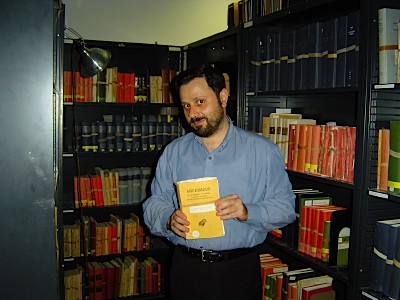
I'd written one of them, after all:


Even worse, there were several books there I didn't know, because my bibliography stopped in 1995. If you're not doing the conference circuit, you have little idea what's coming out, and what editions people have been sitting on ("What do you mean, a new Athens Digenes edition is coming out?") This is particularly bad in Greece, where far too much academic publishing happens in vanity presses, and is never heard of again. Not to mention that, with the collapse of Modern Greek studies, Western libraries don't buy Greek books any more anyway.

Notis was bemused by me not considering Greek university libraries Western. Ah, caught out once again by the Hellenic/Romaic dichotomy. After all, the Greek libraries now have a unified online card catalogue, Zephyr. But me being from Oceania instead of Eurasia, if it isn't on Worldcat, it doesn't exist --- certainly not as far as our interlibrary loans people are concerned.

(Conversely, Notis being from Eurasia instead of Oceania, he'd never heard of Worldcat. I'm assuming btw that Oceania is and always has been at war with Eastasia. Otherwise I might have trouble getting back.)

The pangs didn't stop there. See the project whiteboard?


Let's zoom in close on the list of things to do for the grammar:


That, ladies and gentlemen, was the research question of my PhD thesis.

(Even worse, that was the question I didn't get to do anything mediaeval on, because I ended up distracted for two years by the modern dialect data.)

Nor did my attempts to impress them with my gleanings of odd inflections quite work out as planned:


ME: [to Notis] Have I got an inflection for you! 1st person passive imperfect -unmu. Turns up twice, in the Achilleid as estekunmu, and the Alexander Romance as erxunmu.

IO: Yeah. I came across that in the Theseid as memfunmu.


Well that'll learn me. I should have already known not to mess with Io. (And note that the Theseid is basically unpublished.)

At any rate, I discussed with Notis for a couple of hours what we were doing in our respective gigs --- same subject matter, same data even, but not really same approach or results. The grammar, after all, is a grammar: it's tight and organised and exhaustive (I was very impressed by the sneak preview of the articles chapter). My lemmatiser is really engineering instead of science: it tries to deal with all stages of Greek at the same time in the one search engine, so it's less perfect than if it did one dialect at a time, and relies a lot on ranking. Fallible ranking, as Notis found in a search for "creek" he did while I was there. (Fixed later that night; duals are not your friend.)

I did get to lunch with Io and friend, and dine with the researchers and other friend. In between, the grammar project was, after all, a place of work, and they had deadlines, so I moseyed over to the Greek Lexicon Project, which is developing a learner's dictionary of Greek. The dictionary isn't competing with the big standard dictionaries; but I have unearthed a handful of headwords missed out by those standard dictionaries, and thought they might be interested.

So unannounced and all, I knocked on the door in Classics (once I found it), and launched in:


BRUCE: ... Yes?

ME: You don't know me, but I've been lemmatising the TLG for the past five years, and I may have some lemmata for you.

BRUCE: ... You're Nick Nicholas! Do come in!


It's good to be king.

We only chatted for a quarter hour (they too were in a place of work), but it looks like there's room for followup there. Turns out that Bruce is giving the Friday evening seminar that Gabby (an old TLG colleague) had invited me to. They're actually taking the semantics bit of the dictionary seriously, which standard classical dictionaries tend not to (especially as they all date from 1840); so I'm looking forward to it. Will have to take my leave of the people at London School of Economics early, though.

With a couple of hours remaining, I went down to the Classics Undergrad library, to see what I could see. You only get access to the Grownup library if you have a letter of recommendation stating your business. I can't for the life of me get this preciousness; and that's the kind of preciousness that Web 2.0 will not bust open.

No surprises in the Byzantine section (banished to an alcove off the side); the mediaeval grammar had taken all the good stuff anyway. Cute 1880s grammar of Albanian in Greek characters, reversing Greek characters to do new phonemes. (So reverse kappa was what's now "q", reverse gamma was "gj".) When characters were symmetrical, they had to go plundering: lowercase gamma revived the Byzantine lowercase form (a miniature of the capital); capital lambda ("l" vs. "ll") went for the Roman character). Don't let anyone at Unicode know; as far as I can tell this was a one-off; and unlike the reverse letters of Ancient Greek Musical Notation, it was aesthetically challenged.

I also gathered up some lemmata for the lemmatiser, from the specialist dictionaries in the undergrad library. Again, most of them I'd already seen; but I got four words of Callimachus pinned down, and there's a new dictionary of Menander I'll have to order in when I get back.

Once ejected from the library ("You have a key to get out, don't you." "Uh, no. That would be my exit cue."), I wandered into the town centre (and not back to the industrial park). There was something different about Cambridge than Oxford that I couldn't pin down. My first stab at it was, Cambridge was grey. There was certainly plenty of evidence of that about:


Io was dismayed to hear my one-predicate encapsulation of Cambridge. No, she said, you aren't seeing the right part of town. You must go to where the colleges are. And she's right: the colleges aren't grey.

More beige, really.


OK, OK, beige and magnificent.


Or redbrick and old and magnificent.


Or in the case of the Fitzwilliam Museum, marble and magnificent (and a little Albert-Speer-ish):


Except for the green bits. They were green and magnificent.


But the bits that weren't the colleges didn't counterpoint with the colleges in the aggressive, jumbled way that Oxford High St did. And Io --- a Cambridge partisan through and through --- proffered the crucial insight:


IO: Cambridge is a village and Oxford is a town.


And all became clear. Especially after she lamented that the only place open past 11 pm was the Greek souvlaki place.

Oh, btw, scrumpy? Never again. I downed just half a pint of scrumpy, and couldn't walk straight. A pint of scrumpy! You might as well pour a pint of vodka! I think they actually did pour pints of chardonnay in there: they certainly had wine on tap.

Wine on tap. What the hell kind of country have I gotten myself into?! Probably the same kind of country in which restaurants are vegetarians.


(ΧΟΡΤΟΦΑΓΟΣ ΕΣΤΙΑΤΟΡΙΟΝ—a slight mistranslation. That's cursive Hebrew, right?)

Wednesday morning, I was getting out of Cambridge and to That Other Place ("Oh no! Not that place west of here!") The 06:30 bus has intriguing evidence to suggest that Cambridge and That Other Place are actually accessible from each other.


But a bus is a daft vehicle to travel on. You'd have thought I'd learned that lesson on the Greyhound in Richmond, Virginia...


*flashback*

ME: My luggage is on that bus that just left.

BORED GREYHOUND DUDE: Yup.

ME: And I'm not.

BORED GREYHOUND DUDE: Yup.


No luggage lost this time, but I did lose my reservation number; so that's £6.50 I'm never seeing again.

Dishevelled, sleepy, and cramped (daft vehicle to blog on, too), I am now being disgorged at Oxford. Where I'll hold on to my philological identity just a smidgeon longer...

Friends wot blog

Twitter Updates

Calendar