Blogged elsewhere

Interoppo Research
(IT Standards & Interoperability)

Linking research & learning technologies through standards » Nick Nicholas

Ἡλληνιστεύκοντος
(Greek Linguistics)

2009-05-20

The Ibycus mainframe

In re:
TLG: Ibycus

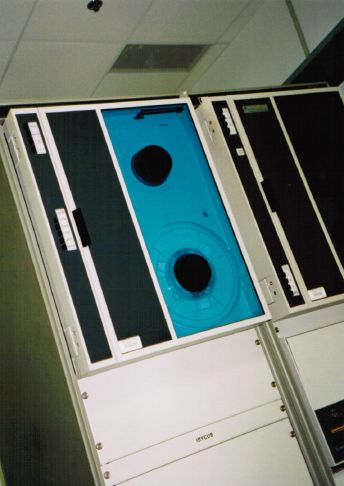
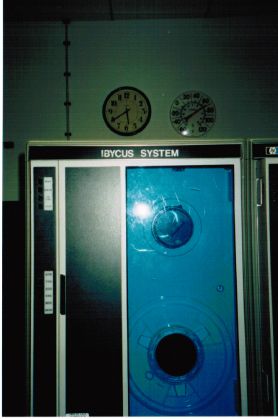
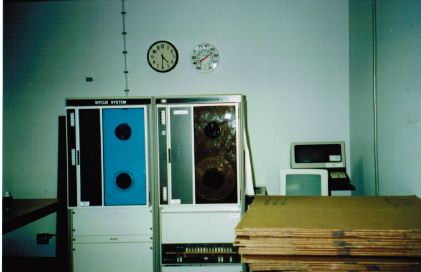
The Ibycus computer was what Thesaurus Linguae Graecae data crunching got done on throughout the 1980s and 1990s. It was the stuff of legend, an HP 1000 customised in David Packard Jr.'s garage, with spelling and format checkers and text editors in assembler, that crunched through tens of millions of words of Greek in its own temperature controlled room.

It's also the stuff of legend featuring in the "Lernaean Text" (or Hellenic Quest text), the long-running and indefatigable distorted urban legend doing the rounds of the Net for years, claiming that Ibycus (or Imycus) has determined that Greek has 90 million* distinct words. It also says that Bill Gates wants his programmers to program in Ancient Greek, John Sculley is still running Apple and publishing with CNN (?) the Hellenic Quest software to teach the world Greek, and Greek words have deep cabbalistic meanings and no arbitrariness of signs. That's why Nikos Sarantakos calls it Lernaean: however many times you cut off its head (including refutations by the TLG itself), it keeps coming back, because enough people want it to be true.

In the real world, the TLG as of this writing has around 100 million tokens [instances of words], 1.5 million types [distinct words—as in  run ran or ἄνθρωπος ἀνθρώπου] and (depending on how you count them) closer to 200,000 lexemes [dictionary words]. The count will go up as the TLG expands coverage, and the lexeme count will vary with different decisions on how to treat words. The lemmatiser currently tends to conflate variants for more hits in searching, so the count will be on the low side (though I'm including some 30,000 proper names, which is strictly speaking cheating). Still, in the real world, I don't see how anything will take that count from 200 thousand to 90 million. And for strictly classical Greek, it'd be only a little over half that...

In the real world, too, Ibycus was just a mainframe, not the harbinger of a New Hellenic World Order; and my first task when I joined the TLG in 1999 was to help decommission it. The TLG texts were being copied off Ibycus to machines with 8-bit bytes in February when I got there, and my first job was to finish writing replacement format and spell-checkers on PC. Ibycus was unplugged and removed in late 1999, and the TLG page on Ibycus shows the removalists at work. (Unfortunately the machine got damaged in the process, and the TLG couldn't find a museum willing to house it.)

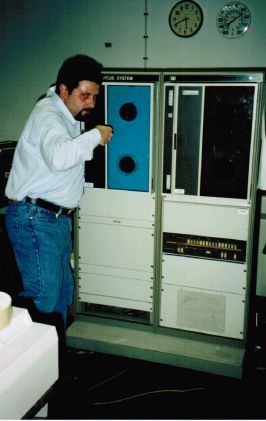
I did have some other photos of the box from 1999, though:


That's me, trying to lay down the law to the HP 1000...

[* EDIT: Had typo'd to "90 distinct words", and thank you to dokiskaki for pointing that out. 90 distinct words would certainly have made life much easier...]

2009-05-18

Bid Time Return

The cleanout of my books complete, I'm slowly trying to rearrange them into place in my garage. There's a couple of duplicates that have been mercilessly discarded—I didn't need both the 3rd and the 5th edition of O'Reilly Javascript book, or two Perl in a Nutshell books. One might further argue that I don't need either, now that noone in IT uses dead trees. I'm still somewhat sentimental about these things, even though on the few occasions I have a Perl query (and, mercifully, even fewer occasions for a JavaScript query), I google it—or use the Perl Books on CD that came with the O'Reillys.

I'm also getting rid of my high school violin. Eventually. Don't want to discuss it. The baglama stays; the fact that I don't play it either is overall less traumatic.

One of the books ferried across Saturday for hosting in the garage is one of two or three hardcovers my Dad bought me when I was seven. Bid Time Return, by Fairlie Taylor (née Addie Fairlam). The book was the childhood reminiscences of young Addie, born 1887, written when she was close to 90; they're engagingly wide-eyed, and describe a very different world to anything I'd ever experienced. I read the book when in Launceston, in I guess 1978. Eight years later, in a novelistic coincidink, I was living in the same Cheltenham that Addie grew up with. Well, it wasn't the same Cheltenham; our street was market gardens until the 1980s, Southland Shopping Centre has taken out a huge chunk of the suburb, and of course the cityscape is nothing like what Fairlie was describing. No horses, no hats, no pothooks as the introduction to handwriting, no Protestant–Catholic hostility, no thirteen year old girls running auction houses.

But Charman Rd is still there, with the railway station even older than her—even if her father's auction house (and brother's photography shop) aren't. (And even if, because of Southland, the shops around the railway station tend not to do as well.) The cemetery behind the railway station is still there—now, according to some high school kids' history assignment, housing Fairlie as well. Cheltenham Primary School is still there, and for all I know so are the tree stumps they'd play around.

I never loved Cheltenham, despite living there for twenty years all up: it was a dormitory suburb, not enough going on, the action was in the City and Carlton and Northcote. And heaven knows, I couldn't write 170 pp on my childhood at twenty years' remove, let alone seventy. Nor am I any better off for writing a sequel: I have no memory and no attention span and no accretion. And of course I can no longer even read a book all the way through: page, page, skip 10 pages, skip 50, back 30, and completely missed how exactly that Callum chap got to be the lost love of her life. (Things got telescoped once she got to teacher's college.) Still. Would that I could write as vividly and engagingly at 37, leave alone 90...

2009-05-13

"Nick Nicholas"

Surnames, they're a labile thing. Not everywhere is Iceland, where your patronymic lasts a generation; but not everywhere has the self-same string of letters identify a lineage for a millenium, either. Crete switched to a new patronymic suffix en masse, -akis, in the mid-19th century. Well, the Christian Cretans did. The Muslim Cretans didn't, but they don't live there any more. The Jewish Cretans didn't, and they don't live at all. (The one Jewish Cretan left did: Nicholas Stavroulakis.) So until recently, when Greeks, and later on non-Greeks, restored some demographic diversity to the island, there were districts where 98% of the names in the phone book ended in -akis. But there's not many -akis's before 1800. The Who's Who of Cretan Renaissance Literature (quatrocento to settecento) reads: Sachlikis, Della Porta, Choumnos, Falier, Picatorio, Bregadin, Sklavos, Achelis, Cornaro, Chortatzis, Troglio, Foscolo, Bugnali. (Yes, I'm keeping the Italian names Italian. When they were dealing with the authorities, so did they.)

Things are labile in Cyprus too. The dominant pattern in Cyprus is for surname to be archaic genitives of proper names—making them straight patronymics. And people would switch their patronymics to surnames.

I know little about my father's side; my grandfather went by ο Νικολής του Πούτρου in the village. "Boutros's Nick". That's Boutros, as in Boutros Boutros-Ghali—or more informatively, as in the Arabic for "Peter". Does that mean I have links to Lebanon? Probably not immediately, although Greek Cypriots seem to be more sanguine about lack of racial purity than Greece Greeks; it just meant that names lingered and travelled.

But Boutros's Nick was not written down as Boutros's Nick. He was written down as Nicholas of Mark-the-Pilgrim, Νικόλαος Χατζημάρκου (or Χ″μάρκου, because Χατζη- was a damnably frequent surname prefix, and people would save themselves the penstrokes when they could). And when he was Englished, he was Englished as Nicolaos Hadjimarcou.

As an Englishing, "Hadjimarcou" tells you stuff, which is why I took the <dj> across in opoudjis. It tells you that he was a Cypriot, so he pronounced the prefix as /xadʒi/, the way it came across from Arabic hajji via Turkish haci, and not as the alveolar Hatzi- of the mainland. It wasn't the only such Englishing in Cyprus: the other day I noticed a brandy distillery, trading since the 1880s as Haggipavlu. But Hadjimarcou is not really an Englishing of /xadʒiˈmarku/ at all: it's a Frenching. Which I guess shows that French was the default foreign language for the English colonial administrators.

Boutros's Nick had five sons and two daughters. Four of those sons ended up in Launceston, Tasmania. The first left for Australia six months after the birth of the youngest (who has remained in Cyprus). George did not at first go to Launceston; he went to Sale, Victoria. And in 1947, noone in Sale, any more than anyone in Launceston, felt like pronouncing Hadjimarcou.

The second son had already made his patronymic switch to Chris Nicholas by the time he arrived in Launceston. And when the third son arrived (my father, Stavros—Steve to those who speak to him as I write to you, in English), he followed suit, and so did Andrew the fourth son: it would have been awkward to have brothers in the same town with different surnames, particularly a surname awkward for the locals. The fifth son, Savvakis (or Markantonios according to his christening) has stayed in Cyprus, and has stayed Hadjimarcou.

This was assimilation, of course, and it was compounded by the inevitability of me being christened Nick, after both my grandfathers. My father only officially changed the surname when we left Tasmania for Greece, so his papers would be consistent with the rest of the family's: I've never been called Hadjimarcou, except that one time in First Year Uni when I wrote a letter to the editor.

Once or twice my father has expressed mild regret on the name change—"Nicholas" is a name, not a surname, he noted. The double whammy of my name being my surname? The birth certificate says Nick Nicholas, not Nicholas Nicholas; at any rate, with all the patronymic surnames, double whammy names are unremarkable in Cyprus. So no, despite what people often assume when I'm introduced to them, my parents have never expressed regret to me about calling me Nick Nicholas.

I myself wasn't particularly attached to the name, though, and when I used Hadjimarcou as a nom de plume, I was considering making it a nom de deed poll. Twenty years on and with a crap memory for anything past last week, I'm not sure, but I don't think it was out of some nationalist imperative to recover my roots: I've never particularly identified myself as Cypriot outside of the occasional overlong [n] when I speak Greek. It was more that "Nicholas" is a name, not a surname.

But I didn't change it when I cared to; and by the time I was establishing first a scholarly and then a professional identity, I certainly didn't care enough to. I answer to Nicholas (though not as a first name), I defend its authentic post-mediaeval misspelling, I even asked that someone's coinage of Nicholasian referring to my writings be Greeked to Nicolaic. But I don't bask and glory in the surname: it's just a signifier.

It's been convenient, having an Anglo-compatible name, I won't deny that. I haven't felt alienated from this country, to seek to define myself against it; then again, by my time, I wasn't particularly compelled to define myself with it: switching to Hadjimarcou wouldn't particularly have cost me here either. Those that needed to know I was Greek, knew it; that was enough for me. Identification, after all, is a labile thing too.

That "Nicholas" was labile when we went to live in Greece. The Australian papers may have said Nick Nicholas, but my parents have always left that to the papers, and called me Nikos. It's just a signifier, it was a translation of Nikolaou to begin with, so the switch to Nikos Nikolaou passed without comment: that's what my Greek papers said. (Well, they said Nikolaos Nikolaou: the State does not allow for shortened names, it's Europe.) The village schoolteacher knew me as Nikos Nikolaou, and so did the town priest.

It's less labile now: my identity is bound to papers written in English, and passports in English, and profile pages in English. In my 1995 trip to Greece, I started getting Νίκολας in Greek, and Νικ. I got more of it in 2000, and 2004, and 2008. And identity may be labile, but I'd have liked it to be labile on my terms—meaning I get a Greek identity, and an Anglo identity. Being given an Anglo identity in what Greeks call me, with an English name I don't use in Greek, means that someone else is telling me I'm not one of them. That, I don't like.

And yet, I say "in Greek it's Nikos" with some hesitation. I'm not one of them, that's the truth. And even if I was, I publish in linguistics under an English name (including, fatefully, my papers in Greek, because professional identities don't get to be as labile). I have an Australian accent that takes weeks to wear off when in Greece, and I don't get to spend weeks in Greece. I comment on the magnificent Nikos Sarantakos' blog as "Nick Nicholas"—because I registered with WordPress for my day job blog, and I'm not particularly driven to put a wall up between my linguist online identity and my business analyst online identity. But if people see "Nick Nicholas", and work out that I'm not a local, of course they'll call me Νικ Νίκολας; what was I expecting? At least when they script-switch to Nick Nicholas in the middle of Greek script, it doesn't look as obvious. (That happens a fair bit, btw, because transliterating is now out of fashion in Greek.)

OTOH, "NickNick" annoys me in English (and at least one friend uses it because she knows it annoys me)—but ΝικΝικ as used by the other bloggers chez Sarantakos is welcome. It is a spontaneous abbreviation of the kind you see a lot there, and it joins Ηλε-Φουφούτος becoming Ηλέφ or Ηλεφού, Μπουκανιέρος becoming Μπουκάν, Φαροφύλακας becoming Φαρό. Unlike the way I perceive Νικ Νίκολας, I perceive as inclusive, because it assimilates me to that community's norm. Of course, they're just doing it to save keystrokes—the same reason Boutros's Nick got written down as Χ″μάρκου. But I'll take my communities where I can find them.

This all was prompted btw by the intriguing thread launched by Άδωνις ο παραχαράκτης ή Άδωνης ο παραχαράκτης; It ranges far from the intended topic, like good comment threads do, and there's stuff there I disagree with but can't articulate a cogent refutation of—again like good comment threads do. There's a couple of linguistic observations which I may pass on to Hellenisteukontos; but I've got to finish off the list of omicrons misspelled as omegas that I've saddled myself with for the past month.
2009-05-06

Cavafy and his chickens

Found this today in the Greek blogosphere, and name-checking it for the English blogosphere: reminiscences from 1964 of an Egyptian colleague of Cavafy at his desk job in the Irrigation Dept, Alexandria, who was his underling and succeeded him when Cavafy retired. The original newspaper publication of the reminiscences has also been digitised by the Greek Parliament.

Exec summary?


  • He'd sneak in late, pretend to be massively busy by strategic placement of papers, occasionally shut the door and gesticulate writing poetry.
  • He was responsible for departmental correspondence, doling out corrections by the thimble, and an utter pedant.
  • Which made the Egyptian colleague exclaim to him once, "Mr Cavafy, you penelopise my work!" He liked that.
  • Sucked up to his English bosses (but did get bollocked at least once by his big English boss: "I shall try to give you satisfaction…").
  • Kept his distance from people at work pretty much.
  • Only knew enough Arabic to tell his servant to buy him chickens for dinner. And he'd inspect said live chickens at work.
  • And kept feathers of the chickens to make sure the servant didn't switch them on him.
  • And he was tight. Would smoke cigarettes half at a time.
  • The commenters to the blog post are floored, not that Cavafy barely spoke Arabic mid-colonialism, but that neither did the Greeks of Alexandria in 1964. (It was only the second time the interviewer had ever set foot in an Egyptian's house.) Of course, that wouldn't have helped in their showdown with Nasser (which is why there are few Greeks in Alexandria now—and I'm sure their Arabic is a lot better).
  • Does the personal detail of Cavafy as a bit extra in the set of The Office inform our reading of his poetry? Nah. Still interesting though.
  • Was Ibrahim al Kayyar (sp?) being bitchy in dishing out on his predecessor from when he was 20 and Cavafy was 50? No. He was asked what he thought of his boss at a desk job, not to venerate at the altar of the Great Poet. And Cavafy, like any Great Poet, was still a human being. I mean come on, I find it endearing that he slacked off to write poetry. The "bring me my live chicken, Miryani!" business—maybe not so much...

2009-05-05

20-to-01: Screw You, Channel Nine

There's plenty a thing I've missed by not following network TV in the past decade. There's plenty more that it's just as well I've missed.

My blood boils, my pores distend, my hands wrench into a strangling motion at the shlock, the pettiness, the smugness, the sanctimonious rejoicing at others' misfortune, the proof of the idiocy of the few people left watching network TV, the proof of why few people are left watching network TV—that is Channel Nine's 20-to-01. B-List celebrities and a mummified Moonface Newton, lamely clucking at the misfortunes and missteps of A-List celebrities. What a cheaparse show to make. What a cheaparse sentiment to peddle. What a cheaparse parody of righteousness. Cluck cluck cluck at Jane Fonda on the anti-aircraft gun, and Rihanna, and Robert Downey Jr, cluck cluck cluck Winona Ryder, and Mel Gibson, and John Landis, and what were they thinking, and I can't believe they did that, and cluck cluck cluck cluck cluck. Well cluck you, B-List celebrities, and click off.

קיינער זעט נישט זיין אייגענעם הויקער Keiner zet nisht zayn eigenerm hoyker. "Noone sees his own hunchback."

Bücherdammerung

This should have been more traumatic than it was, but: Saturday I was at my parents', sorting through my books that had ended up over the years in boxes in their garage, to determine what would stay (and go to my place), and what would be dispensed with.

It should have been more traumatic, but these were books that I had not seen in years, and had grown unaccustomed to. Even though the books from my childhood, in particular, were what reared me. So farewell, my 1977 World Book Encyclopaedia, which my parents would allow me to access one paper-wrapped volume at a time over the next six years; you taught me the world, but that was several ages before Google and Wikipedia. (I don't think a thirty year old encyclopaedia gets to fare very well at all; but I'm not dwelling on that.) Farewell, Greek children's book retellings of Swift and Defoe; I never got to know Gulliver and Crusoe in the original Georgian English, and I doubt I will now. Farewell, Asimov paperbacks: you introduced me to sci-fi, and eventually made me turn my back on fiction entirely. You graced me with projecting into the future before the impending Singularity made all projection pointless. Somewhat less of a farewell to the old transformational grammar textbooks I picked up, thinking one day I Must Really Get this whole Chomsky thing: it's not my dayjob, it's not even my ongoing side interest, I'm not going to read the 1968 exegeses of the theories. And I'll Google it if I ever do need to. Not everything good is online enough, but there'll be no shortage of the East Coast linguistic mainstream online.

It should have been more traumatic, and I was pretty snippy during the whole process, but I still kept more than I discarded, and not all of it because I was going to keep reading it. The Shakespeare paperbacks are safe for the moment. The old Calculus textbook I first learned maths from—old enough to contain learnèd doggerel and allusions to the Jacobite rebellion—stays. Not a jot of anything in Esperanto is touched: it's been over a decade since I've had anything to do with Esperanto, but I've ended up a kind of custodian to Frank Banham's Nachlass, and I'm holding on to it. (Frank Banham was the long-time editor of La Rondo/The Australian Esperantist—now Esperanto Sub La Suda Kruco; not much on Banham online, but here's a PDF of the first issue he put out in 1940.) Same goes for Mark Durie's sort-of Nachlass, left outside his office door when he left linguistics for the Church. (They include his Indo-European linguistics assignments, from back when one learned historical linguistics as an undergrad via Lithuanian. As opposed to now, when one doesn't learn historical linguistics as an undergrad at all.)

The books left behind are in a couple of suitcases in the garage, and the books that have made the transition to my place are in stacks in cupboards in the garage—both waiting for when I can afford more shelving. The fact that it's perpetually too cold to go to the garage to check something when I need to (invariably when blogging at 1 AM) may yet turn out to be an argument for further book rearrangement...

Friends wot blog

Twitter Updates

Calendar